
The Conquest of Twilight: On Syd Krochmalny’s Paintings

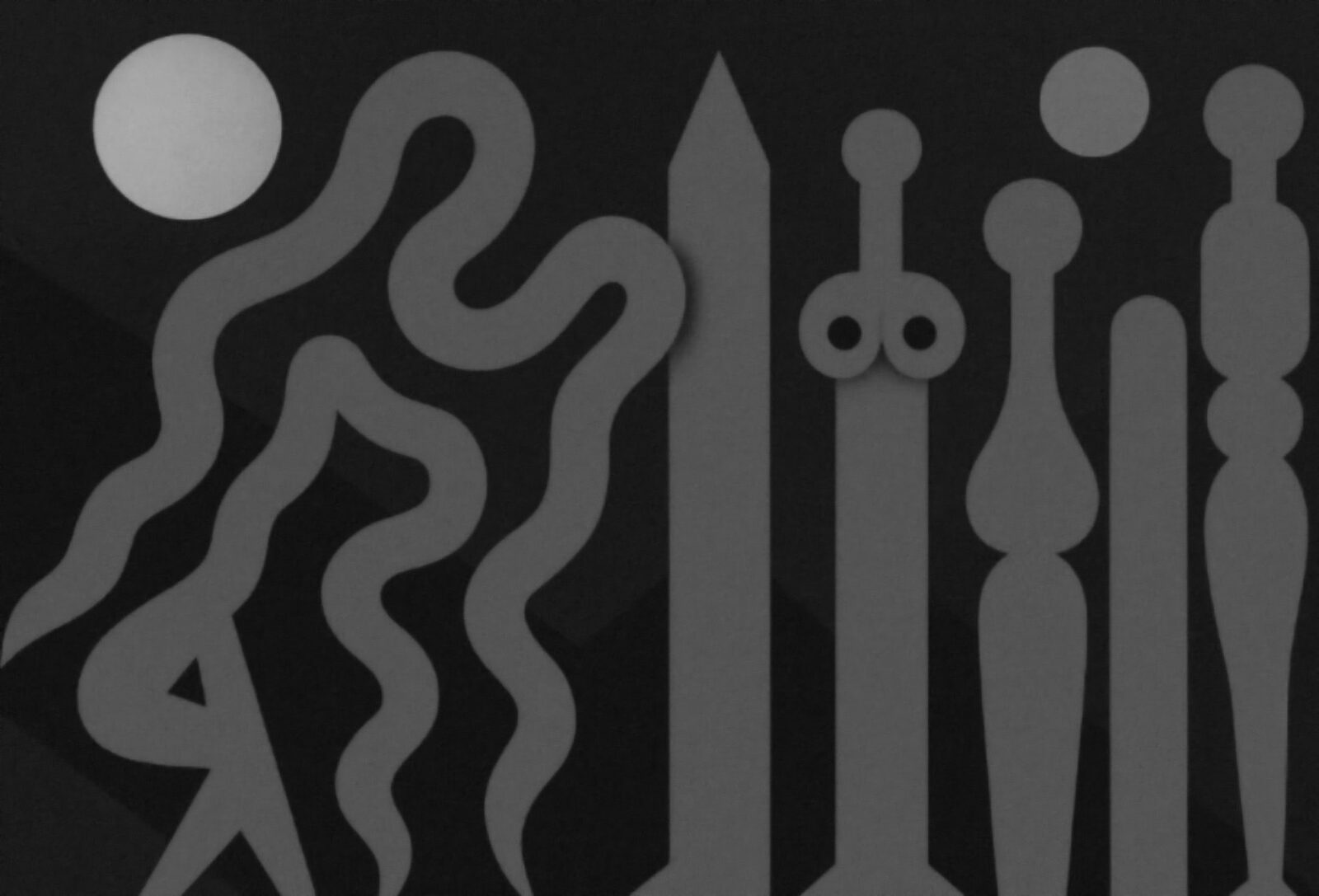

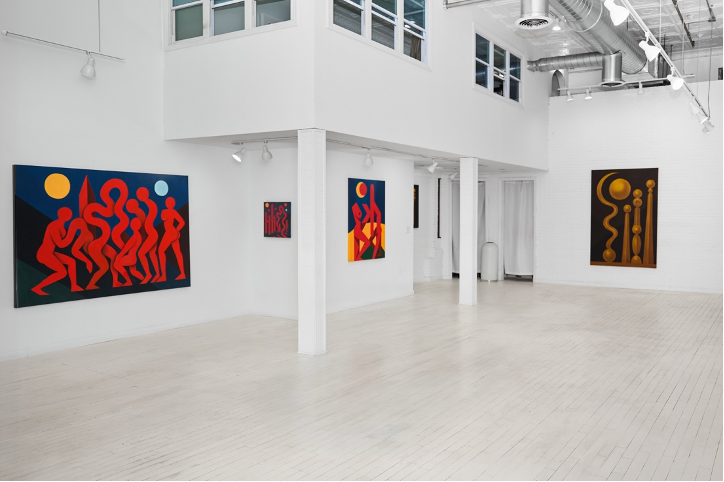
At The Locker Room, A Hard and Soft Poem for The Night brings together eleven oil paintings by Argentine artist Syd Krochmalny, developed after a period in Berlin—partially inspired by its queer and uninhibited nightlife. With a practice that has unfolded across painting, installation, and writing, his work has consistently explored the relationships between desire, language, and forms of visibility; in this series, those concerns reappear shifted toward a more material and atmospheric intensity.
Installed throughout the gallery, the works unfold as a dispersed field rather than a fixed sequence. Through dense, layered surfaces, Krochmalny constructs a space in which vegetal, geometric, and bodily forms overlap and resist any clear separation. Rather than representing specific scenes, the paintings seem to retain a physical state, as if something of the night persisted in the very viscosity of the paint.
Among the works, Neither Alive Nor Dead occupies a singular place: partially hidden within a shelter-like structure and mounted on a black wall, the painting demands a more intimate approach and deliberate act of discovery. On its surface, figures are suggested which, without fully consolidating, evoke bodies from different realms–animal, vegetal, perhaps mineral–gathered in a kind of ritual or communion. Figuration, however, does not seem to be Krochmalny’s immediate aim, but rather the means through which this shared intensity becomes perceptible.
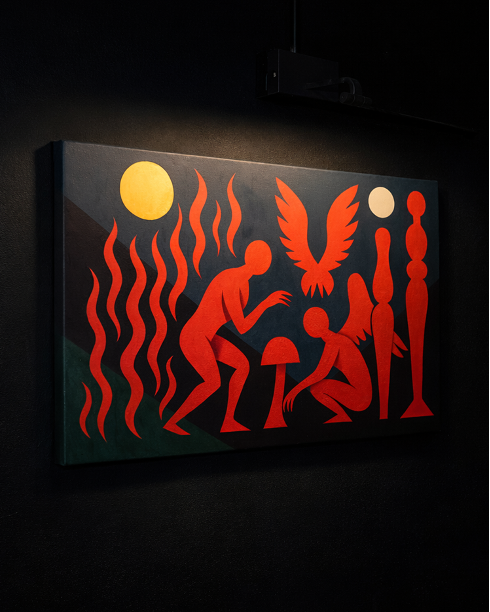
In the ambiguity of these forms, which seem to emerge and dissolve at the same time, an unstable, almost oneiric drift appears, one that could faintly evoke Salvador Dalí or Ad Minoliti, though never fully surrendering to the image. In this sense, the work displaces any stable reading and reinforces, through its very location within the gallery, the idea of an experience that resists immediacy.
There is in Syd Krochmalny’s paintings a deeply reflective, almost metaphysical atmosphere. The twilight of a generation (and of a species) is both announced and articulated in the interplay of those layers of paint. The artist does this without fanfare, as if he did not wish to proclaim it; the twilight is there, pulsing in the shadows, but it will not arrive on its own: it will be us, driven by our primordial indolence, who will bring it about. This episode (and Krochmalny’s series) could be titled “The Conquest of Twilight,” inhabited by beings sunk in their own thirst.
The paintings exude a hypnotic atmosphere that does not respond to the anxieties of narrative; rather, it is the flexible, organic, and sinuous forms that capture our attention and do not release it until they plant a question mark in our minds. It is not so much a matter of asking what those figure-things wandering across the landscape are, but of who we are, accustomed as we are to a certain perceptual inertia.
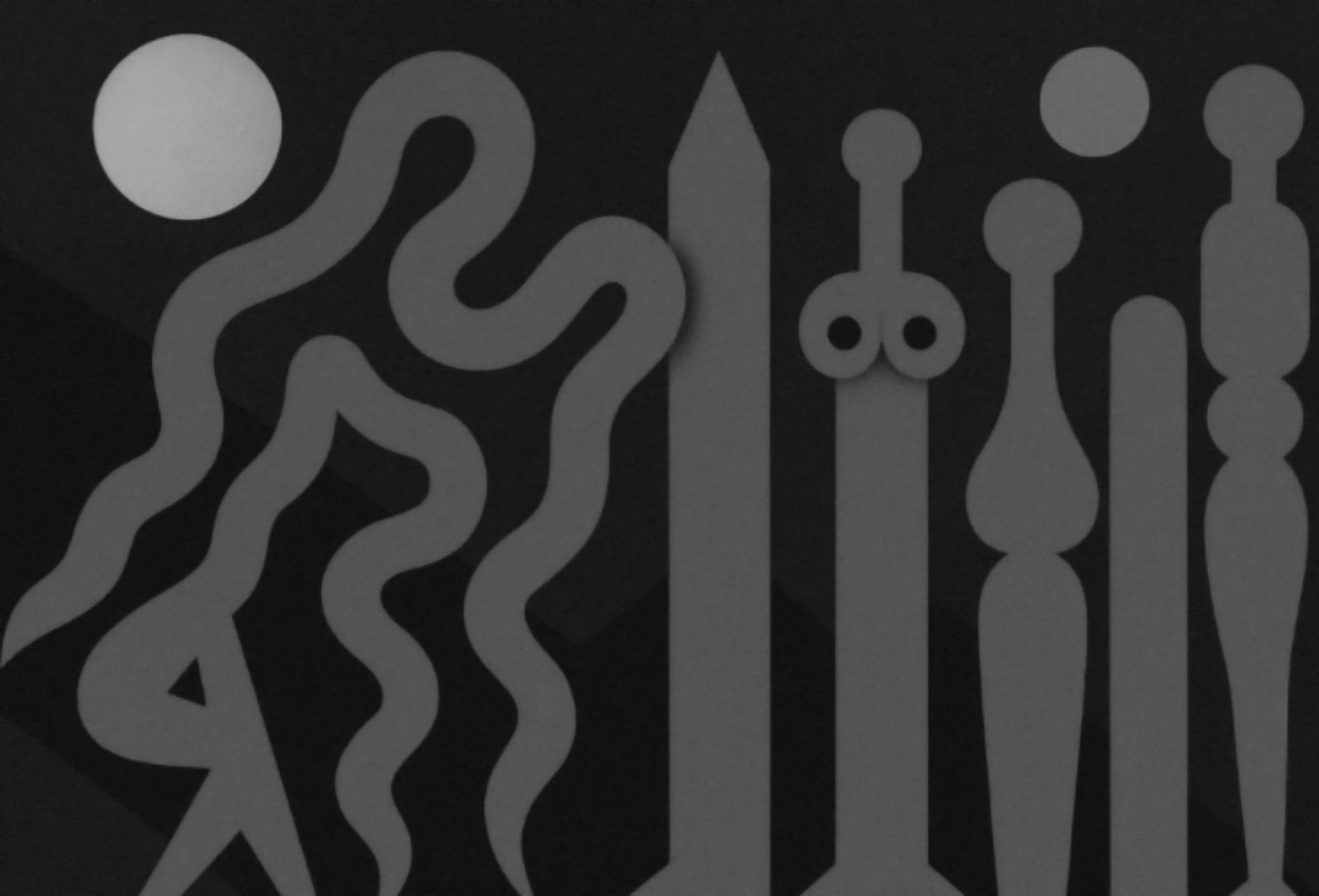
It is not the staging that captivates us, but the way Krochmalny constructs the drama: the unity of colors, the tones, and above all the passage from one to another, from green to blue or from blue to green, earthly and cosmic colors; and the orange-yellow hues that illuminate the shadows, breaking the configuration of a stable horizon, like the first rays of sunlight on the morning after the catastrophe.
Far removed from the individual, what prevails in the paintings are elemental bodies that depend on other bodies, whatever their ontology may be. There seems to be no distinction between the animate and the inanimate. The soul circulates, blind and deaf, like desire. It is a desire for future reconstitution. For beyond the longing for that lost paradise in which we were once happy, the representation of the present body transcends the flesh and at the same time presupposes it. The old distinction between being and entity is no longer sufficient to understand our passage through the world.
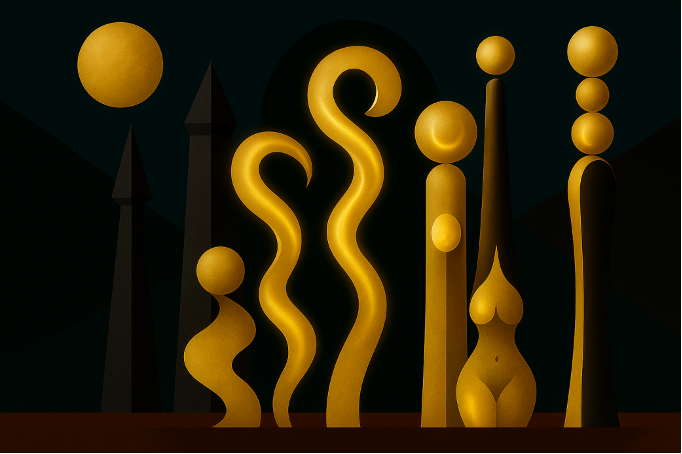
If anything is embodied in these paintings, it is a true passion for the ambiguous. We know that twilight is not only the declining phase that announces the end of something; it is also the light that precedes the dawn. Thus, what is contemplated, that undeniable manifestation of what exists, creates a climax that resists fixing its meaning: we cannot tell whether we are arriving or departing, whether it is the future or the past, whether they are things or people. Nothing and everything at once; yes and no; a disconcerting strangeness that may allow us to pass through the darkest night.
A Hard and Soft Poem for The Night on view through April 26, 2026 at The Locker Room, 253 Church Street, New York.
You Might Also Like
Syd Krochmalny: Not a Stupid Painting
“Elemental Vortex” Mónica Giron’s Exhibition in New York
What's Your Reaction?