The Opening Gambit: Generative Alterities and the Paradigm of the Salon

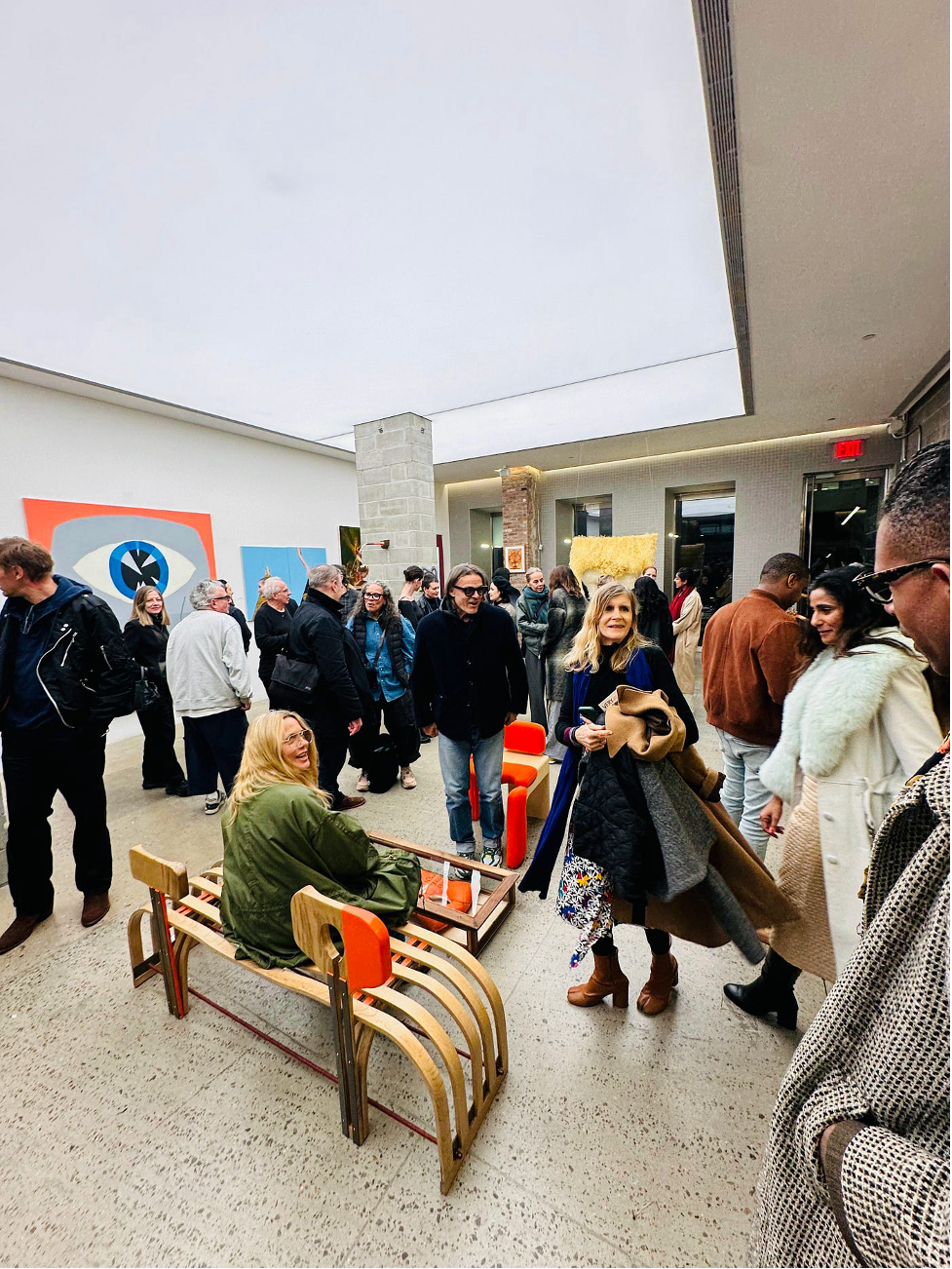

Stepping into The Opening Gallery’s new enclave at 41 Division Street is to enter a space of vibrant interlocution. The atmosphere is that of a contemporary salon: a guitarist’s strum provides an ambient soundtrack, a family lingers in spontaneous debate, and a group of tourists moves with curious engagement. This is a deliberate departure from the hushed reverence of the white cube — a space curated not for passive viewing, but for active, lived experience. As its director, Sozita Goudouna, observes with a gesture encompassing the room. “It’s evident when you enter that you’re not going to feel intimidated.”
The exhibition, Generative Alterities, inhabits this fluid environment with a rigorous premise: to forge a genuine dialogue between artists of the Global North and Global South, transcending tokenism to establish a fundamental methodology for seeing the world anew. This is a curatorial tightrope walk that avoids academic posturing, instead actively generating the productive “otherness” its title promises. Goudouna, a scholar whose interdisciplinary work on Beckett marries philosophical depth with visual art, brings this same polymathic sensibility to the gallery, creating what can be understood as a Foucaultian “heterotopia” — a real space where incompatible elements coexist productively
A Dialectic of Gazes and Materials
The exhibition’s intellectual architecture is built upon potent juxtapositions. Lloyd Foster’s suspended sculptural portraits, embodying what theorist Nicholas Mirzoeff calls “the right to look,” engage in a dialectic with Nan Goldin’s diaristic photography and Max Blagg’s poetics from within the West’s own margins. This is more than a comparison of subjects; it is a staged conversation on the very mechanics of visibility.
In an era defined by hardened borders and algorithmic echo chambers, the group exhibition proposes a radical alternative: that difference itself can be our most powerful tool for regeneration. While it confronts the rise of a new “tech feudalism” by creating a charged salon for dialogue between artists from Global South and Global North. This is not a call for harmonious fusion, but a deliberate curatorial strategy to generate friction, insight, and new ways of seeing beyond our polarized discourse.
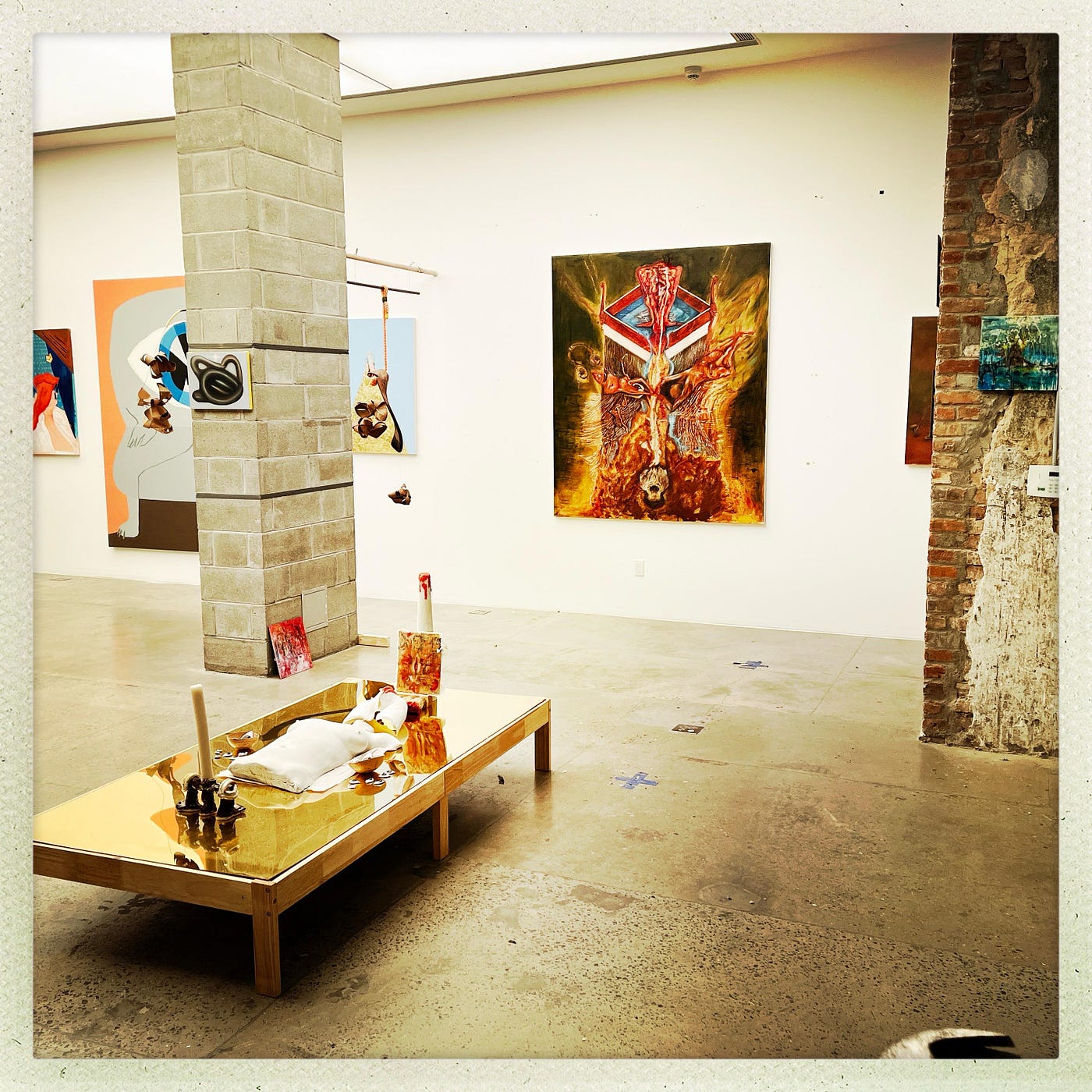
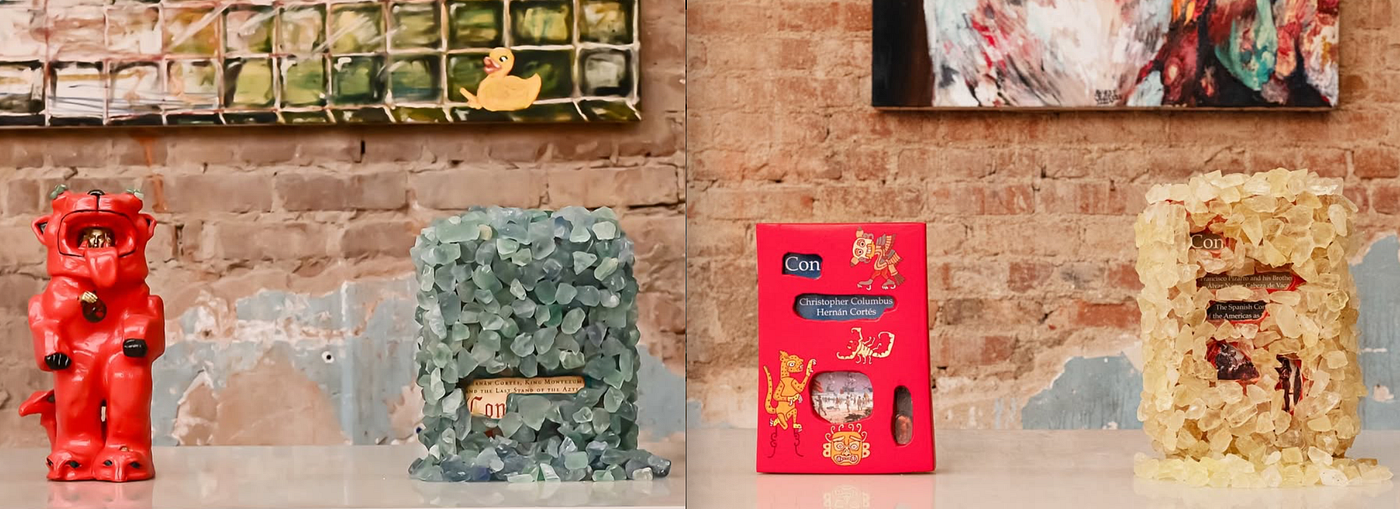
A leading role is played by the Indian artist, Anu Yadav, whose central installation anchors the show. Yadav’s work, drawing from ritual and subaltern mythologies, presents a distinctly different artistic language. Her sculpture featuring her own body resists easy translation into Western categories, and this untranslatability is its point. Placed in dialogue with Victoria Bartlett’s synthetic “second skins,” the exhibition maps a terrain where pre-modern residues and futuristic forms productively collide. Nearby, Jamie Martinez’s sculptures, crafted from the detritus of global consumption, render visible the “wasted lives” of capitalism, offering an aesthetic critique forged from the system’s own refuse. This critical tapestry is enriched by a chorus of distinct perspectives. From the Global South, Artemis Kotioni, Soterio Bezio and Anna Samara explore cross-cultural identity and memory through layered personal and collective histories, while Aphrodite Desiree Navab re-imagines ancient iconography through a contemporary feminist lens. Marita Pappa and Eleni Paridi interrogate social structures and the digital-physical divide through photography, performance and immersive sound installation.
From the Global North, Anna Sofie Jespersen’s subversive paintings deconstruct institutional authority, and Alina Yakirevitch gives voice to the trauma of state-mandated identity. Mia Enell’s surreal paintings delve into the psyche of the contemporary subject, a theme echoed in the psychologically charged interiors of Clintel Steed and the mystical abstractions of Ellen Frances. Matthias Van Arkel and James Hyde investigates the materiality of painting itself through sculptural installations that challenge object-image boundaries, while Anne Deleporte and Hans Weigand masterfully dissect contemporary visual culture through appropriation and complex aesthetics. The penetrating portraiture of Brenda Zlamany and the socio-political conceptualism of Alina Bliumis & Jeff Bliumis further anchor the exhibition in nuanced inquiry. Oliver Halsman Rosenberg investigates digital identities, Joan Bankemper creates communal horticultural interventions, and Irina Movmyga weaves intricate abstract narratives. Mark Borden (Egospeed) offers a razor-sharp, media-literate critique of acceleration from within the belly of the beast.
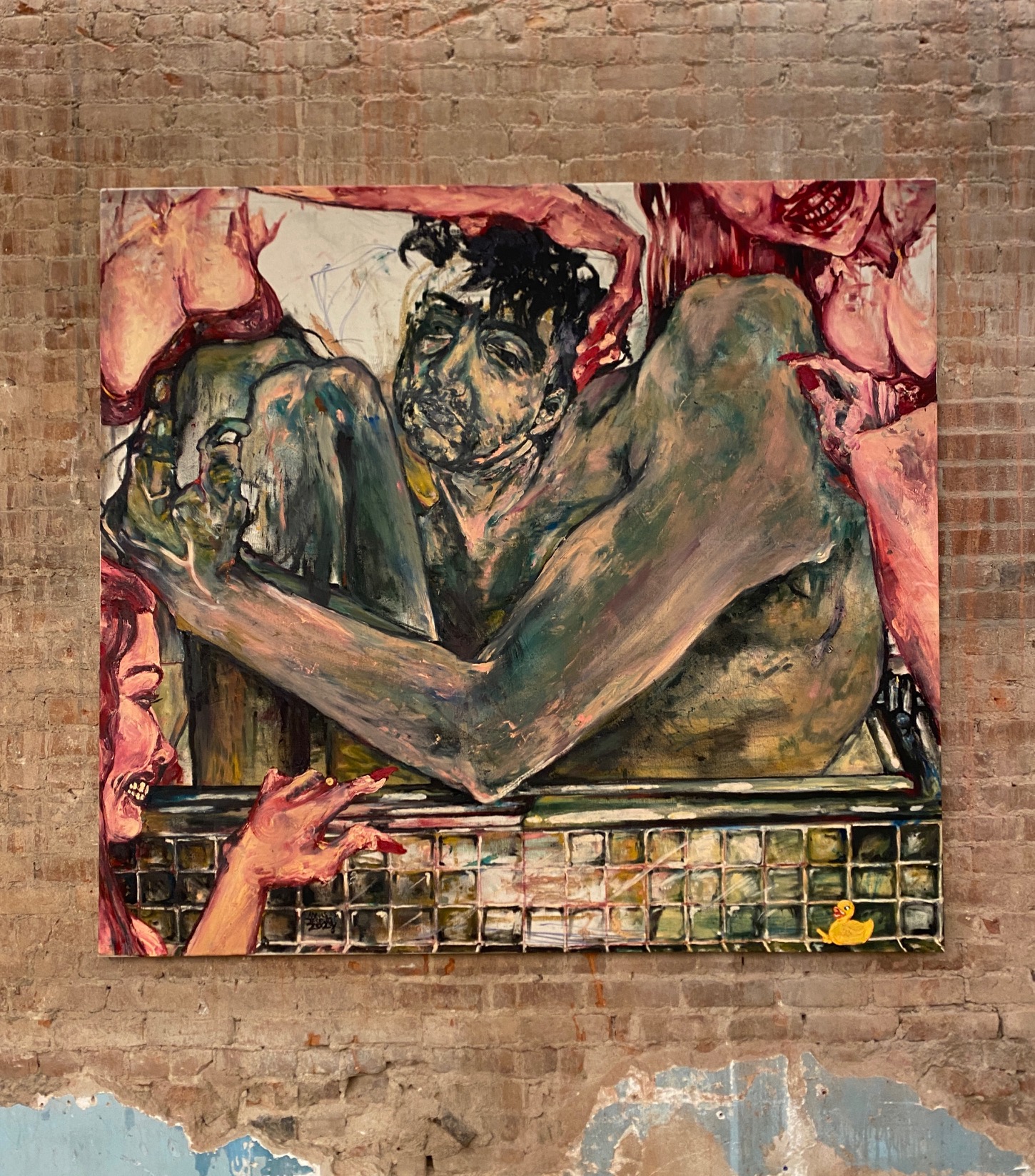
The Ukrainian-born F-Twins (Anna and Valeria Lyshchenko) contribute their philosophical art movement, Primarealism, which seeks to visualize a reality beyond our sensory limitations. As their manifesto states, it “simultaneously fosters empathy within the individual and compels reflection on your role in this world.” The collaborative work of Undisclosed Recipients (Victoria Bartlett & Zack Joslow) explores the synthesized body, design and collective form, questioning the construction of identity.
Reframing the North and the Salon Method
A series of photographs of vintage automobiles shot mostly on the same block in the West Village over time by Mark Borden might initially seem an outlier. Yet, Goudouna positions them as central to the conversation. “The cars, and the American narrative they represent, constitute an iconic narrative of the global north — an archetype of aspiration,” she explains. They capture a unique aura nearly erased by mass production. “There is no exclusion of the global north here,” she clarifies. “This is not about instituting another segregation. It is about integrating these different formalistic qualities.”
This integrative ethos is the hallmark of The Opening Gallery’s “salon method.” Under her direction, the gallery has become a nexus for a polymathic program — from collaborations with André Serrano and Kenneth Goldsmith’s first solo show in NYC in 25 years, to exhibitions engaging the ideas of Edward Said and Ludwig Wittgenstein. This spirit of intellectual and affective risk, as past collaborator Joan Bofill noted, means that “to hang is to expose yourself.” It is a model that privileges discourse over mere product, a philosophy embodied by the gallery’s support for neurodiversity and charitable causes, proving that commercial and ethical imperatives need not be mutually exclusive.
A Parallel Paradigm Shift
In its visionary championing of artists ahead of their time, Goudouna’s initiative with The Opening Gallery performs a curatorial function analogous to that of the late, influential dealer Hudson of Feature Inc. Hudson, who was known for an ethos that was invariably “out of sync” with the market. He introduced New York to Takashi Murakami and Raymond Pettibon when no other gallery would, understanding the value of work at its earliest stage. As curator Matthew Higgs noted, Hudson’s decisions, which once seemed like “total curveballs,” were “fundamentally correct.” Goudouna operates with a similar prescience and conviction. Just as Hudson provided a platform for Tantric art from Rajasthan or Tom of Finland’s then-risky homoerotic drawings, Goudouna creates a vital space for voices like Anu Yadav’s ritualistic femininities or Yakirevitch’s feminist dissent from Russia. Both Hudson and Goudouna have demonstrated that the most significant curatorial and dealing practices are not about following trends, but about building a foundational audience for radical work through intellectual rigor and unwavering belief.
With an eye for spotting emerging talent and a passion for celebrating the work of under-recognized artists, Goudouna has held curatorial positions at some of the top art institutions in the United States, including Performa Biennial, Onassis NYC and Raymond Pettibon Studio. Then and now she consistently renders a potent diagnosis of our time’s central tensions, offering an insightful prognosis of what lies ahead. She has organized groundbreaking surveys and forward-looking exhibitions that synthesize politics and aesthetics. This ambitious curatorial style characterizes her work, whose exhibitions have often considered hard-to-pin-down concepts related to generative aesthetics, respiration, and the environment.
When asked about the non-profit gallery’s future, Goudouna’s focus returns to the immediate, accessible experience. What of the visitor with no knowledge of post-colonial theory? “I think the selected artists… anyone can approach it,” she states. “It’s in the eye of the beholder, in the sense that it is clear there is a visual rigor. You don’t need to know more to understand.” This is the exhibition’s most profound achievement. The theoretical scaffolding — Glissant, Mirzoeff, Foucault — provides the curator’s toolkit, yet the work itself requires no decoder-ring. In the quiet dynamism of 41 Division Street, Goudouna has constructed a portable methodology: bring together disparate worlds, let them converse, and trust in the visceral power of significant art to communicate. The framework matters immensely for the critic and historian alike. But for the beholder? The directive is simple and inherently democratic: simply look. The visual rigor will tell you everything you need to know.
Anna Sofie Jespersen and Alina Yakirevitch will present Kremlin Playhouse, a durational performance in which they reenact the 2024 interview of Vladimir Putin by independent journalist Tucker Carlson followed by a live jam by Egospeed on December 3rd, 5-8PM. Stavros Niarchos Foundation Public Humanities Initiative (SNFPHI) will host a conversation between Georgios Giannakopoulos (City St George’s, University of London), Dimitris Antoniou (Columbia University), and Katherine E. Fleming (J. Paul Getty Trust and NYU) on Saturday, December 6th at 12pm.
Generative Alterities on view at The Opening Gallery through December 8 at 41 Division Street, 10002.
You Might Also Like
Syd Krochmalny: Not a Stupid Painting
Not Straightforward or Impossible: sgp in Conversation with Alina Yakirevitch
What's Your Reaction?