
Alexa Grae on their Modular Pop-Opera: “I Started Writing Songs for My Voice”

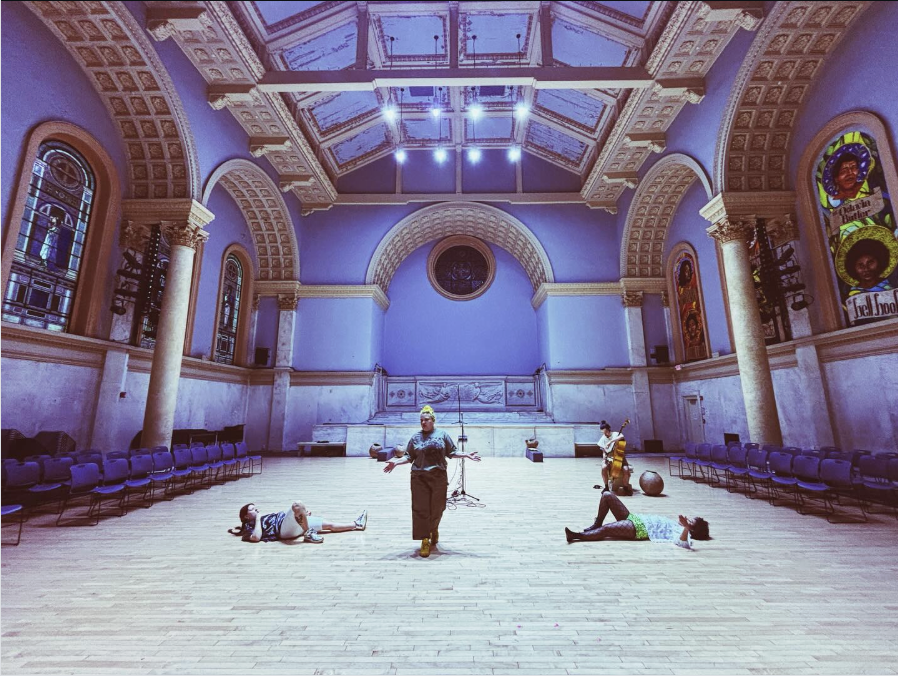

On the night of January 7, pre-show chatter rings of the walls of the “Meeting Room” at Judson Memorial Church, for the fourth day of Out-FRONT! Festival 2026, presented by Pioneers Go East Collective. Once home to the Judson Dance Theater and Phyllis Yampolsky’s Hall of Issues, the church has become a sanctuary for providing refuge for those deemed the least of us; those who sought to live a life forged through radical art. Slightly iridescent blue-violet floods the dance studio like space and attendees ebb and flow within its staging. They wait in line, greeted by the kindness of curator and dance artist Remi Harris, who is working the check-in. They grab the church’s offerings of soup and citrus water, which follows with cookies during intermission and bubbles at the end. The night is filled with thoughtfulness, reminiscent of the care our beloved Cecilia Gentili, who passed in 2024, bestowed to many of us; a banner honoring her life hangs directly behind me, among other trans/queer activist ancestors. Attendees are here to witness the double bill of Alexa Grae’s, Tone Pillar and sugar vendil/isogram’s, Antonym: the opposite of nostalgia.
Thingness emerges when attempting to capture live performance. It is born out of its ephemerality. When ephemerality is met with the sure failure of translation by a respondent/gossip/writer/critic, it opens a portal into the human tendency toward curiosity, past what we think we know to be true. Grae embraces this potential and takes head-on the evanescent work of opera. Tone Pillar is experienced as a triptych that moves between pop and opera sensibilities. It employs live vocal/cello performance, dance/movement, and video work to subtend the modulation of sound to embodied notions of self-preservation. Serving as both librettist and composer, Grae considers how the verticality of lived experience in an anti-black world—which is to also say a trans/queer antagonistic world—runs up against the circuitous constitution of self. Moments like the dancers’ use of spherical objects to revolve around a mic and stand gesture toward this aim. The multimodality of the work is in-progress, but with space, time (and funding), the dimensionality of this work and its future iterations will intensify “the body intellect” viewers are called to embrace.
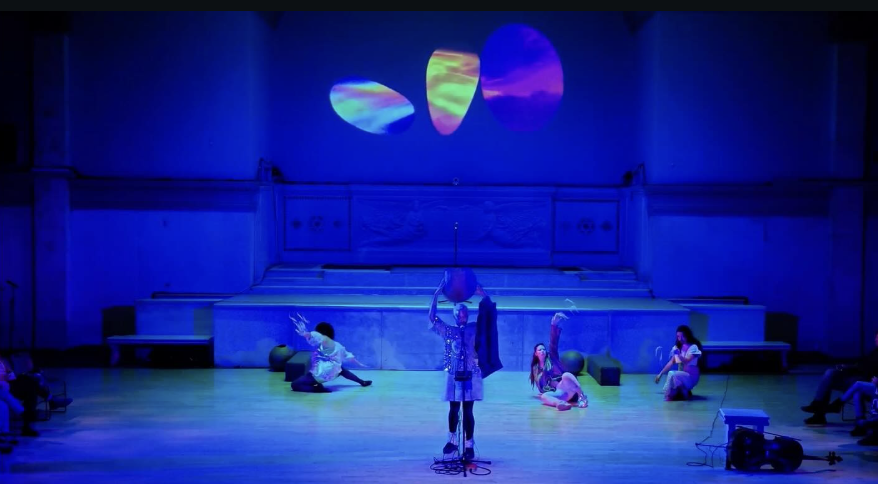
A few days after the performance, I had the chance to talk with Grae about Tone Pillar and what informs their art practice.
Brittnay Proctor (She/They): I know that you graduated from Northwestern and received your MA in Vocal Performance and Literature, as well as a certificate in Performance, but can you tell me a bit more about your background and how you were trained?
Alexa Grae (They/Them): I grew up singing. I studied piano as a child, and basically sang everywhere I could. When it came time for college, I thought, “oh, we need to go to school to be a pop star.” [In college] we watched an opera in one of our diction classes. I had never seen opera, and I was like, ‘woah.’ I got naturally into it; the drama of the sound and diving into characters got me very excited. I was also majoring in composition, so I started writing songs for my voice because I wasn’t finding the exact repertoire that felt super particular [to me]—I didn’t know there was a gender portion [to opera].
In grad school, I studied further and deeper. Again, I felt like I was at this place where I wasn’t really finding the exact repertoire that felt really good, or if it was being done, it was in very few places. I locked back into my own composition goals, and I had to remind myself to create the thing I want to do.
BP: Was there a specific context that brought you to Tone Pillar?
AG: Tone Pillar started not from sitting and [contemplating] “is this what I’m working on?” but through taking snapshots of my life. It was during [the start of] COVID. I had been in New York for about six or eight months and didn’t want to make. I wanted to focus on the other things I was curious about. I really got into a running practice and a deep meditation practice. I was checking out astrology. I deepened my connection to social justice, specifically within our city and its global reach. Running, meditating, and marching offered me a connection to a voice, or things that I wanted to say. But I didn’t know an expansive way to find the material; instead, I started piecing together what this [work] would become and tried to make it into a tone. This is what got me to think of Tone Pillar in relation to self-preservation.
BP: That’s amazing. I was interested in what role movement had in the conception of Tone Pillar and how you envisioned working with Stephanie Acosta, or what your process in thinking about sound alongside movement and choreography was.
AG: It’s interesting. It started from the sound, which we sat on for a while. I built it modularly, so things could be moved, shifted, and we would find that interconnectedness. I didn’t have movers in my head. I have worked with dancers before, in a very 2D aesthetic. Stephanie offered great thoughts. We talked a lot about what it would be like to hold a bunch of energy from various stories and multiplicity. She suggested that if I wanted to present that [energy] in the work, then I needed to be present in all the multiples. We tapped into the natural world of the body—it’s always in front of us. I think that’s where we landed with the dancers. But [we] also [discussed], what it is like to spread energy out so you’re not trying to pull at every single [person] within a room. Energetically, that’s something I struggled with.
BP: Viewing and listening to the piece, I experienced it as having three parts or movements—a kind of triptych. Now, thinking of it as modular is really helpful in my mind. Thanks for that. We’re in a moment where contemporary art is curious about and is embracing sound art. You could have easily framed yourself as a sound artist. I want to hear what you have to say about the importance of multidisciplinarity in your practice as an artist and what different genres of art can lend to your work.
AG: I think the idea of multidisciplinary/interdisciplinary art is related. I like opera for its extreme range; the idea that it is meant to go from here to the end of the house. [It is different from] pop music, or playing house shows, where you can accentuate nuance. I was trying to gather some different practices and expand my idea of: “If I’m seeing this and calling it opera, I don’t have to sing exactly the same.” I play through the genres or the color palettes that I know.

BP: I really love the valence that your work gives to a tradition like opera. It’s a tradition that even as it tries to reimagine itself, is stuck, tethered to various distinct traditions. So, it’s wonderful to see the ways you’re playing with this genre and its form.
AG: To jump back, there are three works. I would say Tone Pillar is the third. Not of a series but an evolution. Evolutionary to where I’m at now. Before it I did an album and two operatic soundscapes, all synthesizers and stuff. Sur la Nuit was composed out of poems written by my mom, and I had my aunt translate them into French. I needed a little distance from the text because it was very vulnerable to perform. I also love the way that the French language feels in my body and in my mouth. But that was also me being aware that I didn’t feel called or drawn to my own language. I felt like I could respond to it from my mom’s psyche [in French].
Before then, I did a project called The Diva in 7 Experiments. It was this idea of doing these little sound pockets to uplift the femme. I was borrowing a lot from Whitney Houston, just not necessarily [her] text, but the ideas. I went from this pop pocket to a grander expression, but not using language. That was also part of this evolutionary process.
I’ll just add that my goal in using the operatic tradition is to explore how we get back into the body. I want it to feel felt. I want it to feel impactful. You don’t need to hold on to every word.
BP: Pop aesthetics are more immediate.
AG: Yes. What is it about the merging of the pop aesthetic and opera that [makes it] very present? I would say that, also with the blurring of genres, I try to put in a lot of rhythmic elements. That often will put the audience in the space of meditation; they can move me in a lot of different timelines, and then move themselves into [alternate] timelines. That gets to what you’re asking about [in regard] to sound art. That word is getting closer to something that I’ve been wanting to label or try to explore with this kind of operatic performance.
This interview has been condensed for length and clarity.
Alexa Grae (they/them) is a Brooklyn-based interdisciplinary artist, vocalist, and composer.
What's Your Reaction?