
In Stockholm, Karim Boumjimar’s Insistence on Mutability is Defiant

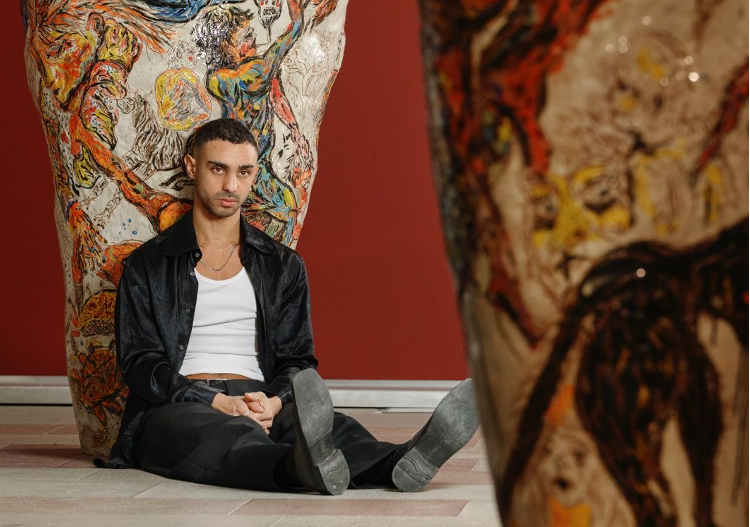


I first heard of Karim Boumjimar through one of his classmates from the MFA-program at the Royal Danish Academy of Fine Arts in Copenhagen, who described him as something of a prodigy. With two exhibitions on view in Stockholm, at the gallery CFHILL and the contemporary art center Liljevalchs, his work is certainly of the moment. We met over breakfast at Café Saturnus, just a few blocks from CFHILL. Our conversation moved easily between his artistic journey and the social and political undercurrents that shape his work.
Born in Málaga, Spain, to a Moroccan mother, Boumjimar has long identified himself first and foremost as an artist. What often gets lost in the reading of his work is how deeply instinctual his artistic drive is and has always been: “I come from a working-class background, and I have always been an artist,” he tells me, almost matter-of-factly. For him, art was never a strategic career path, nor a socially sanctioned ambition. It was simply the most natural way of being. Long before he had language for queerness, politics, or broader frameworks of identity, he was already making things. Drawing, shaping, assembling. Returning to the act of creation like muscle memory. Now, his work consistently explores themes of identity, intimacy, and instability, and it is precisely this perspective—grounded yet boundary-pushing—that has positioned him as one of the more distinctive emerging voices in the contemporary art landscape.
In immigrant households, especially those defined by economic precarity, art is rarely understood as a viable future. For Boumjimar, this tension was constant. His mother, working tirelessly to support the family, could not imagine art as anything but instability. When she moved to London to work caring for elderly people, the pressure to choose a “real” profession only intensified. Yet he never stopped. He kept making art, quietly and stubbornly, not as rebellion but as survival.
Eventually, he was accepted to art school in London, later studying at Central Saint Martins. The move was less a calculated decision and more a continuation of the only rhythm he had ever known: make work, follow instinct, repeat. He later moved to Denmark after meeting his partner—without ever having visited, and barely knowing what to expect—and was accepted into art school there as well. The pattern is strikingly consistent: Boumjimar does not build his life around ambition or narrative arcs, but around necessity. “There was never a single moment of motivation,” he says. “It’s simply the way I have always lived. Creating every day is part of my rhythm and my identity.”
That biography is not separate from the work; it is embedded in it.
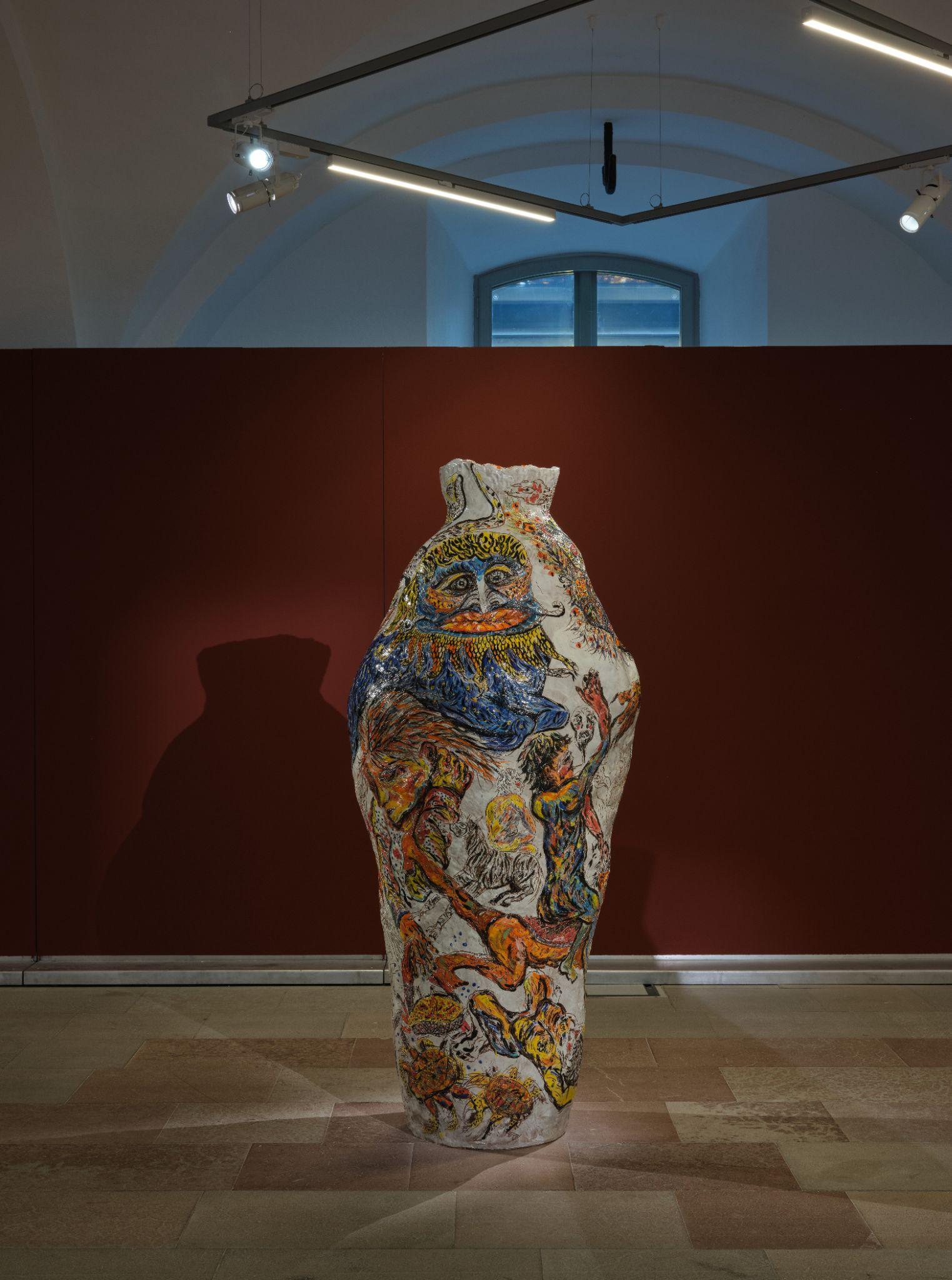
At CFHILL, Deep Cuts marks a significant shift in Boumjimar’s practice. While earlier works leaned more heavily on drawing and two-dimensional mythologies, this exhibition announces a turn toward sculpture—toward clay, weight, gravity, and fragility.
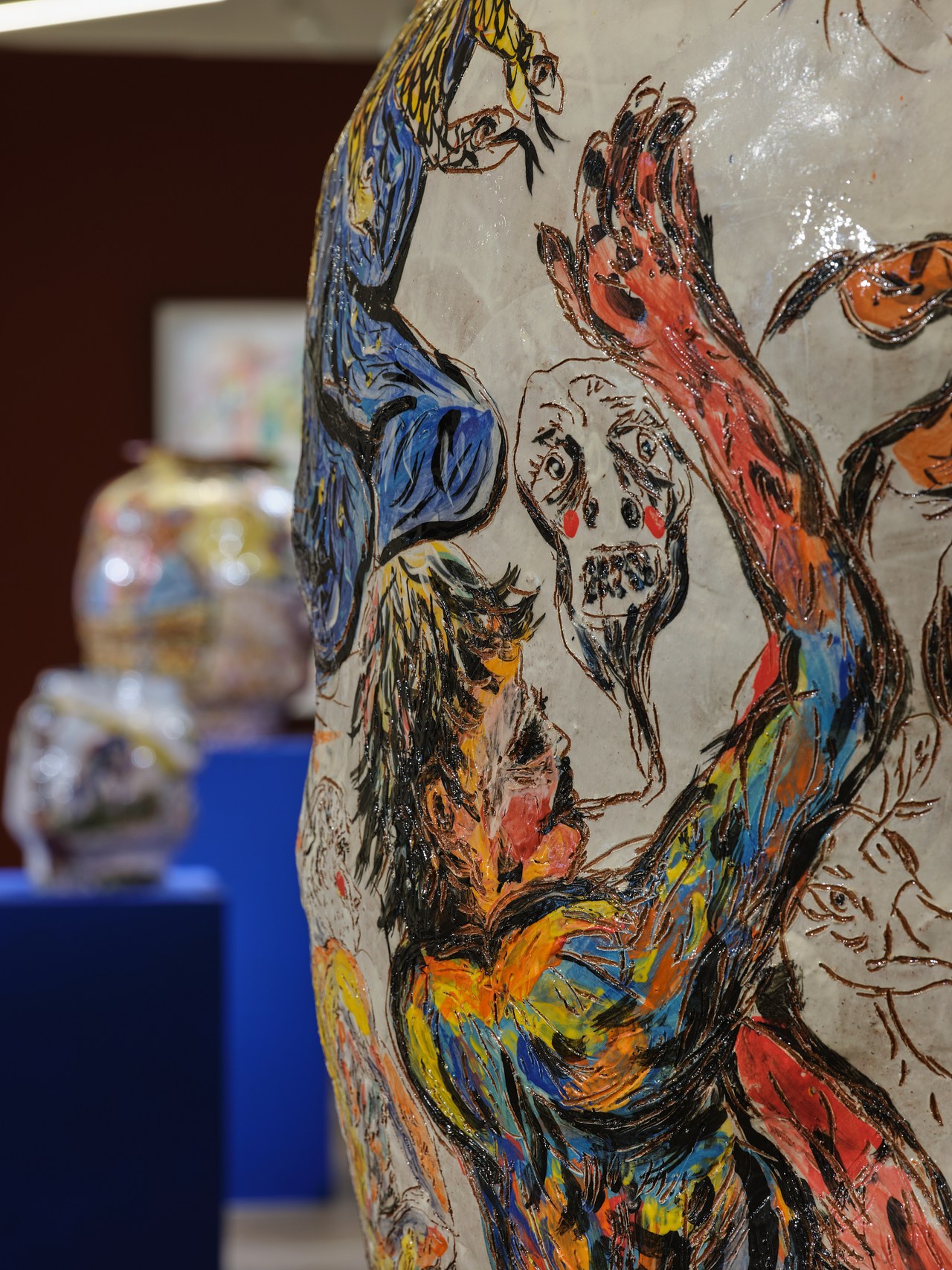
The ceramics in Deep Cuts resist traditional readings of craft. These are not vessels in the functional sense, nor sculptures in a classical one. They feel more like bodies interrupted mid-transformation. The materiality of the works is deliberately unresolved: surfaces crack, slump and collapse, resisting polish in favour of visible tension and contradiction. Forms swell, break, cave in, stretch. The surfaces shift between slick, almost fleshy glazes and rough, earthen textures that seem to remember the violence of touch.
There is an unmistakable bodily charge to the work: not bodies as stable entities, but as mutable, breached, reassembled. Titles such as Dionysian Demon, and Restored River gesture toward a cosmology that crosses myth, sexuality, ecology, and nightlife. Club culture pulses through the objects, not in obvious iconography but in rhythm—in trance, ritual.
Critically, Deep Cuts is not a perfectly resolved exhibition. And that may be its strength. At moments, the symbolism teeters toward overload—mythology, sexuality, ecology, ritual all threatening to crowd the same surface. Some works strain under the density of their own references. But this instability feels structured rather than careless. The exhibition does not aim to soothe or decode itself. It insists on tension.
The clay, heavy and vulnerable, becomes a metaphor for his own trajectory: shaped by pressure without becoming brittle. Entirely self-taught in ceramics, developed through long hours of studio labour in Copenhagen, Boumjimar approaches the material with a rare combination of humility and instinct, allowing clay to slump, strain, and remember the body. The resulting works feel less like demonstrations of technique and more like quiet acts of devotion — records of persistence, touch, and trust in the fragile intelligence of the hand.
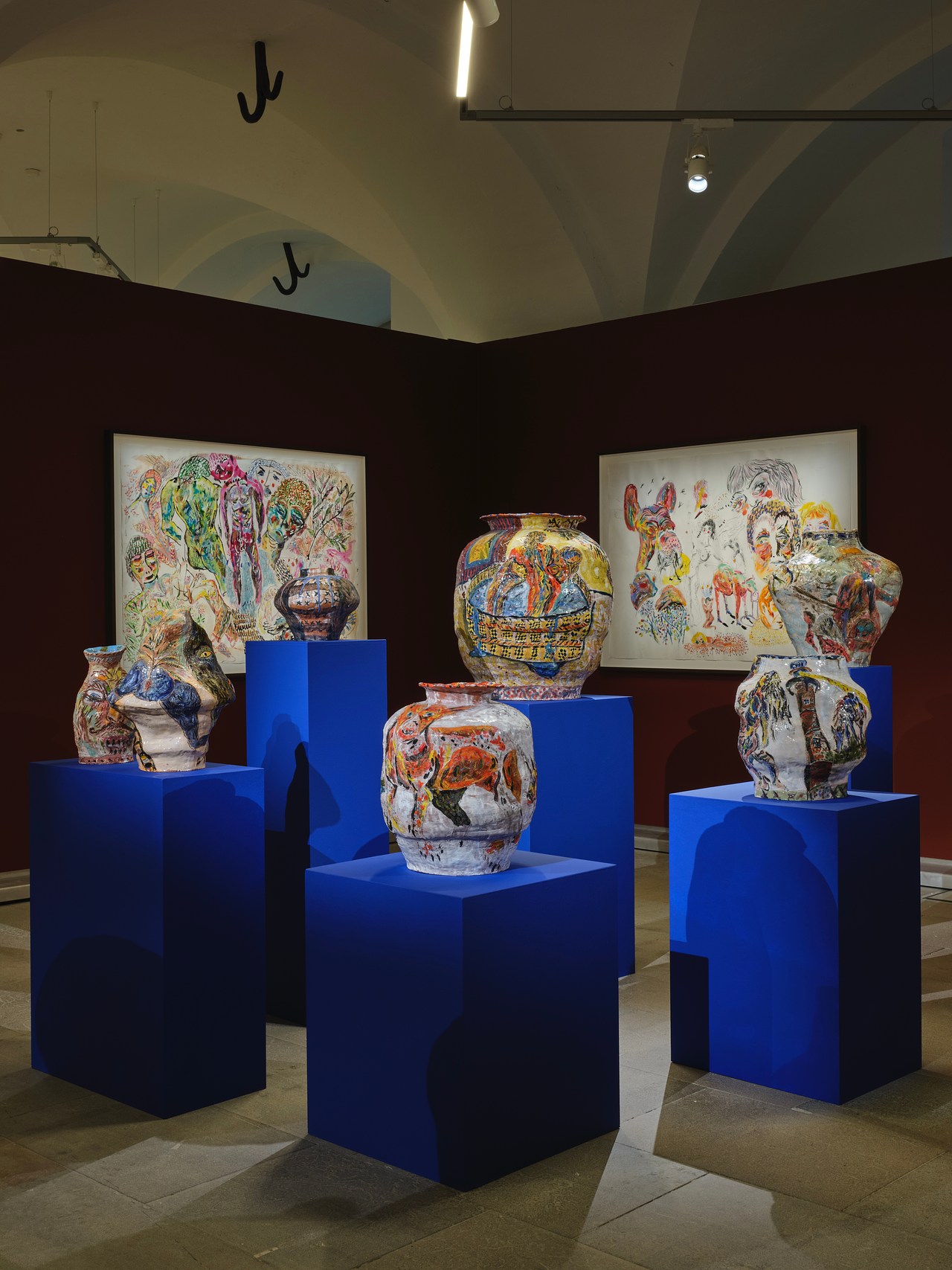
If Deep Cuts is bodily, intimate, and insular, Stockholm Cosmologies is outward-facing. Presented in the formal and institutional space of Liljevalchs, Boumjimar’s cermaic work is placed among fifteen international artists whose practices engage with world-building, origin stories, ecological thinking, and spiritual frameworks.
In this context, his work shifts register.
The sculptures begin to read less as individual organisms and more as fragments. What felt visceral and self-contained at CFHILL becomes relational at Liljevalchs. His pieces seem to communicate with the surrounding works by Loulou Cherinet, Theresa Traore Dahlberg. and Lefifi Tladi—forming loose constellations around themes of migration, ancestry, territory, and belonging. Here, the instability of his vocabulary is tested. In a group exhibition, repetition becomes more visible. Certain motifs—hybrid bodies, morphing anatomies, organic architectures — recur with familiarity. At times, this risks flattening the complexity of his symbolic system. But it also reveals coherence: his work does not dissolve when placed in dialogue with others; it insists on remaining porous.
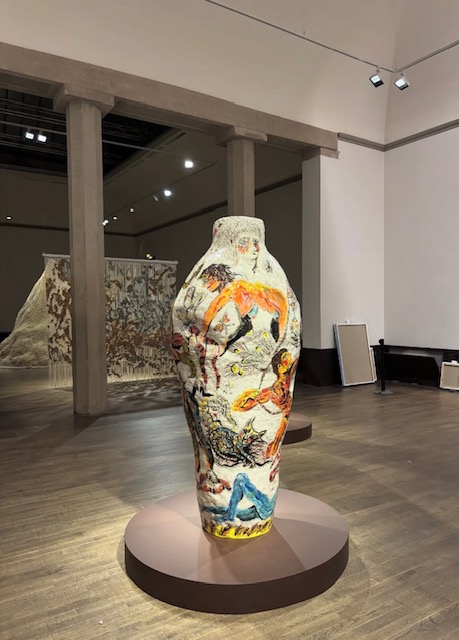
Perhaps most compelling in this setting is how naturally his work aligns with the exhibition’s broader ambition: rejecting singular narratives of origin in favor of plural cosmologies. His sculptures behave like migrants themselves—adapting, translating, absorbing.
If Deep Cuts demonstrates his capacity to manipulate material into a state of restless becoming, then Stockholm Cosmologies reveals how that restlessness operates within a collective, institutional, and global framework. His contributions do not decorate these exhibitions; they underpin them. They function less like statements and more like connective tissue between different ways of imagining body, world, and myth.
Boumjimar is building a visual language that is emotionally charged, materially confident, and conceptually layered. His work takes risks. It sometimes overreaches. It sometimes overloads itself. But it never retreats. He is an artist shaped by class, migration, and instinct—not as themes to illustrate, but as conditions of existence. In a cultural moment obsessed with clarity, branding, and legibility, his insistence on mutability feels quietly defiant.
His practice resists stabilization. It resists translation into neat categories. It remains alive through friction. At a time when identity and integrity are being renegotiated across artistic disciplines, Boumjimar’s refusal to settle may prove to be his most enduring contribution.
Karim Boumjimar: Deep Cuts on view until December 30 at CFHILL, Riddargatan 13, Stockholm.
Stockholm Cosmologies on view until January 16 at Liljevalchs, Djurgårdsvägen 60, Stockholm.
You Might Also Like
Larry Poons: The Grace of Falling
Science and Fiction Intertwine in ‘Underwater, On Fire’ at UCCA Clay
What's Your Reaction?