
Black Femme Anger For the Righteous

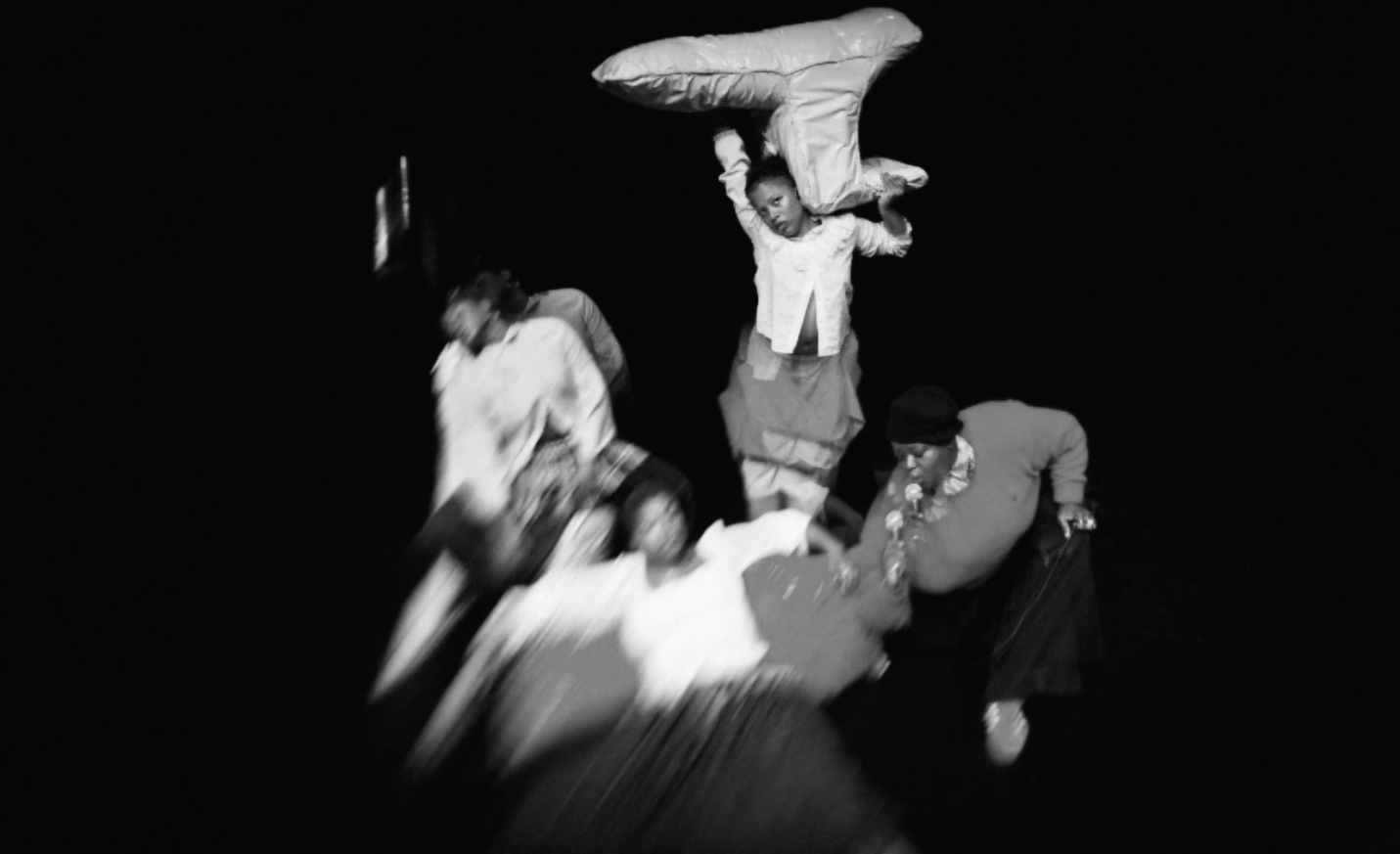

My walk through the Lower East Side en route to Abrons Art Center for the premiere of Symara Sarai’s dance play Angelic Architectures carried with it an air of warmth and hopefulness. I was ready for an interrogation of Black queer femme self-determination in the wake of the antagonisms that curtail it. On my commute back to Brooklyn, I contemplated all the little, yet pointed ways I have been policed out of my anger and how to thwart future attempts.
A vestibule for the free flow of emotionality, Angelic Architectures examines what Black queer femmes want to do in the here and now, without fear of shame or surveillance. Performers cussed and yelled, forcefully pointed—using the length of their arms to take up space, hurl cushioned chairs across the stage, and heave each other over the shoulder. In the first vignette, Kentoria Earle declares, “I am the visual!”
I had the chance to speak with Sarai over Zoom a week after the performance premiered. When I asked them about the Earle’s declaration, they reflected that generally audiences come to witness the performers, but rarely see the larger picture of labor and emotions. The turn of phrase came out of an improvisational moment during rehearsal, and it stayed.
Angelic Architectures was incubated over 18 months through the Abrons Performance AIRspace Residency, which offered a studio space, a production budget, a commission fee, and a premiere. For Sarai, the administrative and financial support the residency provided allowed them to leave as a stronger artist. “Everyone was taken care of, and that was something that gave me a lot of confidence because when you have the ability to take care of your people and take care of the work, [you] show up [and] you can make the work,” they explain.
Time is hard to come by in an accelerationist economy. Especially if you’re Black, queer, and femme. This way of managing wealth and resources necessitates the constant churning out of work by an artist, whereas the art object/spectacle (and artist) is alienated from its condition of possibility: dedicated time. A work appears, we consume it, and move on to the next. We don’t fully grasp the ethos inherent to acceleration because it hides in the language we use to describe the productivity of an artist: “premiere,” “retrospective,” “prolific,” “emerging,” “mid-career” and so on. Acceleration and its economy make possible the atomization of Black femme labor into discreet functions, chief of them being usefulness—for others, not self. In contemporary art, it shows up as inspiration, but not compensation. Hypervisibility, but underfunding. To be viewed, but not seen. The façade of care, couched in one’s instrumentalization to prove that we’ve made progress.
So much of the performance captures the fullness of being seen and heard, honing in on the audience seeing and hearing the performers. Aesthetically, viewers are engrossed by the dominance of red that colors long, plastic curtains and the saturation of blue in the design of the performance space—made possible by lighting designer Ava Novak. Performers are fashioned so we “could really hear the ways [they] were physically fighting… to hear the effort of [their] labor.” Each have their individual, ingenious sartorial style. These visuals enhances the embodied experience that is central in Angelic Architectures.
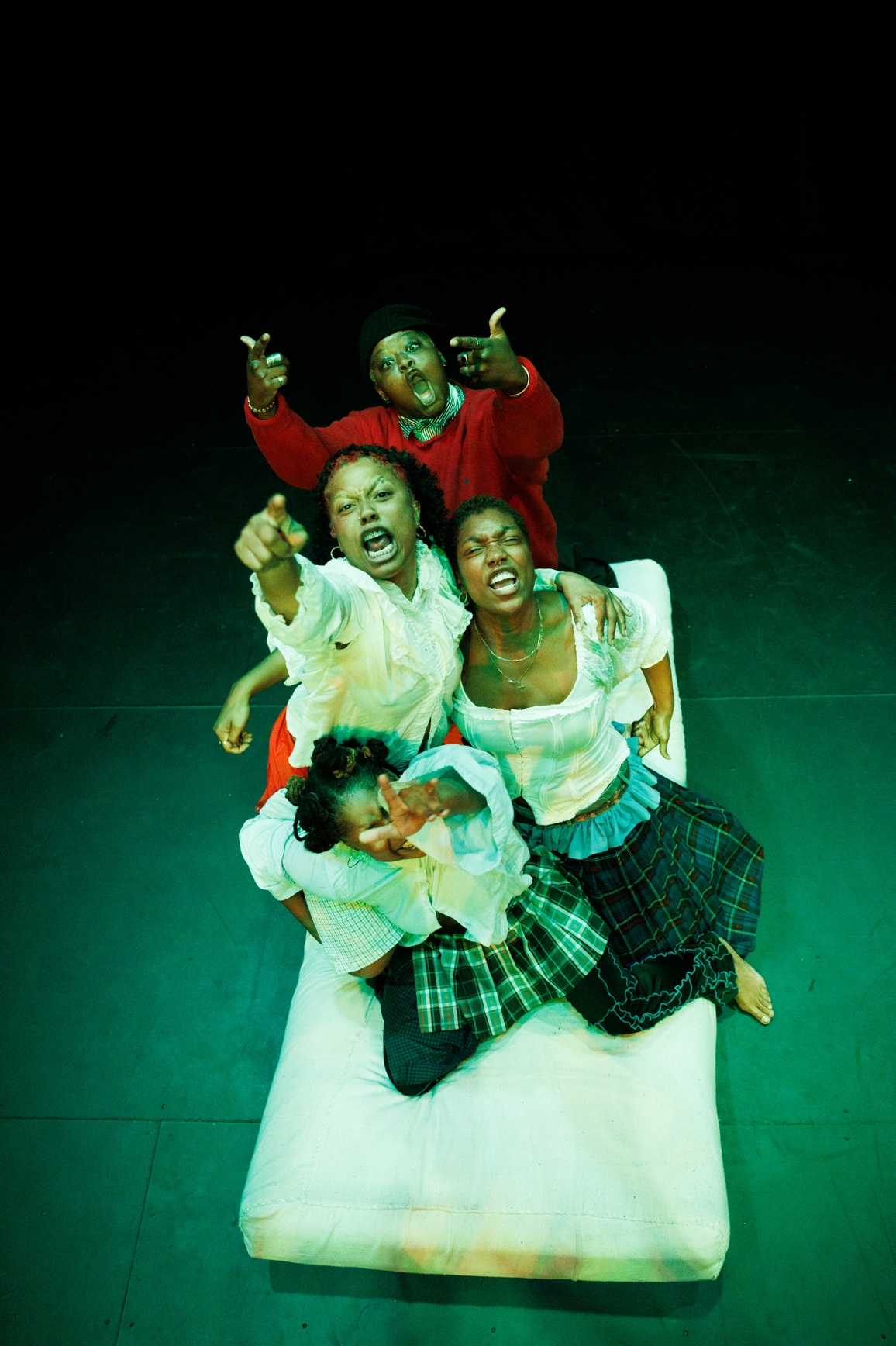
The performers test the limits of endurance. Lifting, tussling, and multi-directional sprinting are modes of movement that propel dancers across space. The movement vocabulary flips the antiblack framing of Black femme rage, using the energy of unbounded embodiment to jolt viewers. Performers lock eyes with viewers; they directly address them in dialogue, dance up and down the narrow aisle, unnerving them with the call to witness and be grounded in a presentism of the right now. The intimacy of the space heightens the forms of confrontation explored throughout, providing, in Sarai’s words, “safe containers in which [Black queer femme’s] are able to explore the full range of our emotionality.” Embracing this “architecture of emotionality,” the performers created physical structures of Black femme emotionality through embodied performance. For Sarai, the process of coming to the work was “quite cathartic and therapeutic:”
“We would find the sensation of emotion and feel the power to fully execute and be inside of its range without feeling emptied and it was interesting because as a choreographer at times, I have to sit out. And I would have these moments where I would wonder what this feels like to witness. Is this going to be a lot? Weirdly, as an audience member [I] would feel charged and ignited. I felt my autonomy and freedom…[Ultimately], we were trying to find different platforms of being with our emotional body and taking power inside of it versus losing the power.”
What is brackish to the status quo is flipped into free-flowing freedom, but fleetingly. In one of the final vignettes of the performance, viewers are confronted by a tension that runs between the anarchy of Black queer femme’s and Black authority figures, sometimes emerging in their Black maternal form. The dancers riotously play in a structure that is understood to be a home. They are carefree and fully actualized, until at one point one of the performers screeches, “look at me when I’m talking to you, bitch!” A punctum of sorts, it’s a moment that makes palatable how Black queer femmes have to navigate the treacherous terrain of discipline and punishment in the sphere of the domestic: where Black queer femmes are often encouraged to be anything they want to be and simultaneously forced to shrink themselves into being seen and not heard. What is made evident in this moment is how the Black queer femme is not a stand in for “Black queer woman.” Like performance itself, it is also a container. It holds all of the forms of Black gender and sexuality that are fluent in nonnormative femininity.
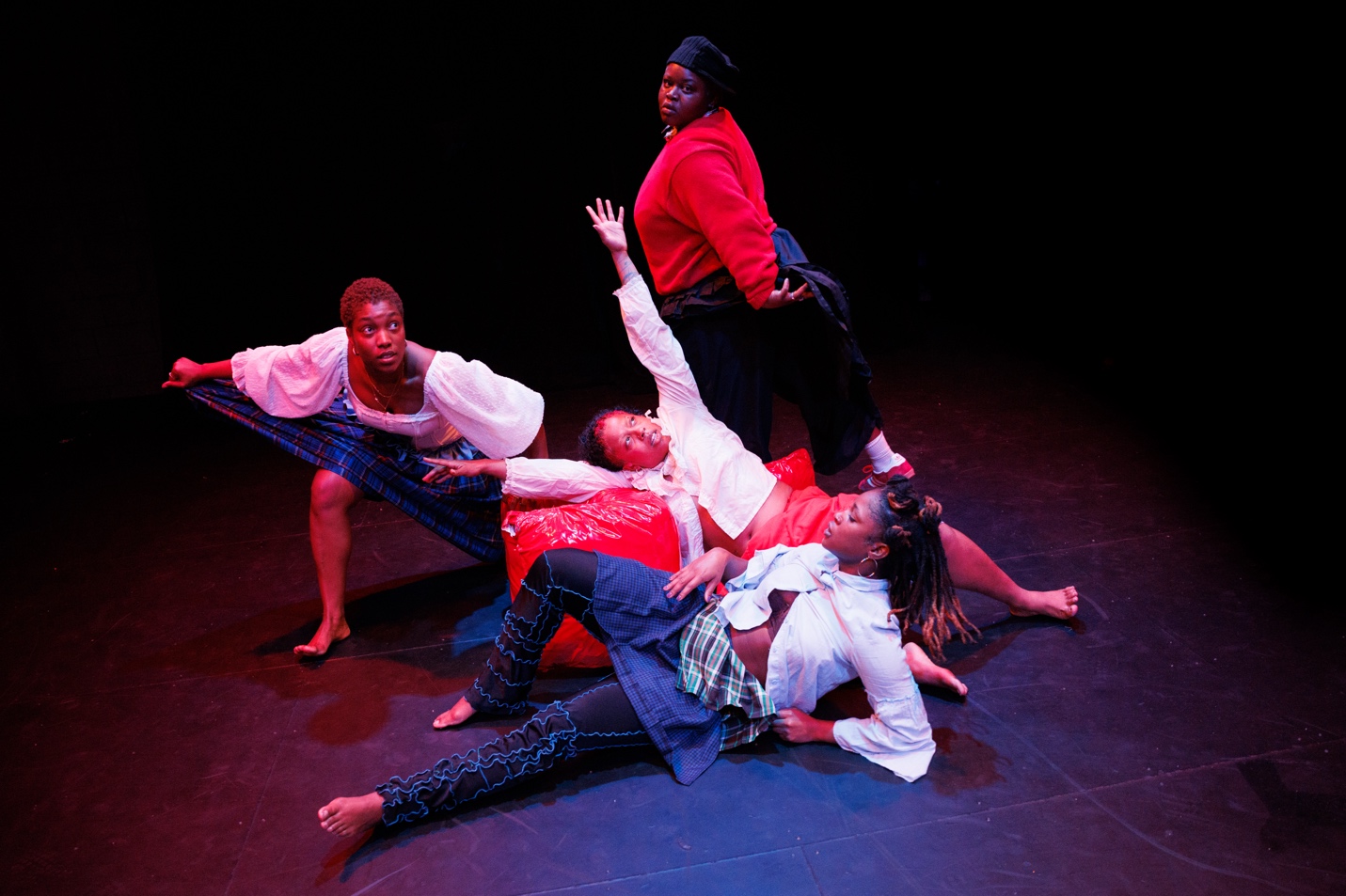
It’s no surprise the works ability to alchemize movement into power. Sarai has innovated interdisciplinary and choreographic works that have been internationally recognized. The 2023 Bessie Winner for Breakout Choreographer, she was named one of Dance Magazine’s “Top 25 to Watch” in 2025, and is a prior a recipient of the Dai Ailian Foundation Scholarship based in Trinidad and Tobago. The work was made possible by personal relationships between Sarai and her collaborators: Earle, Kashia Kancey, and CHIMI, the latter performing an original score that amalgamates punk sensibilities, Black music traditions, like spirituals, and electronic operatic form. Their formidable dance and sonic chorus reminded me that Black femme anger is a tool reserved for the righteous, not to be dismissed in favor of seemingly harmless emotions like “joy.”
Angelic Architectures had five performances in Abrons Arts Center Experimental Theater from Friday, April 17 through Saturday, April 25, 2026.
You Might Also Like
Giving the Finger to the Trappings of Genre: ‘Vaginal Davis: Magnificent Product’
A Rare Collaboration, New York City Ballet’s Sara Mearns Dances Amidst Diana Orving’s Sweeping Arcs
What's Your Reaction?