
Alexander Calder at Foundation Louis Vuitton is Sophisticated, Yet Unguarded


One of the most touching passages in Alexander Calder’s autobiography Calder: An Autobiography with Pictures (1966) is when he recounts receiving a pair of pliers as a gift. He describes the tool with such affection and wonder that it feels as though the entire world has shifted before him. Where most of us see a piece of wire, a scrap of cloth, or a bit of wood, Calder sees the possibility of an entire universe.
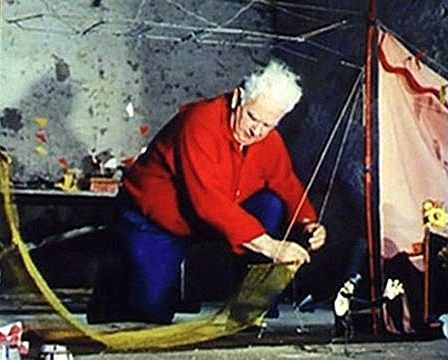
At Rêver en Équilibre, or To Dream in Balance, a monumental retrospective spanning fifty years of work by Calder at the Fondation Louis Vuitton in Paris, it was deeply moving to watch archival footage of the artist, grey-haired and internationally celebrated, crouching beside his miniature Circus Calder and bringing its performers to life. Clowns, lions, kangaroos, acrobats, and tightrope walkers emerge from wire and fabric to perform brief acts of astonishing ingenuity. Armed with his beloved pliers, he conjures a circus, a zoo, and a cast of characters from the humblest materials. Watching him play with these handmade figures made me want to gather scraps of paper and begin constructing a circus of my own. The joy is infectious.
Rather than presenting Calder’s career as a series of isolated masterpieces, the exhibition reveals a continuous process of experimentation, demonstrating how his most celebrated works grew from decades of inquiry into movement, balance, and space. Tracing the formative years Calder spent in Paris between 1926 and 1933, where encounters with the European avant-garde shaped his artistic vision. It then follows his return to the United States during the Second World War, a period in which he refined and expanded his practice. This period culminated in the iconic mobiles and stabiles that emerged once he began living and working between France and the United States.
As Picasso once said, “Every child is an artist. The problem is how to remain an artist once we grow up.” Calder seems to have solved this with unusual ease. In his work, nothing of that early imaginative certainty appears to have been lost.
Watching a child draw or play, there is never any doubt that a line on paper can open into another world, that a scrap of cloth and a fragment of wood can become a person, or that a twist of wire can become a horse. Things simply are what they are made to be. Calder combines this instinctive sense of play with the precision of a highly trained hand, allowing the freedom of childhood imagination to coexist with remarkable technical control.
It is this combination that makes his work so distinctive: at once deeply sophisticated and entirely unguarded, as though invention were still a form of play. What is a great artist if not someone who expands our sense of what is possible and says, in effect, “Look, you can do it too”? Yet Calder’s gift contains a paradox. His work from the 1930s feels radically accessible, as though anyone might attempt it, but the figures themselves are so inventive, so economical, and so full of life that one is ultimately left in awe of their genius. In effect, here, Calder is the magician of his own traveling troupe.
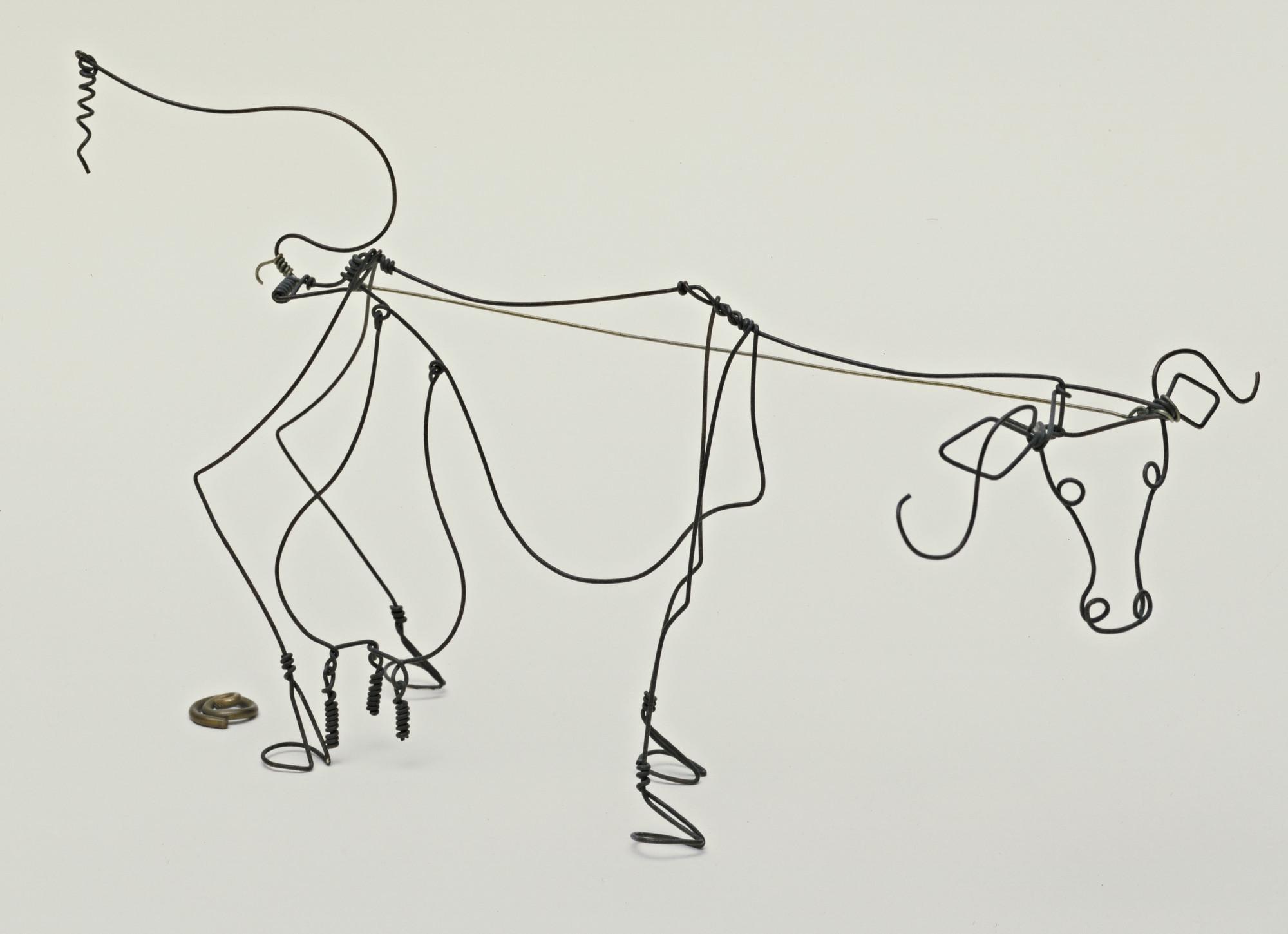
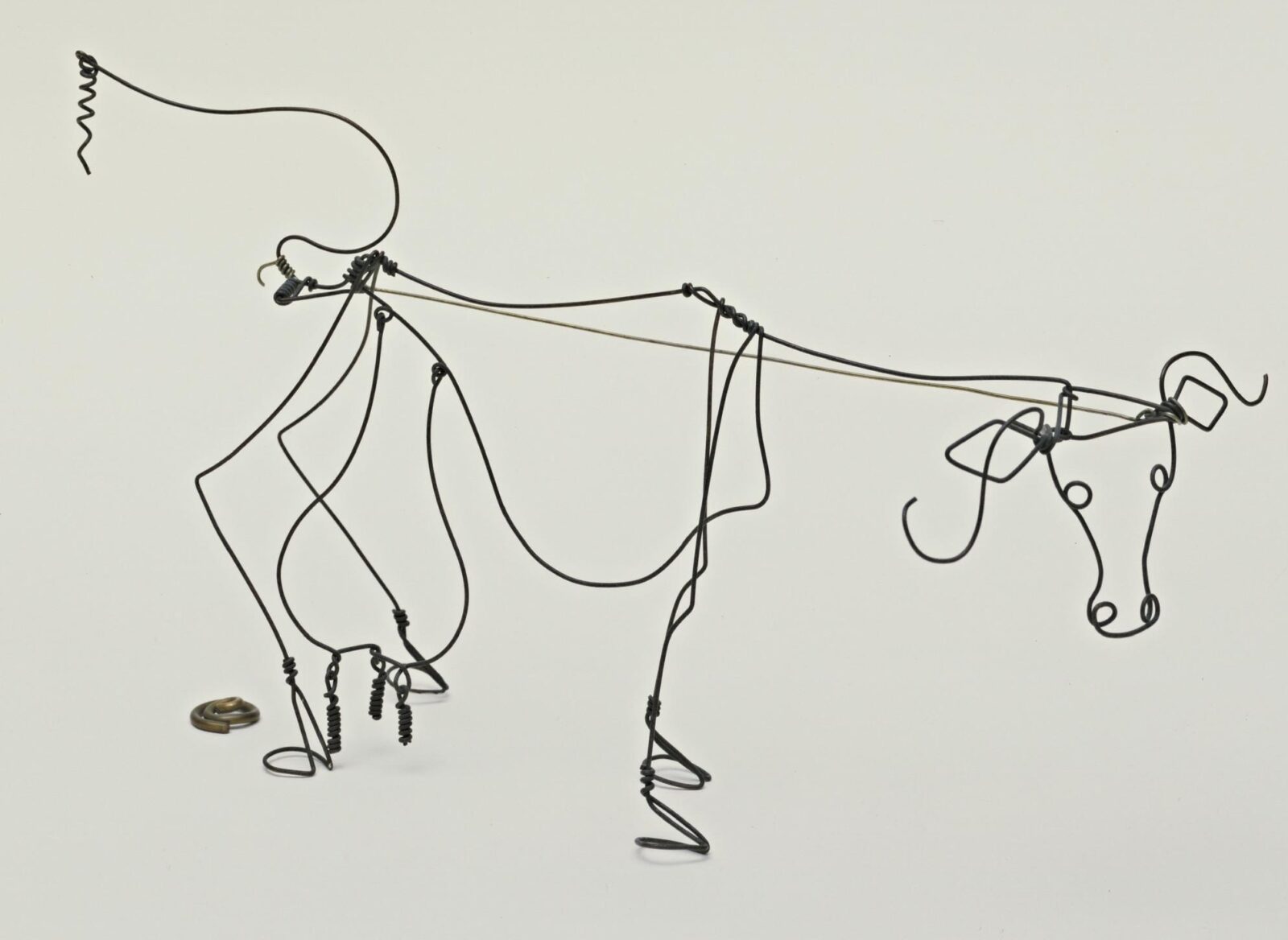
The ink drawings of animals (1925–1926) that greet visitors at the entrance to the exhibition are equally remarkable. Drawn from studies at the Bronx Zoo and Central Park Zoo, Calder sought to capture the animal’s movement with the fewest possible lines. Executed with extraordinary economy and confidence, these preparatory drawings possess the same vitality and immediacy as the figures of what eventually became Cirque Calder, revealing an artist capable of transforming the simplest gestures into something unforgettable, but also the time and passion it took to create Cirque Calder. If I could steal anything from any museum in the world, it would be one of Calder’s cows with its twisted metal droppings of course.
It is these small acts of humanity that make Calder feel real and attainable rather than a titan perched atop Mount Olympus of Art. His genius lies not only in the originality of his inventions, but in the generosity with which he invites us into them. Looking at his work, one senses that curiosity, play, and experimentation are available to anyone willing to begin.
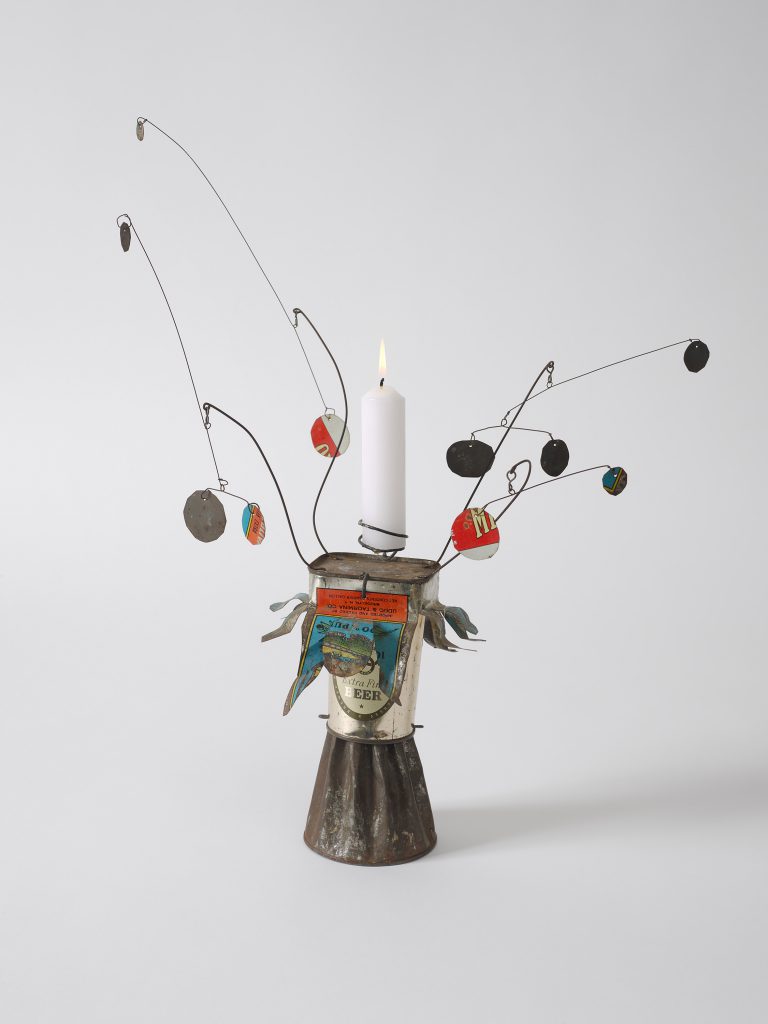
Later in the show, a touching moment comes in Birthday Cake (1956), a sculpture Calder created to celebrate his mother’s ninety-third birthday. Rather than presenting an actual confection, Calder fashioned a whimsical cake from wire and scraps of metal, complete with a candle rising from its center. The work is both affectionate and mischievous, transforming a family celebration into an act of sculpture. One can only hope that Calder’s mother did not have a sweet tooth.
The curator began to unravel the origins of his understanding of color, abstraction, and, most importantly, space after Calder arrived in Paris in 1926. This is where the exhibition hit its stride. The displayed works by Picasso, Mondrian, Miró, and Calder side by side are a reminder that these artists, now enshrined as self-contained universes, once moved through the same circles, visited one another’s studios in Paris, and developed their ideas in conversation with each other.
Overall, it is the most comprehensive and scholarly exhibition of the artist’s oeuvre that I have encountered. Neither the Whitney Museum in New York nor the Calder Foundation in Philadelphia has so clearly articulated the development of Calder’s visual language and his ever-evolving, unique perception of space.
Thanks to the extraordinary reach of the Fondation Louis Vuitton’s loans, the exhibition is able to map this evolution with unusual clarity and scholarship. We see how Calder’s encounter with a work by Kandinsky first opened the door to abstraction, while Mondrian’s geometric flatness prompted him to consider how abstract forms might be liberated from the picture plane and set into motion through space. The exhibition then traces his friendship with Miró, whose playful biomorphism resonated strongly with Calder’s own visual language. One particularly striking reminder of their closeness is Miró’s painted intervention on one of Calder’s sculptures.
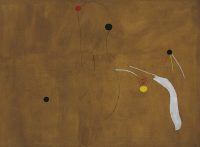
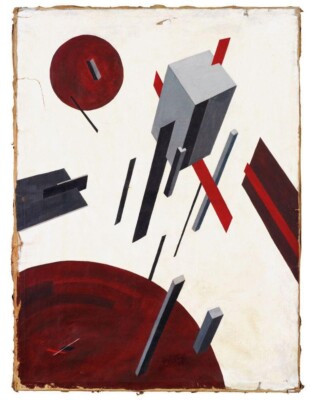
To my mind, however, one voice is absent from this iconostasis of abstraction: El Lissitzky. Long before Calder suspended forms in space, Lissitzky had already begun to project Kandinsky’s geometric vocabulary beyond the flat surface of the canvas. His Proun works transformed abstraction into a spatial problem, positioning geometric forms within an imagined architectural environment. While there is little evidence of a direct influence, the conceptual affinity is striking. Looking at Calder’s mobiles, one cannot help but feel that he succeeded in giving physical movement to many of the spatial questions that Lissitzky had first posed.
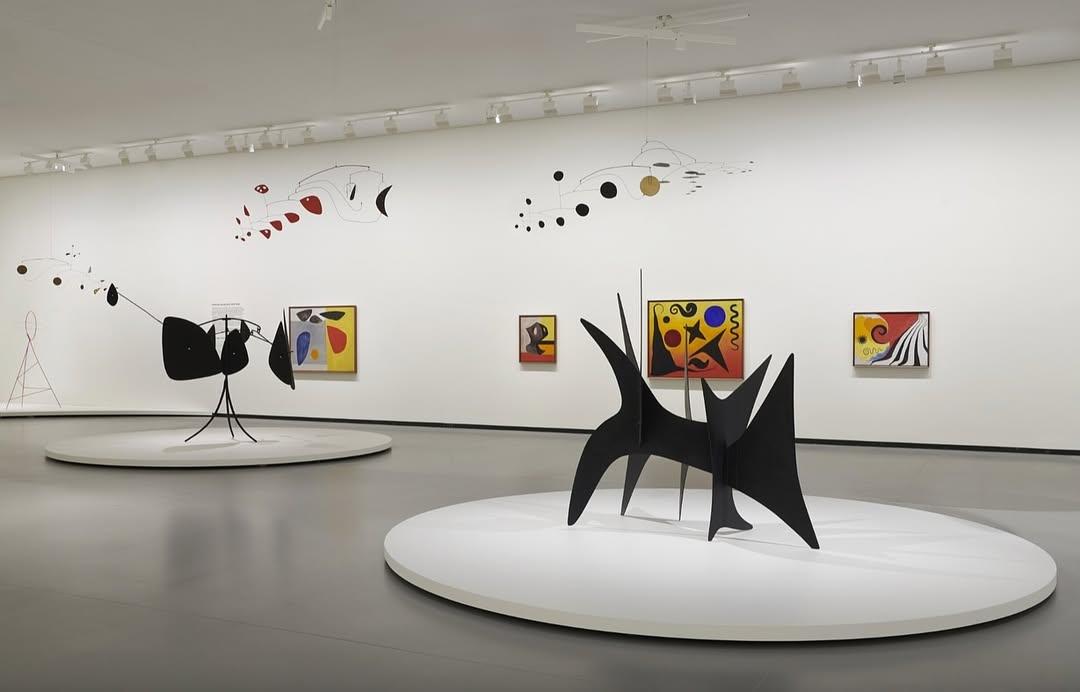
The final two floors function as a kind of victory lap. By this point, Calder has fully arrived. The sculptures, both mobile and stable, become larger, sleeker, and more ambitious, occupying space with a confidence that only decades of experimentation and play can produce. I was grateful that the lighting in these rooms had been so carefully considered, since so much of the pleasure in Calder’s kinetic work lies in watching it activate its surroundings: shadows slipping across walls, forms doubling and stretching as they move.
Unlike the Calder Foundation in Philadelphia, which often presents his work with no direct lighting, thereby placing it in a vacuum-like setting, the Fondation Louis Vuitton foregrounds Calder’s understanding of space, light, and shadow as active components of the work itself. Here, the sculptures are not isolated objects but part of a larger choreography, in which illumination becomes as important as steel, wire, or balance.
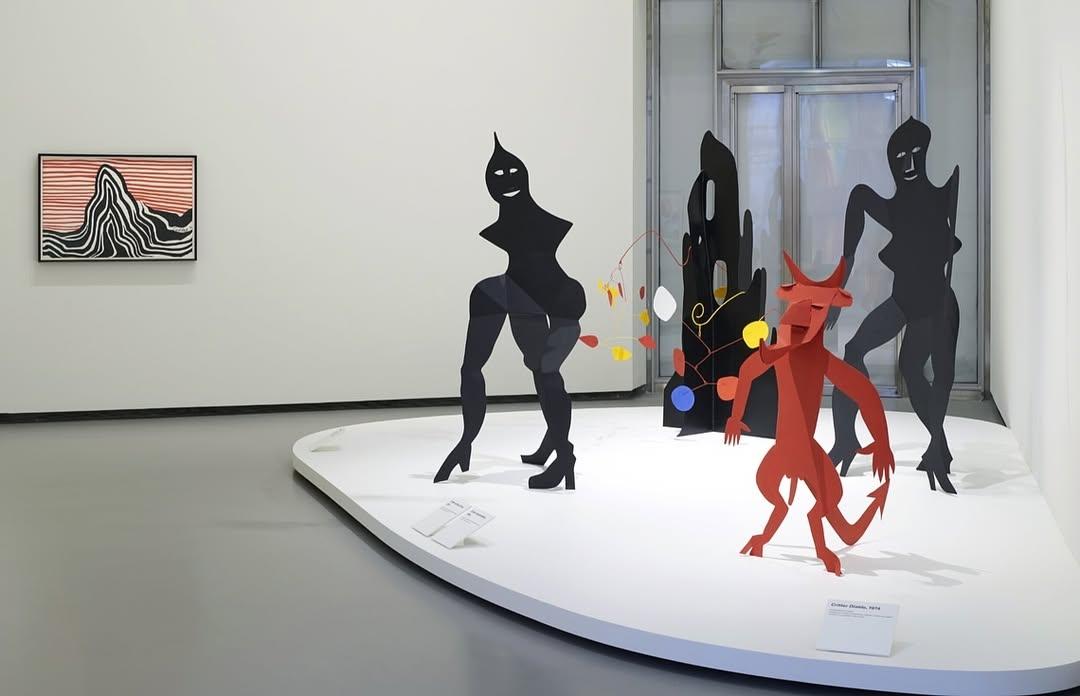
As the works grow more monumental, expensive, and almost extraterrestrial in their elegance, the earlier sense that “you could do it too” drifts away. The magician’s whimsical tricks become harder to see. One particularly amusing exception is Calder’s interpretation of the devil, Le Diable Rouge (1970), who appears equipped with an improbably large red phallus, a reminder that even at the height of his fame, Calder never entirely abandoned his sense of humor or concern with manliness.
After further research, I found myself wishing the exhibition had devoted more attention to some of the stranger corners of his career. Calder’s painted airplanes, racing cars, and parade floats reveal an artist who refused to recognise boundaries between high art and everyday life.
These projects are not footnotes to the major sculptures but extensions of the same imagination. Few artists have managed to leave their mark on such a diverse range of objects, and fewer still have done so with such playfulness. Seeing these eccentric commissions alongside the masterpieces would have reinforced one of the exhibition’s central lessons: for Calder, almost anything could become a work of art.
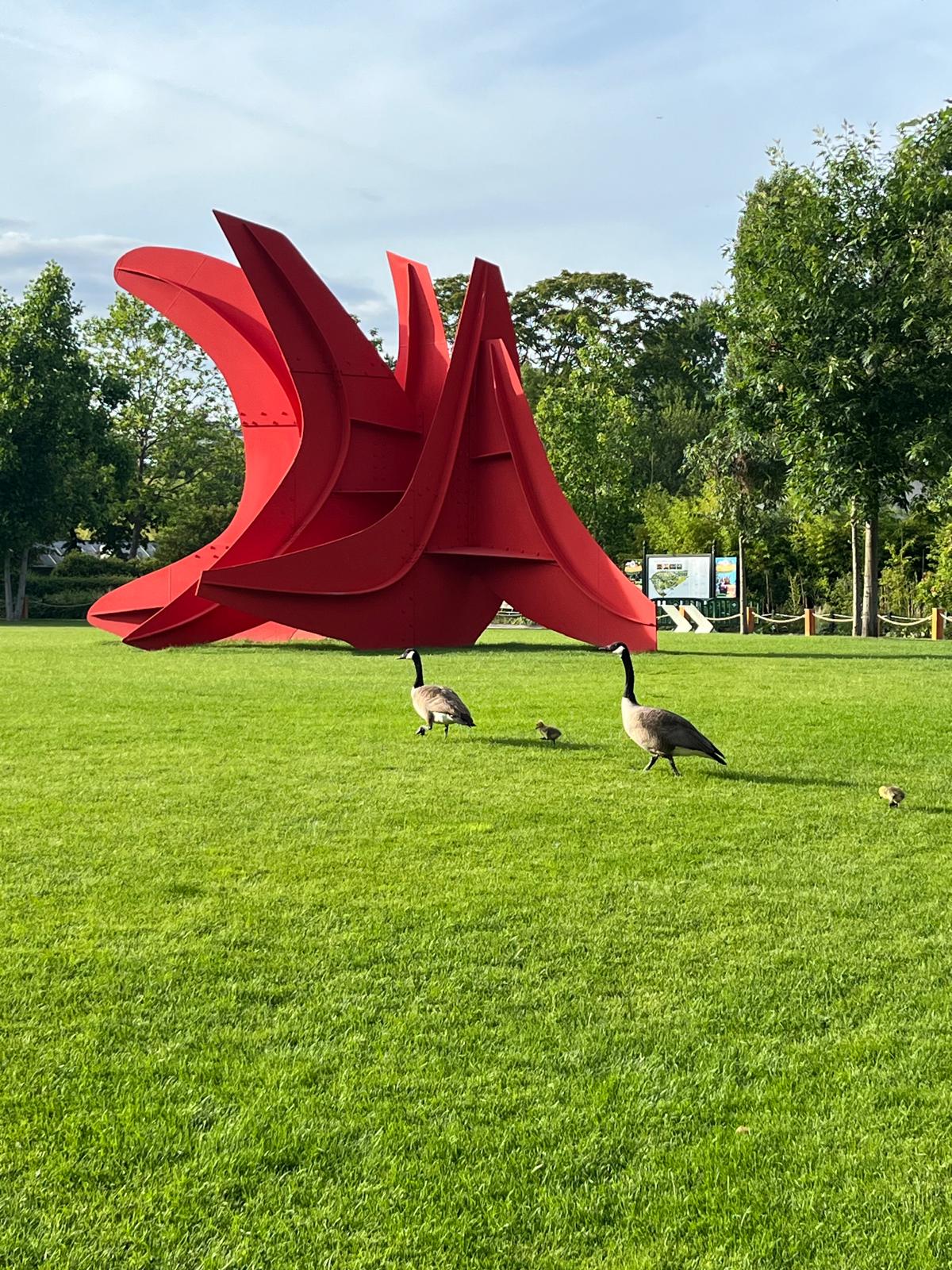
I left the Fondation through the rear entrance, where two of Calder’s monumental sculptures—red, Five Swords (1976) and black, Black Flag (1974)—occupy the lawn. As a gander, geese hopped determinedly with their gosling through the lawn, they did so almost in defiance of the masterpieces surrounding them. The sight made me smile. It seemed an appropriately Calder-esque ending. For all of Calder’s genius, for all his ability to suspend forms in mid-air, make wire dance, and transform abstraction into something joyous and alive, nothing could faze a Bois de Boulogne goose. The birds marched on, unconcerned with art history or the presence of greatness. A fitting end, it was the family of geese, weaving effortlessly between the sculptures, that reminded me how much of Calder’s art was inspired by the simple wonder of watching living things move through the world.
Rêver en Équilibre is curated by Suzanne Pagé, Dieter Buchhart, Anna Karina Hofbauer, and Olivier Michelon and on view through August 16, 2026, at Foundation Louis Vuitton, Paris.
You Might Also Like
A Voyage Through Drawing at Salon du Dessin in Paris
William Kentridge is a Star Among Many at Powerhouse Arts’ Artists Celebration
What's Your Reaction?