
For the Whitney Biennial, Maia Chao Turns the Museum Visit into the Subject

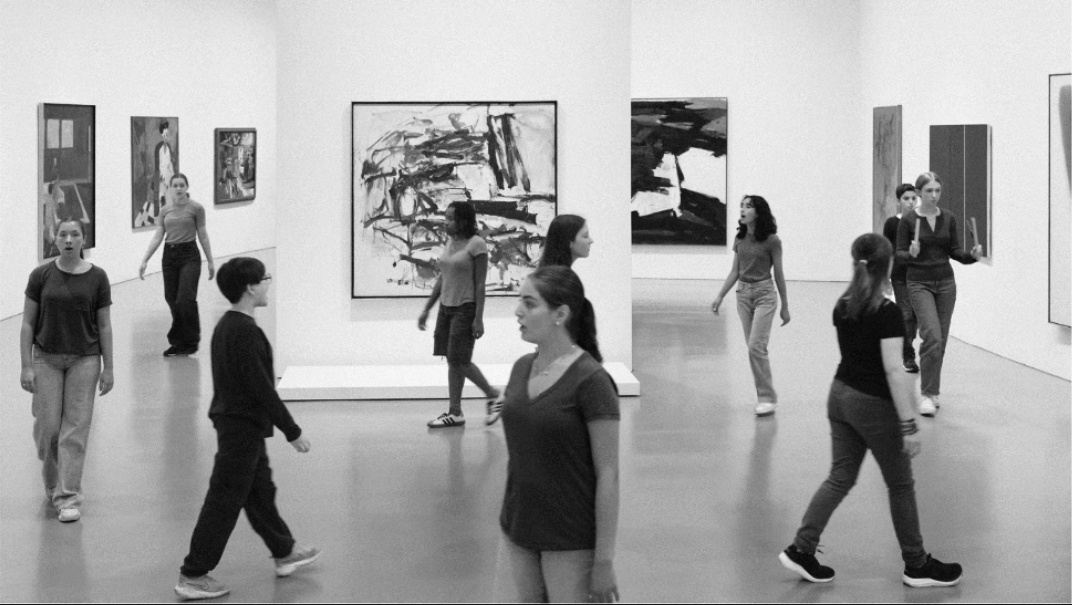

BEING MOVED is a meditation on art in the context of “precarious futures” and what it means to make art “permanent,” Chao explains to me over the phone. It is late April, and we are speaking ahead of her performance commission as part of the 2026 Whitney Biennial. The work will, she explains, respond to the museum’s permanent collection exhibition Untitled (America). It is not a meditation of Rosalyn Drexler’s Marilyn Pursued by Death, or Georgia O’Keeffe’s The White Calico Flower, both related to precarity, or even why they were included in the permanent showcase. Instead, it explores the archetype of a permanent collection by way of people moving through the space—honing in on disruptions. “Attuning to sounds already in the space,” like the beeps and non-descript chatter emanating from walkie-talkies, the punctum of coughing and sneezing from the draftiness of air conditioning, Chao incorporates found sounds into her new work. That the performance will turn the museum visit into the subject is not unexpected for the artist, known for an anthropological approach to her socially engaged art, but the incorporation of found sound is new. That idea came to Chao during a visit to said collection, amused by the squeaks her sneakers made in the otherwise somber space
A noted tension she is exploring in this new work: Art institutions want to share artworks, and yet, there is an imperative to preserve and maintain their monetary value. Even without malicious intent, everyday interactions ranging from careless touches and exposure to light and air pose a persistent threat to the preservation of art. This interest is rooted in the concept of permanence. BEING MOVED builds on Scores for the Museum Visitor (2026), a text-based work that uses vinyl scores to instruct Whitney visitors to perform a series of actions that violate the seemingly permanent norms of art institutions, chief of them being looking, but never touching. Viewers turned participants enthusiastically abide to tactile prompts: “Touch the rectangle as if you are touching an artwork that you aren’t allowed to touch,” “Lean forward over the stanchions until your forehead rests against the wall.” What remains are traces of makeup and oil stains from perspiration.
Chao started to think about the idea of permanence in art contexts when she created the choral performance Agents of Deterioration (2024) for the Hirshhorn Museum and Sculpture Garden’s 50th anniversary exhibition. For it she collaborated with the Children’s Chorus of Washington to create a sonic tour that juxtaposed arts preservation with the environmental crisis. That performance, like the forthcoming one, centered on the illusory concept of permanence and human behavior.
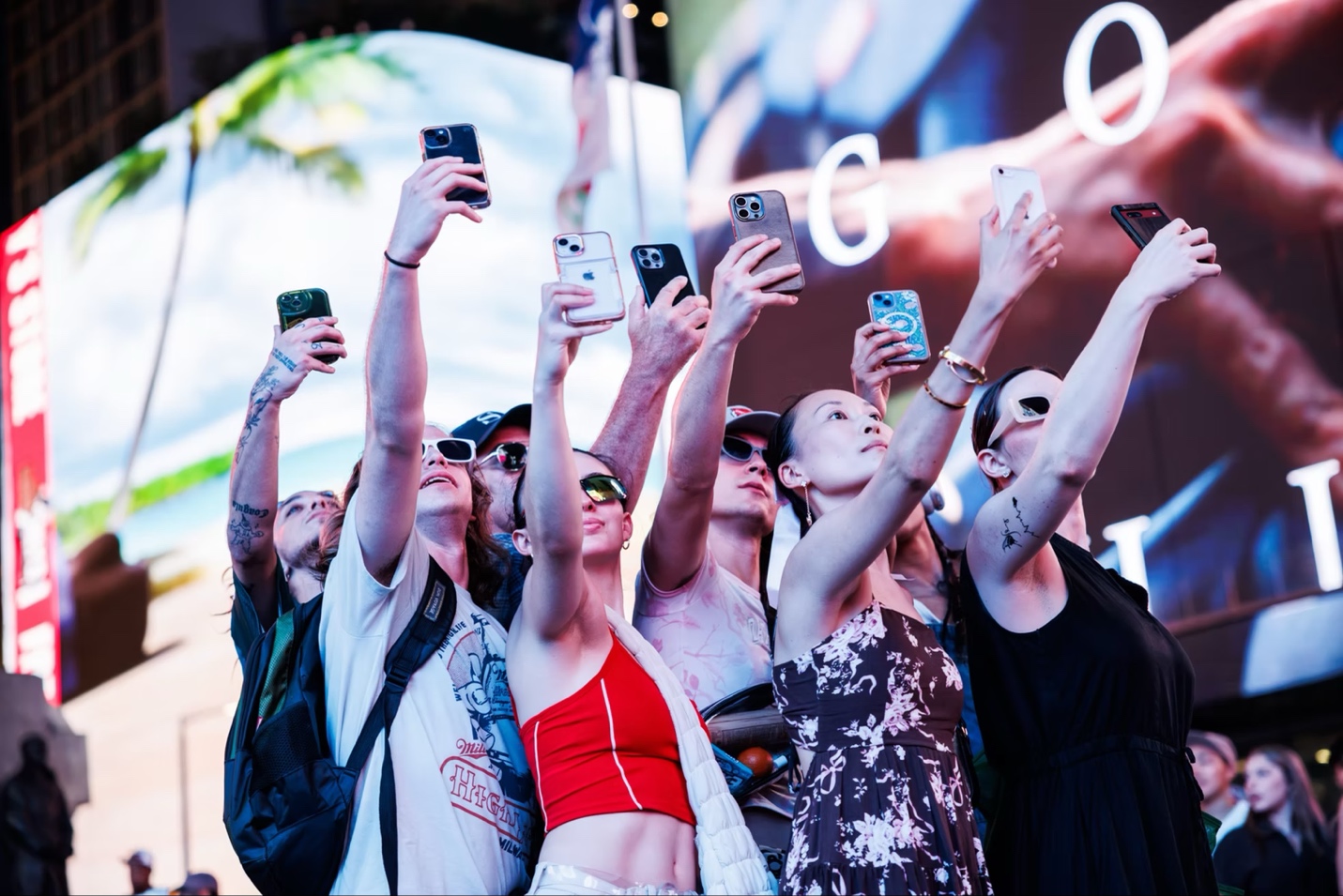
Chao is fascinated with how people look at art, their experiences of art, and the many preconditions of looking at art in a museum. This fascination has extended to her interest in the simulation of looking and viewing in our contemporary moment. American Idle (2025), which was commissioned by Times Square Arts and staged in Times Square, takes on this idea to contend with the ways “the real becoming less vivid and the simulation becoming more vivid…how attention is being conditioned and harvested.” Times Square is a massive social space where lots of human activity happens, but our relationship to mediation, made possible by smartphone technology, provides a simulation of being present and in touch with the real versus having our lives conditioned by simulated environments.
For instance, when Chao was working with her collaborators on the piece, she came across the analytic ‘fixation duration’ used within the context of Times Square as data to describe public engagement. It quantifies the average time spent directly concentrating on something; the higher the fixation duration, the higher the engagement. Chao was troubled by this disembodied way of discussing looking and gazing and it shaped her commission, something that came to shape the piece. As our conversation develops, it becomes clear that in Chao’s work, behaviors, work processes, and ways of engaging with ideas are deeply intertwined, each continuously shaping and sustaining the others.
Similar to Chao’s exploration of Times Square Art’s engagement with the concept of ‘fixation duration,’ BEING MOVED is informed by The Whitney Museum of American Art’s Replication Committee’s approach to replication. The committee is a cross-departmental body established in 2008 to address the ethical and practical challenges of preserving and exhibiting contemporary art that is ephemeral, time-based, or designed for replication. BEING MOVED uses replication by abstracting a set of vocabulary in its choreography, aiming for this process to be interpreted in a feedback loop: “replicating a replication,” she explains. Replication, as a method, brings up questions of authenticity for Chao. Its use in the performance reveals how, in her words, “performance is a mode of simulation,” whereas the role of repetition is “defamiliarizing the everyday.”
For Chao, conserving a performance or replicating it are interesting provocations. During our call, she is unsure if her performances can be distilled into a series of instructions, but assures that BEING MOVED will raise the question: Can replication be used as a method when ephemerality is an inherent quality to performance? I expect that each performance will change participants’ future encounters with art and art institutions. What remains to be seen is how the codes and procedures of the Whitney will run up against the staging of this performance.
BEING MOVED: Maia Chao will be performed at the Whitney Museum of American Art on May 14, 16, and 17 at 7PM.
You Might Also Like
Ahead of Whitney Biennial, Ligia Lewis Conjures a “With-ness” for “study now steady”
A Kiss of Madness While Bathing, Tang Dynasty-Style at Othership
What's Your Reaction?