
In “Making Pictures” Cecily Brown Dials Down the Erotic Charge


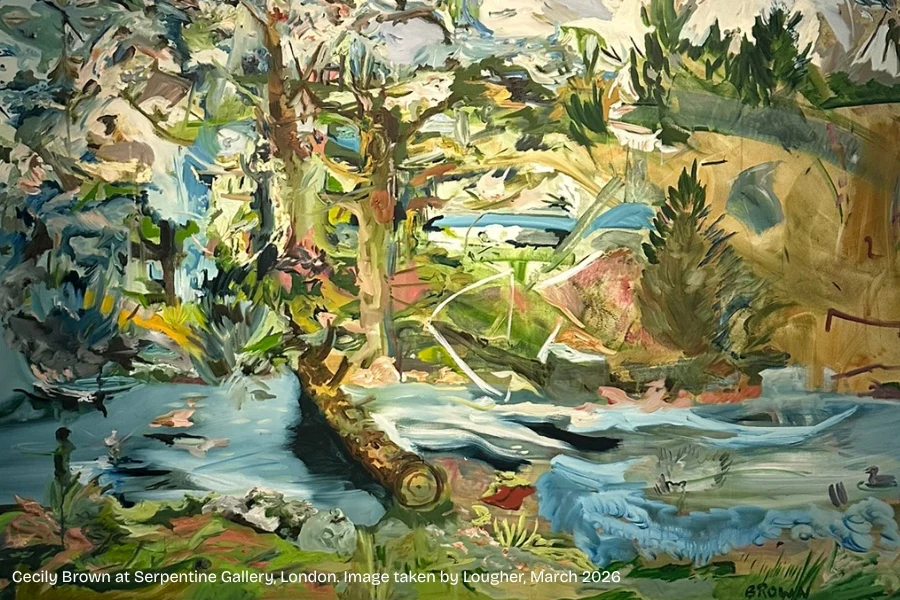
In Edward Helmore’s deservingly laudatory Guardian profile of British artist Cecily Brown, from 2023, she comments: “I could do a slash of pink and someone would assume it was something sexual even when it wasn’t.” Walking through Cecily Brown: Picture Making at Serpentine in London one senses an artist deliberately moving away from the orgiastic turbulence that once animated her paintings.
The galleries are filled with thinly painted variations of dense woodland scenes, fallen trees, streams, and landscapes that feel increasingly pastoral, even elegiac. I particularly enjoyed seeing the same woodland scene done in black and white and then four times in colour in various scales. The camouflaged bodies and figures have not disappeared entirely, but they seem to have been absorbed into the undergrowth, as though the erotic charge that once erupted so insistently from the canvas has been folded back into nature itself.
I first discovered Brown in 2016 while interning at Gagosian Gallery in New York. One of my tasks was clerical work in the gallery’s catalogue library. The “library” is definitely too grand of a word for what actually was a narrow, dimly lit closet tucked away on the second floor of the gallery. As I filed the catalogues away, I passed the time by randomly flipping through their pages. It did not take long to arrive at B for Brown. When I did, I nearly dropped the book. My whole body seemed to convulse. I had never experienced such an immediate physical reaction to works of art before.
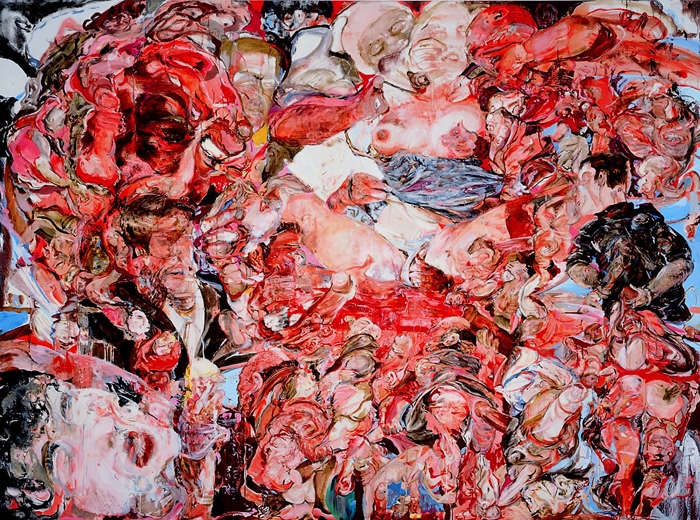
The paintings were thick, sumptuous, and utterly delicious. From a distance, they appeared abstract, all swirling colour and intense nervous energy. As I peered closer, figures began to materialise from the paint, dozens of them, tangled together in various erotic pursuits. Waldo seemed to have misplaced himself somewhere between a crowded beach and the Kama Sutra. Ever since then, I have gone to every Brown exhibition I could, and mostly the longer you look at one of her paintings, the more bodies emerge.
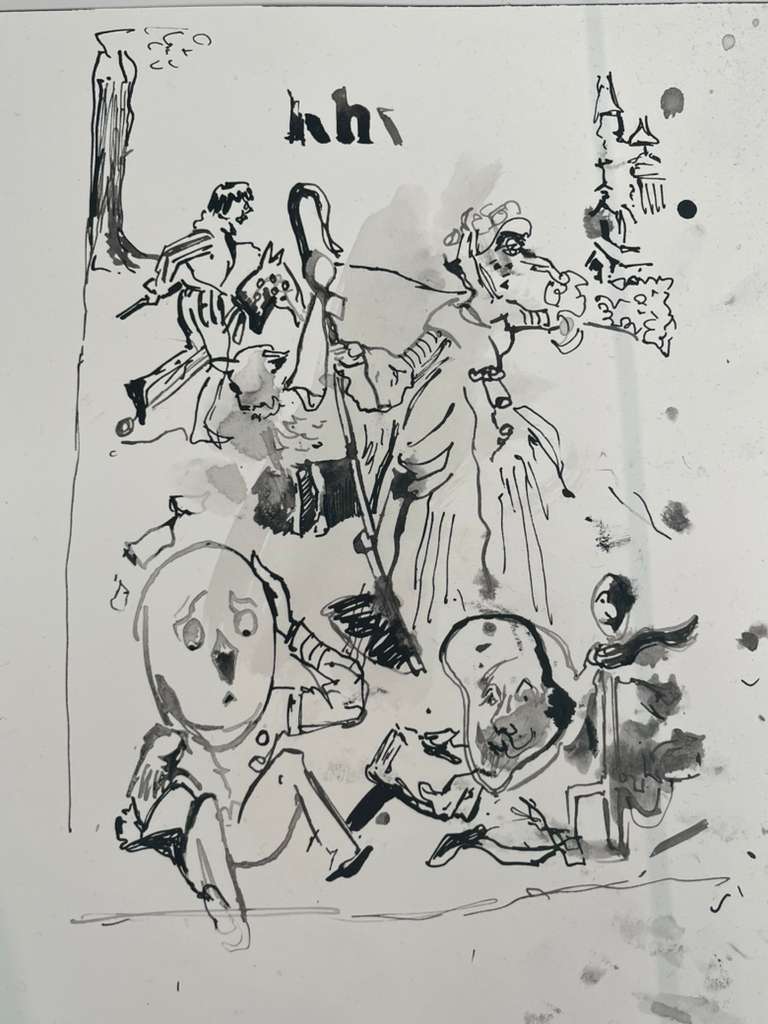
The final room at Serpentine contained a series of delicate pen-and-ink illustrations inspired by British nursery rhymes. They were beautiful, touching works, and perfectly suited to a gallery in the middle of Hyde Park. A witty comeback to the artist’s roots of being an erotic illustrator at the beginning of her career. Yet I could not help feeling a flicker of disappointment. I had come hoping for the painter who once hid orgies inside storms of paint. Instead, I saw some logs and Humpty Dumpty.
Perhaps that disappointment says more about me than it does about Brown. As an artist, I recognise the frustration of the “stay in your lane” mentality that runs so deeply through the ever-expanding art world. There is an expectation that once an artist becomes associated with a particular language or theme, they should repeat it indefinitely, as if invention were a form of betrayal.
It is like walking into a shop that has always sold watches, that you want to buy now, and discovering, upon arrival, that it now deals in pink vintage motorcycles. Perhaps for Brown the disorientation is part of the point, yet also where resistance begins. The tension arises when an artist who has spent twenty years refining a single vocabulary suddenly wants to move elsewhere. Imagine, for a moment, the collective disappointment if Georgio Morandi had turned from jugs to poodles. The object itself is almost irrelevant; what unsettles is the break in the viewer’s or the collector’s expectation.
With Brown, however, the question feels slightly different. She is, quite simply, one of the most compelling painters of sex we have. In that register, very few artists operate at her level of intensity or invention. Flora Yukhnovich, for instance, can rival her in moments of pastoral abstraction; her Humpty Dumpty figures feel closer to reinterpretations of Ken McKie original illustrations for the Lady Bird books than to a fully independent erotic language Brown has been recognised for. I wondered that maybe now that she is in her late fifties her relationship to sex might have changed since she first depicted it in her twenties and so would her attitude to painting it.
Brown has few peers when it comes to the depiction of sex as atmosphere, force, and psychological charge. Even when one regrets certain turns in her work, her erotic output remains difficult to match.
Cecily Brown: Picture Making, curated by Lizzie Carey-Thomas (Director of Programme & Chief Curator) and Kit Gurnos (Assistant Exhibitions Curator), at Serpentine South Gallery, Kensington Gardens, London W2 3XA, United Kingdom, open through 6 September 2026.
You Might Also Like
What's Your Reaction?