NYFA Immigrant Artists on Display at New York Live Arts


As someone who has migrated across two countries as an adult, with English as a second language, I am acutely aware of what it means to exist in-between. I think a lot about how this condition can feel like a doubling: never fully merging with a former self, always hovering slightly above the present, unsure of looming future, seemingly normalized, sometimes even content, and yet accompanied by a quiet unease, a mirage behind eyelids. In this state of weightless unbelonging, I have continually sought programs and spaces where others like me exist within this same suspended space in this country.
NYFA Immigrant Artist Mentoring Program presents such a platform, where artists come together across cultures, countries, and generations to navigate the artworld in the U.S. I was once a mentee in the program and have returned over the years as a mentor. The program has operated for almost 20 years in the city and across the country and continues to act as a crucial connector, becoming ever so urgently needed, especially today.
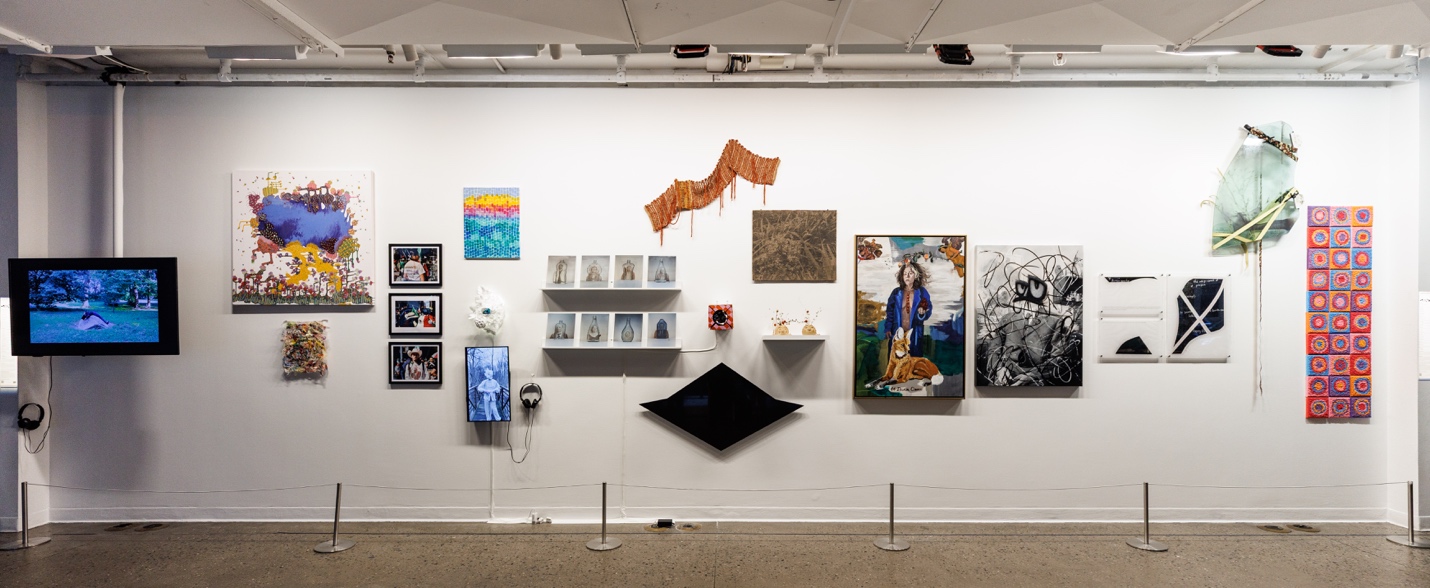
The 2026 mentee cohort exhibition, In/ Between: reclamation mirrored, now on view at New York Live Arts Lobby in Ford Foundation Live Gallery through June 14th, brings together Patrícia Colmenero, Yoojung Hong, Mona Karami, Entung Liu, Hiroshi Masuda, Luisa Mantelli, Avani Patel, Malte Sänger, Shaheen Salehi, Heriberto Sanchez, Celine Mai Seehase, Jing (Ellen) Xu, Sixing Xu, Vasudev Vashisht, Jimena Vega, Voyo Woo, and Sachigusa Yasuda who work across mediums, offering a collective reflection on displacement, uncertainty, and humanity. “The works in reclamation mirrored are declarations of the complexity of belonging to ourselves, to the land, to one another,” exhibition curators Martita Abril, Zahra Banyamerian, and Yanira Castro state in the press release, continuing, “Through their work in a variety of mediums, these seventeen artists arrest and hold us in their reflections, in the reality of being.”
In this context, I talk to my 2026 mentee, Salehi. Originally from Canada, of Polish-Iranian heritage, she came to New York to study at Parsons. A recent graduate and participant in numerous residencies, she is in the process of finding her footing in the city.
KG: You moved from Canada to New York City to study, what did you imagine the city would be, and has that shifted in any way through your experience of studying, living and working here?
SS: I arrived in 2021, just after the initial wave of COVID, so the pace of the city didn’t yet align with its usual intensity. I was able to gradually acclimate, by the time the city returned to its regular rhythm, I was already moving within it. Before moving, I was nervous; everything felt daunting, but I was ready for change, and I knew there was a history of artists who made the move here and have navigated that precarity. Over time, I began to develop a sense of community and was welcomed into mutual aid and support networks that make surviving as an artist here possible.
From arriving as a student to now, a few years out of school, I can say I’ve experienced some difficult years in New York (financial instability, graduate studies, immigration constraints, extended periods of loneliness.) You just move through it and eventually come out the other side. It sounds sadistic but navigating these challenges has reshaped my understanding of what it means to persist within uncertainty and revealed a deeper resilience.
KG: As someone navigating multiple cultural backgrounds, how does that sense of in-betweenness shape your work and your sense of identity as an artist?
SS: Growing up in Canada as the child of Polish and Iranian parents, I was always moving between Eastern European and Middle Eastern cultures. I developed a kind of cognitive flexibility early on, along with a sensitivity to how context shapes meaning, what’s valued, how things are understood and who gets to define them. That sensitivity has extended into how I relate to others, often drawn to other immigrant communities because of the familiar, even grounding, feeling.
While my perspective began through cultural experience, in my work it’s expanded to shape how I think about nonhuman life and call attention to what exists at the margins of dominant systems. I’m interested in how forms of animal knowledge are often overlooked within Western frameworks because they do not easily fit within human-centric systems of understanding. Ideas from cognitive ethology allow me to research nonhuman beings having perception and intelligence, rather than existing as passive entities. Being “in-between” is a way of seeing. It shapes how I approach both cultural and ecological systems: paying attention to what doesn’t fit neatly, what gets missed, and what exists outside of dominant ways of knowing.
KG: How has the NYFA Immigrant Artist Mentoring Program supported you in your practice at this stage?
SS: The NYFA Immigrant Artist Mentoring Program has been twofold through the support of the mentee cohort and the mentorship structure. The mentee cohort has created a space for dialogue with other artists navigating similar conditions and challenges. At a time that feels politically and socially charged, especially in the U.S., it has been grounding to be in community with people who understand these pressures firsthand, while also bringing perspectives shaped by different countries and systems. There’s a sense of shared recognition.
The mentorship side offers a different kind of support. Speaking with more established artists has been invaluable, both practically and conceptually. It has given me a clearer and more realistic sense of what sustaining a long-term practice can look like, while also making the future feel more open and attainable. Those conversations have helped me think more carefully about my trajectory, in terms of longevity, intention, and how to build a practice that can endure.
KG: Tell us about the work you have on view in the exhibition and how it connects to your broader practice.
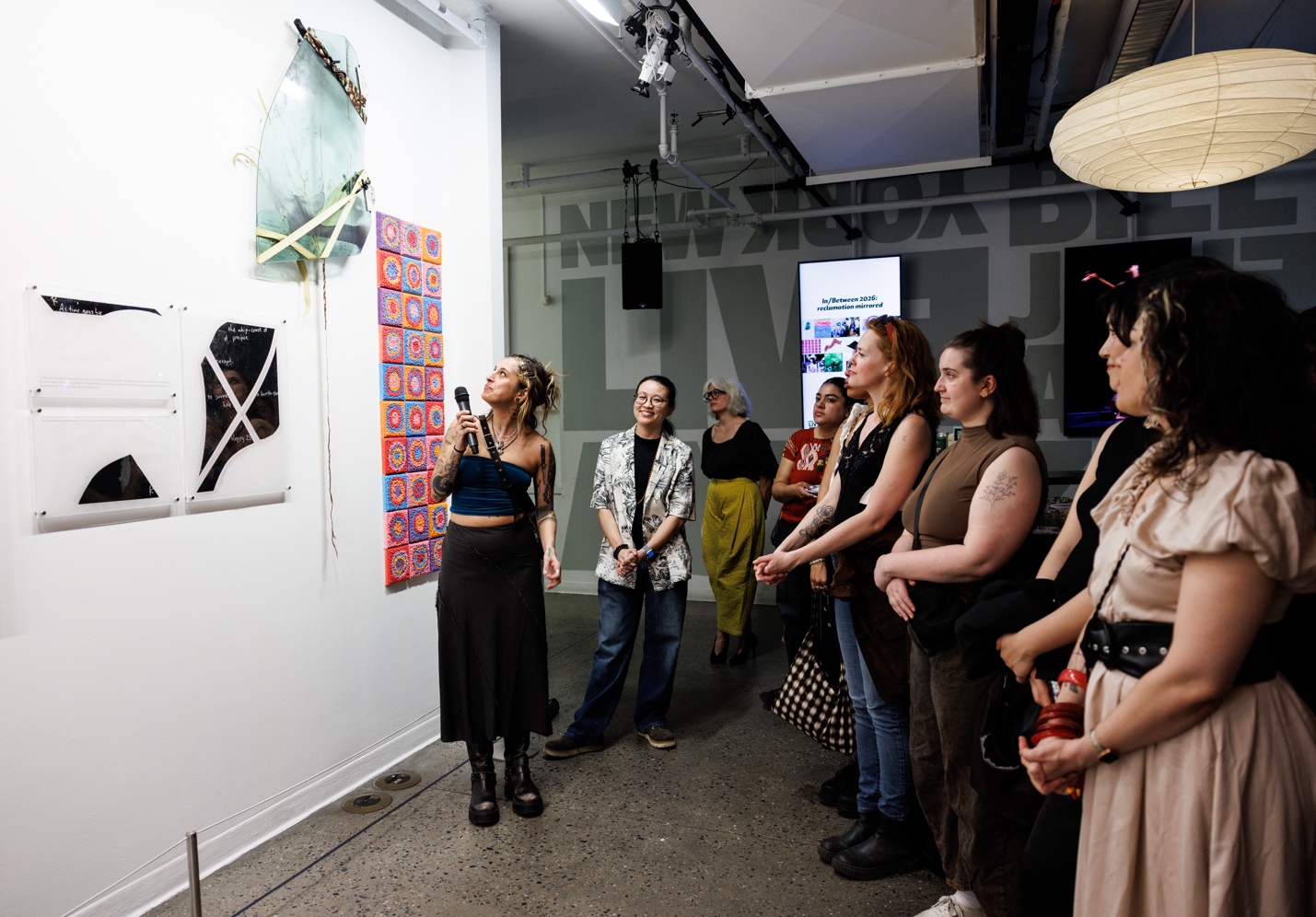
SS: My work, Two Strap Minimum I, included in the exhibition, is part of a larger body of work centered on road ecologies, engaging roadkill, infrastructure, and digital mapping (through a recording of a road trip along Interstate 80 through the lens of Google Maps). The work reflects on how systems of movement and representation shape how nonhuman life is overtaken and overlooked.
The piece uses UV-printed roadkill imagery obtained through FOIL requests, bound with a ratchet strap. In the center of the piece there are roadside plant species such as Dame’s Rocket, Spotted Knapweed and Foxtail, introducing a tension between memorialization and entrapment. While the plants gesture toward an unintentional sense of ecological mourning, many also function as attractants, drawing animals toward sites that inevitably harm. In this way, the installation reflects on how systems of care and neglect are often entangled, producing environments in which vulnerability is both marked and reproduced.
In/Between: reclamation mirrored is on view through June 14th 2026, at New York Live Arts Lobby: Ford Foundation Live Gallery, 219 W 19th St, New York, NY 1001.
You Might Also Like
Artists Share From Their Visa Journey as 4N’s Publisher Announces New Open Call
Katya Grokhovsky on FANTASYLAND and a Decade of Making and Migrating
What's Your Reaction?