
I See You, Rama. I See You.

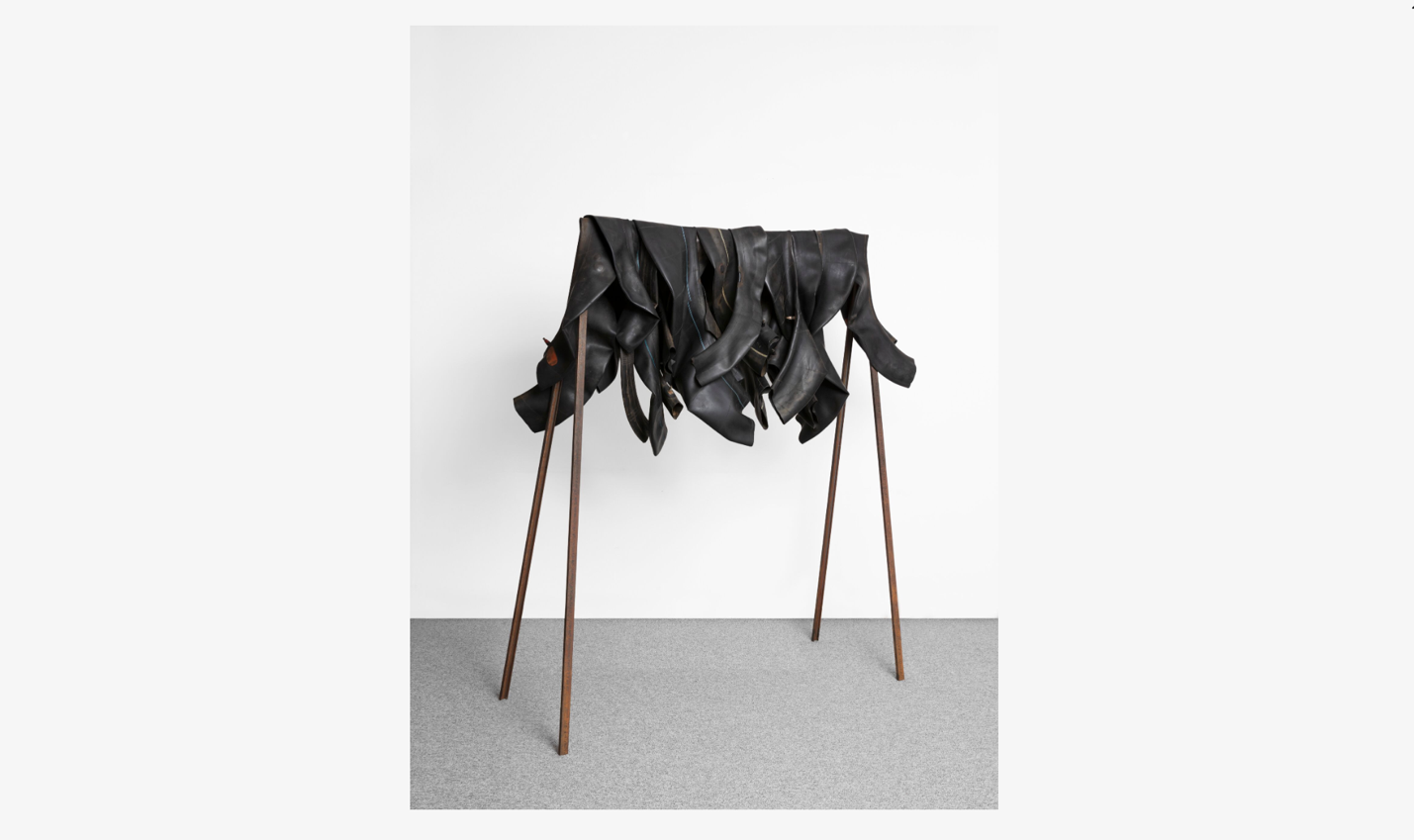

“Radical figure. Maverick. Ferociously Nonconformist. Censored.” The opening wall text at Hauser & Wirth introduces Carol Rama with some of these all too familiar words. They echo an infuriating pattern that has become predictable: an older, or deceased female artist finally receiving the institutional recognition she deserved all along. Present now, but somehow seemingly absent before. Rediscovered. Reframed. Reinserted into history.
Hauser & Wirth’s exhibition, the gallery’s first dedicated to her work, unfolds without a rigid chronology or singular thesis. Organized by Carlo Knoell, the exhibition presents work from six decades through a variety of materials, styles, and recurring obsessions under one roof. Desire. Autonomy. Car inner tubes. Found fabrics. Leather. Mail bags. Doll’s eyes embedded in painted surfaces. Stains. Sculpture. Bricolage. Drawings. Abstractions. Figuration. The explicit erotic imagery that gives way to formal abstract compositions. The exhibition resists flattening Rama’s work into a single plane of inquiry, revealing instead an artist rotating, sizzling, in constant movement and metamorphosis.
I first encountered Rama’s work a decade ago, and since then have followed her long incredible journey toward broader visibility. Where had she been? The answer, of course, is simple. She had been here all along. Experimenting seductively, passionately, and fiercely, under the suppressing eye, rejecting categorization.
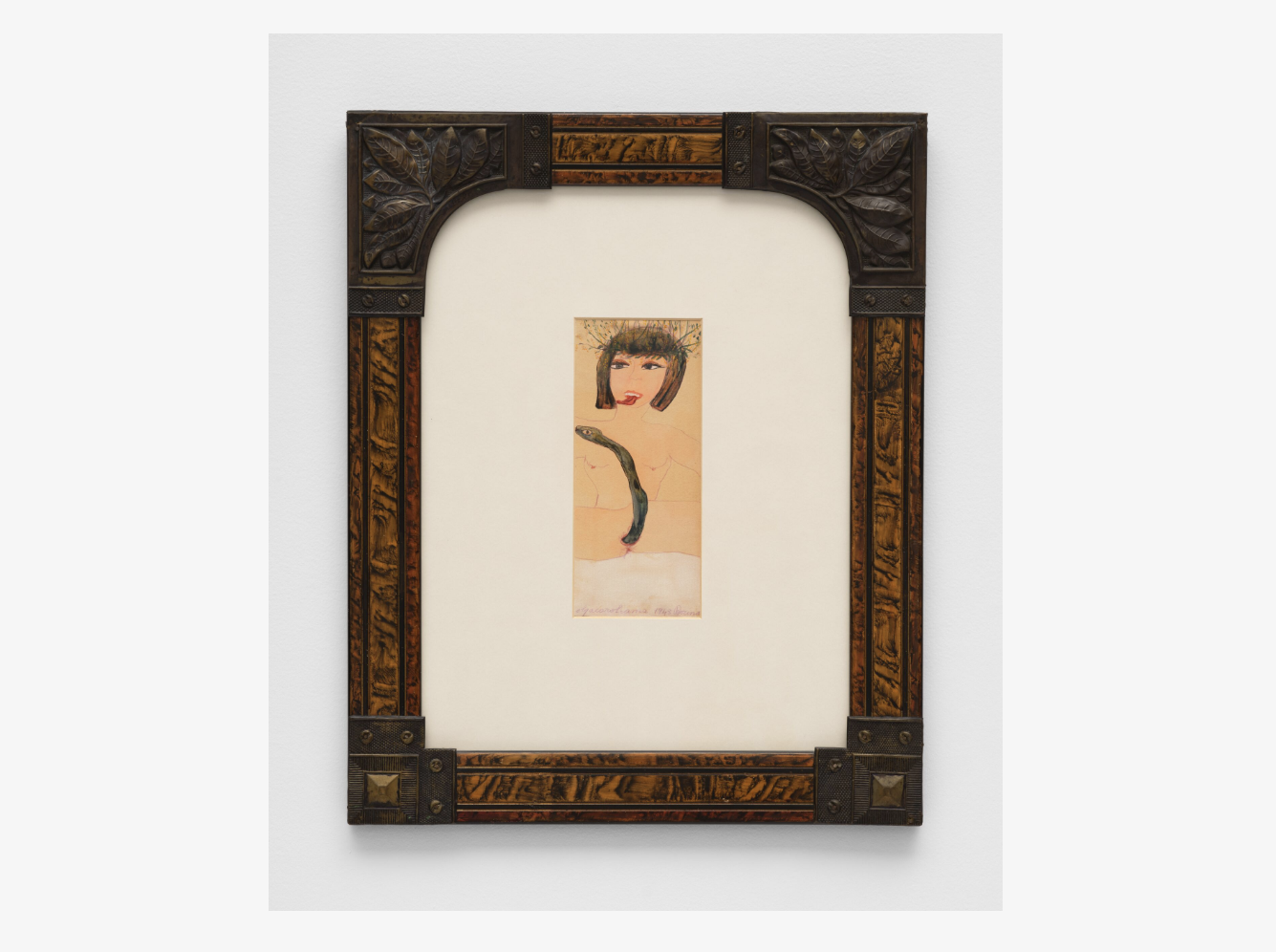
One of her drawings, included in the exhibition, Dorina (Appassionata) (1943) has remained with me for years: a snake in a loop of slipping into, or perhaps emerging from, a vagina. Upon research, this act seems to be a psychological phenomenon reccuring in dreams or, in an awake state, ophidicism, a sexual act in which a person inserts the tail of a snake or eel in their vagina or anus, deriving pleasure as it wriggles to get free.
The autoerotic image is unforgettable, simultaneously humorous, aware, unsettling, all too human and confrontational. Encased within a gorgeously ornate frame, the tension between delicate barely-there lines, soft-erotica pastel colors and provocation zooms into focus. The watercolor and tempera drawing on paper feels emblematic of Rama’s practice as a whole: not speaking loudly for the sake of shock, but intentionally and deliciously arousing, a jewel like cutting subversion in its precision.
There is a freshness to the works in the exhibition, a current urgency. Rama’s ferocious journey into sexuality, eros, the body, materiality, underbelly of madness, and desire feel prescient in our current troubled world. There is an openness to experimentation that feels increasingly rare, an insistence that art can be contradictory, unsettling, untamed at its core.
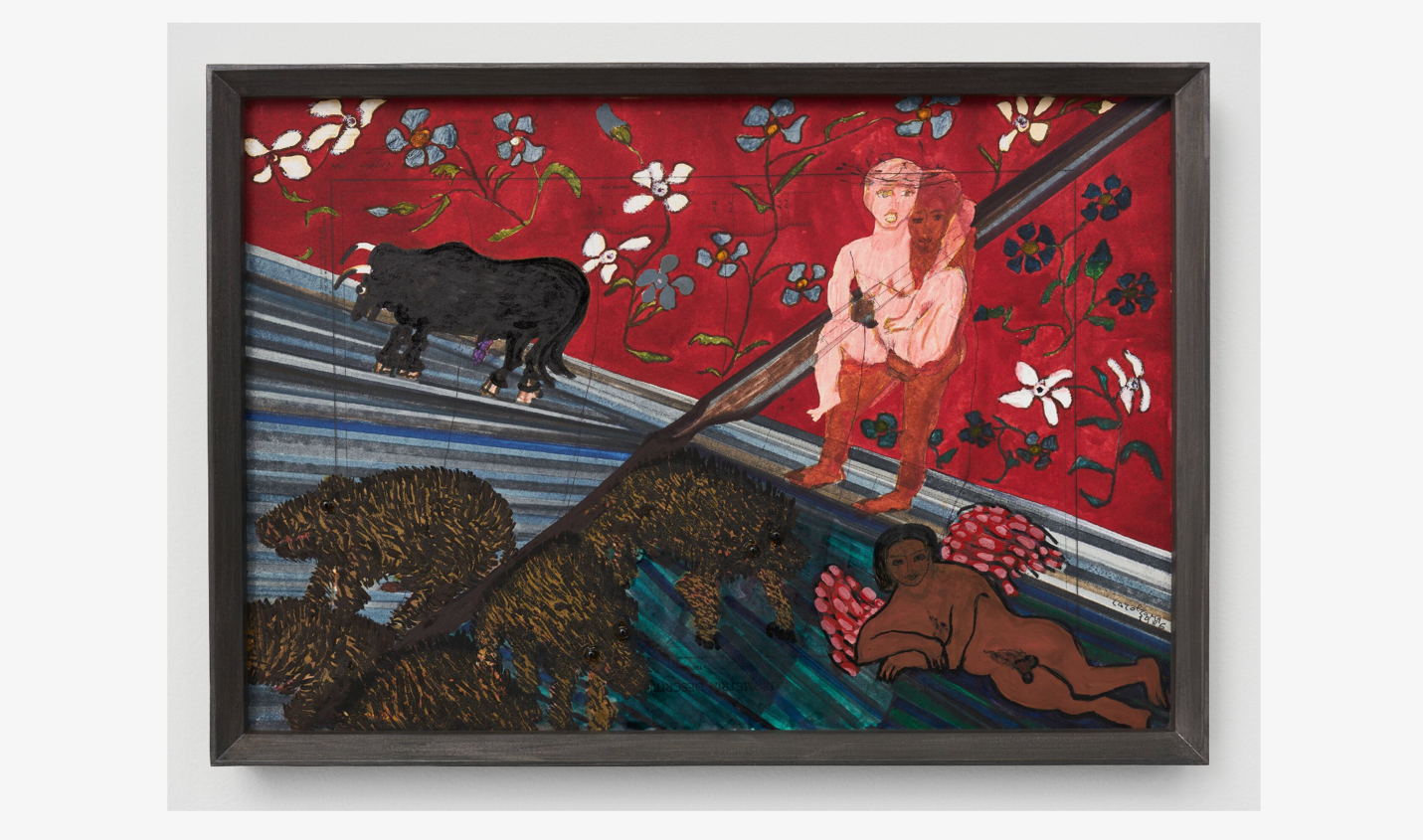
What strikes me most is the freedom with which she moved between visual languages. There is no anxiety about consistency, no pressure to maintain a recognizable signature, perhaps due to, or despite imposed censorship and exclusion. Each body of work feels driven by the time it was made in, events, internal and intentional exploration, and drive. Smears of paint coexist with meticulously drawn lines. Formal abstraction brushes against intimate interior encounters.
Themes of war and corporeal frailty stare back at us through glued eyes. Surfaces that imitate bodily fluid stains reveal an uncanny visceral attractive-repulsive authority. The gallery contains a clear evidence of an artist’s vicious curiosity, of her living boldly, probing the world, leading us gently into pleasurable, violent, and lustful avant-garde sides of us. I can’t get enough.
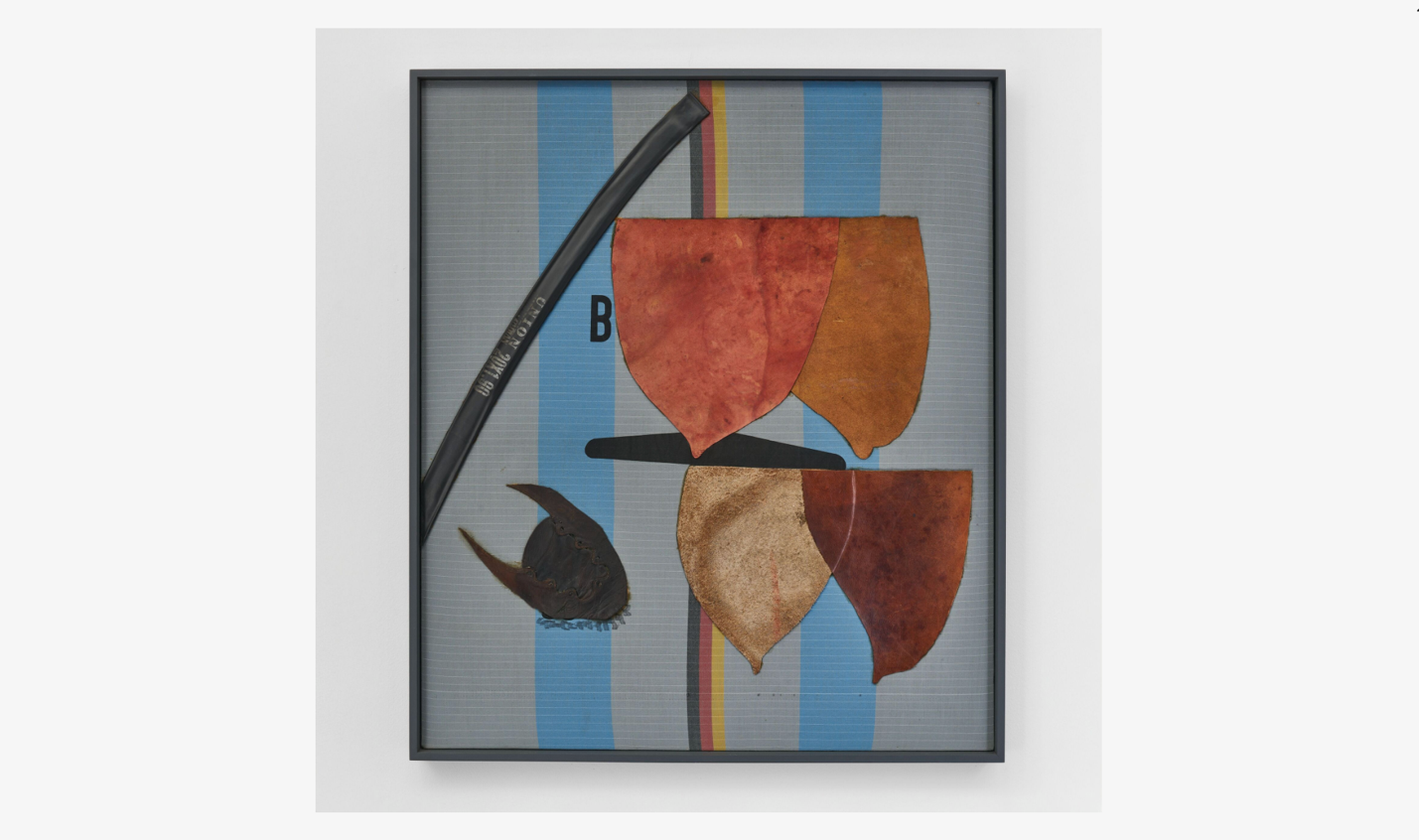
Reading about Rama, one quickly discovers that the self-taught artist was an influential figure and seemed to know “everyone.” Andy Warhol, Orson Welles, Man Ray, and Liza Minelli among them. Born in 1918 Turin, she lived for nearly a hundred years in the city. Making art prolifically since the 1940s. Her first exhibition in Turin at Galleria Faber in 1945 was closed by the police for obscenity; she continued to show at Italian museums and galleries, but also at the Venice Biennale—in 1949, 1950, 1952, and 1956, and in a solo show nearly four decades later, in 1993. She was awarded the prestigious Golden Lion for Lifetime Achievement in 2003. Sometimes her work reached European museums. And yet, somehow, she remained on the margins of the canon for much of her life, an artist whose contributions are acknowledged only after decades of neglect, becoming eventually our seer.
Steps on the path of “rediscovery” include The Passion According to Carol Rama, a retrospective co-organized by Museu d’Art Contemporani de Barcelona and Musée d’Art Moderne, which Paris run closed only a couple of months before her passing. The exhibition traveled to Finland, Dublin, as well as Turin. Carol Rama: Antibodies at New Museum, her first solo show in the United States, in 2017, curated by Massimiliano Gioni, who also included her in his edition of the Venice Biennale in 2013. Having truly arrived on the international scene, her estate is now represented by Hauser & Wirth and Galerie Isabella Bortolozzi in Berlin.
I am grateful to learn more about her work. Meeting her anew in every exhibition, rediscovering something unexpected, dunking my curiosity dipper into Rama’s world. Images lingering, sliding quietly into the subconscious with equal parts acidity and humor. I am craving more of these drawings. More of her unapologetic treatment of female sexuality that feels both intimate and political. Overall, more presentations and inclusions of women living daringly, creating rigorously, flying free in the face of conservative patriarchal society. Carol Rama, a favorite artist you might have never heard of. Meet her, see her now.
Carol Rama. I See You You See Me is on view through 31 July 2026 at Hauser & Wirth, 542 West 22nd Street, New York.
You Might Also Like
Tanja Ostojić’s Institutional Gendered Critique Through a Sculptural Lens
What's Your Reaction?