

When Anh Vo Biked Into the Hudson River

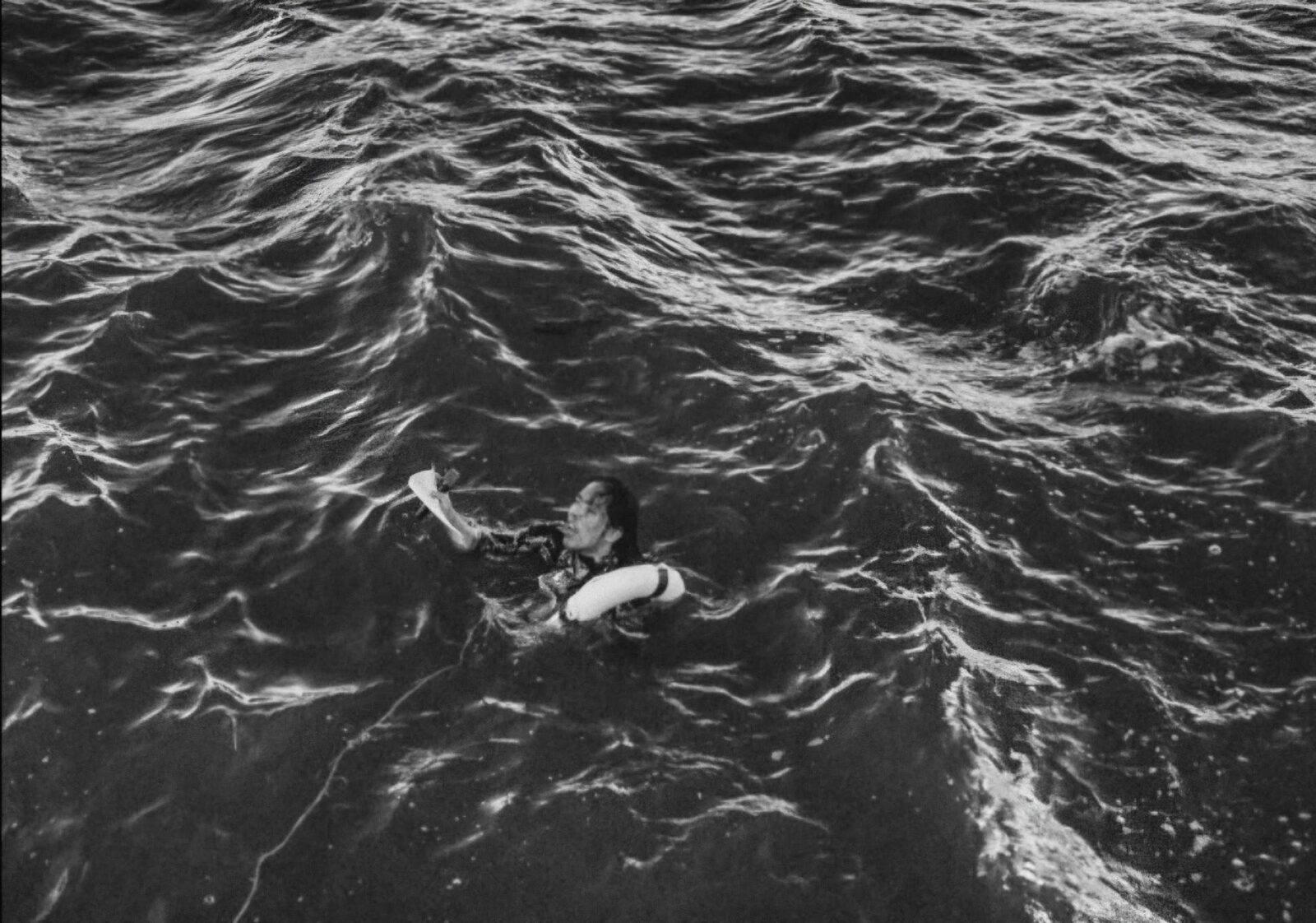

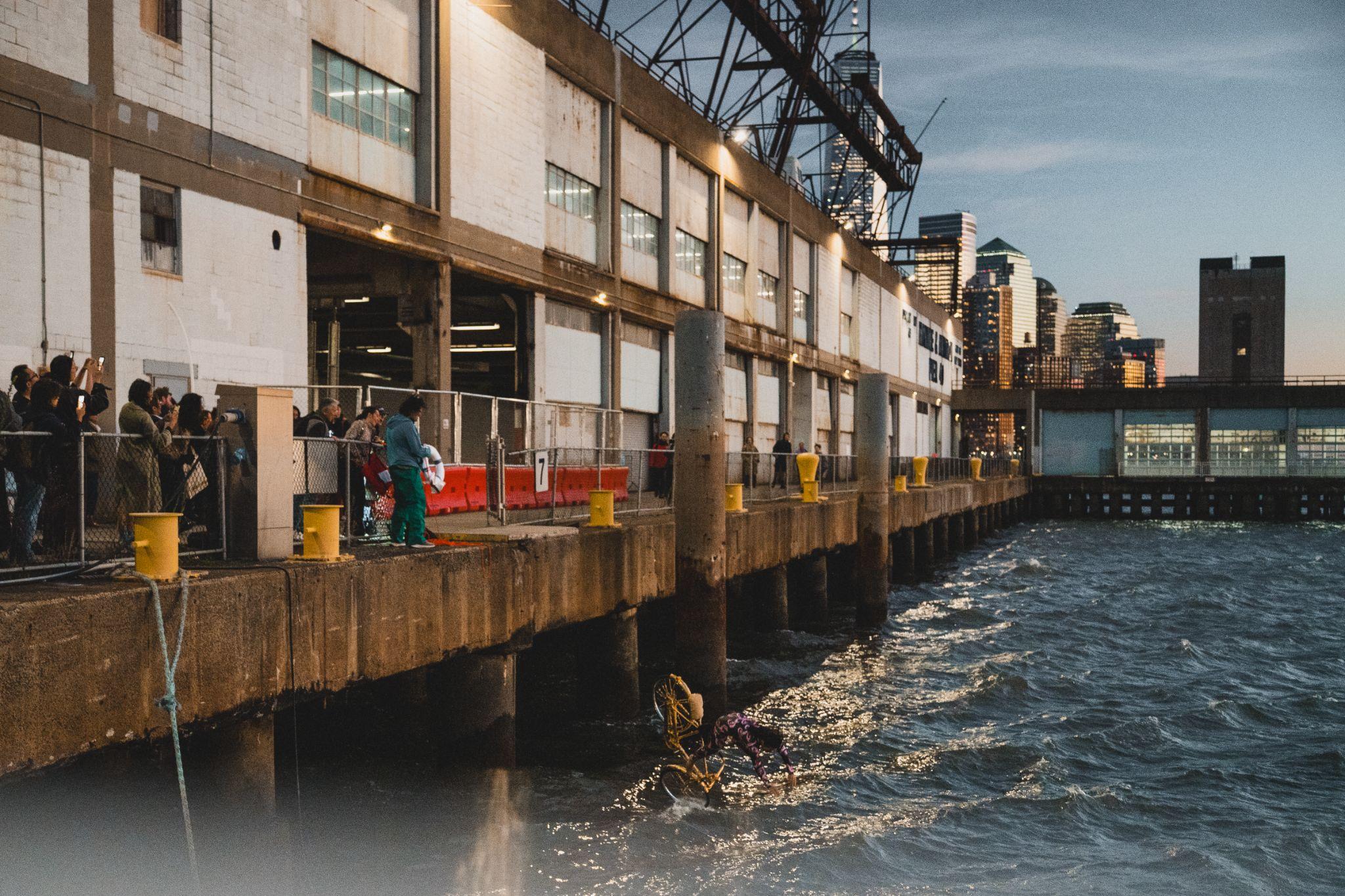
As a seventeen-year-old, I skinny-dipped in the Hudson River. I do not really remember what it felt like because I was completely plastered. It probably sucked: the water is polluted, often cold, and dangerous currents run through it. So, this fall, when I watched the performance artist Anh Vo ride a bike off a ten-foot-plus ledge on Pier 40 into the choppy waters of the Hudson River, I could only think about how absolutely hard-bodied it was.
At dusk before the artist’s descent, an expectant crowd lined the fenced, paved pathway along the Hudson River, heavily trafficked by cringey run clubs. The waves in front of the former marine terminal were tumultuous like the membrane of boiling water, thanks to the gusty autumn winds. The height of the fall, gnarly waves, and cold, wind-swept water created unease among the audience—a distinct tension that something could really go wrong. Titled Phoenix Forever, the performance was part of The Immigrant Artist Biennial: Identity Card, and began earlier in the evening as the artist biked down the West Side Highway with a musician riding on the back of Vo’s bicycle.
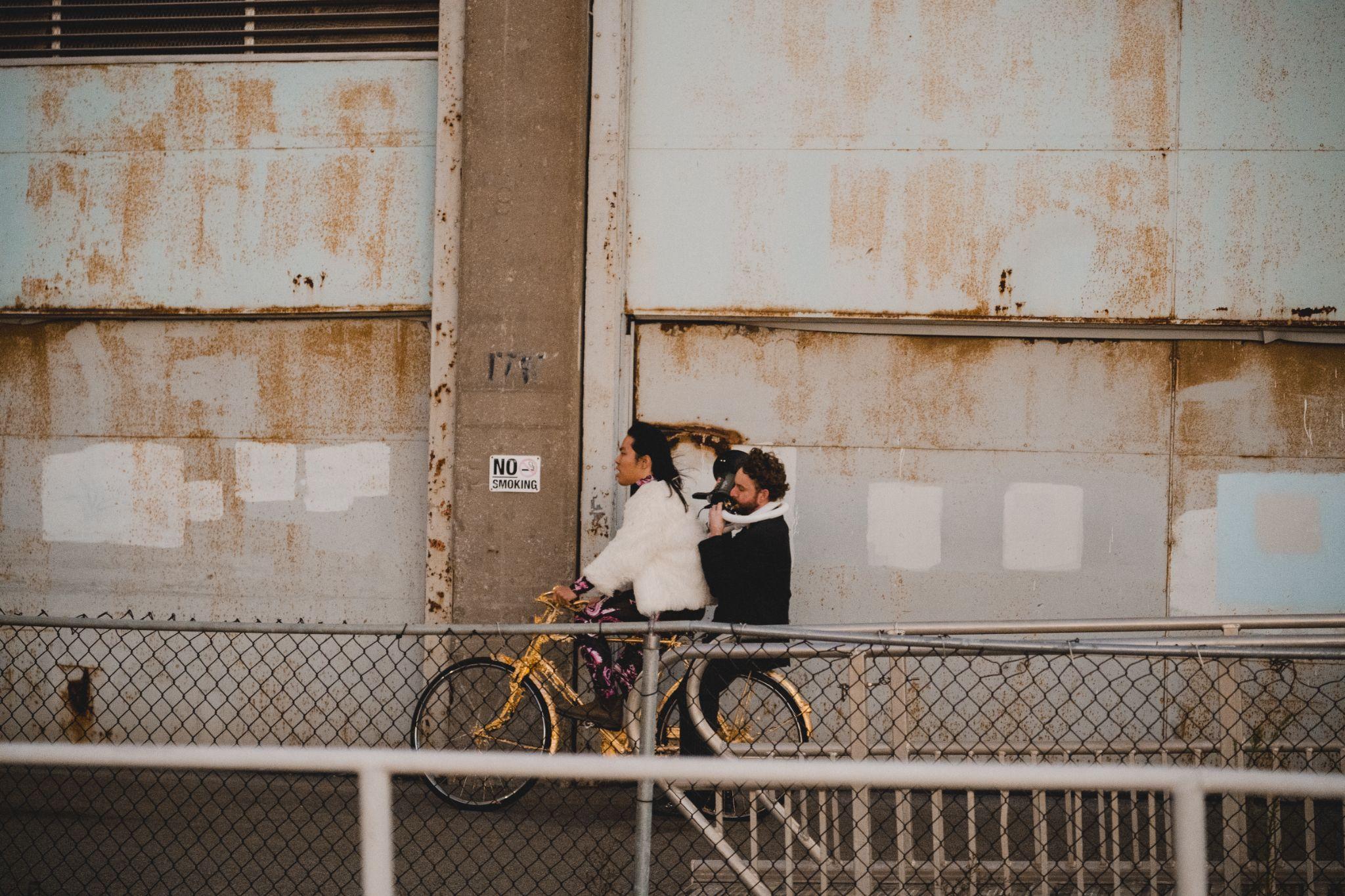
As the organizers learned of Vo’s imminent arrival, they undid two gates in the pier’s fence, opening an unguarded space to the river off the ledge. This was really happening. The artist arrived on a gold-gilded bicycle whose gold leaves looked particularly wonderful as they billowed in the wind. Musician Erinn Buhyoff sat on the back of Vo’s bicycle, blowing into a corrugated bilge pump hose turned into an instrument that made siren-like sounds. After Buhyoff got off, he kept playing, spinning the tube around in a way that seemed inconsequential as Vo, the real star of the show, rode up and down the pier. The artist took a moment to drop off their frilly white coat and shoes, now only wearing a purple bodysuit with dragons on it. Vo rode south down the pier one last time before coming back for the plummet. Although I stood in front of the open gate, the crowd made it hard to see Vo’s approach, heightening anticipation. Before I knew it, the artist rushed by in a flash of purple-gold, and I caught only the last splash as I rushed to the edge of the pier, savoring the moment’s jolting suddenness.
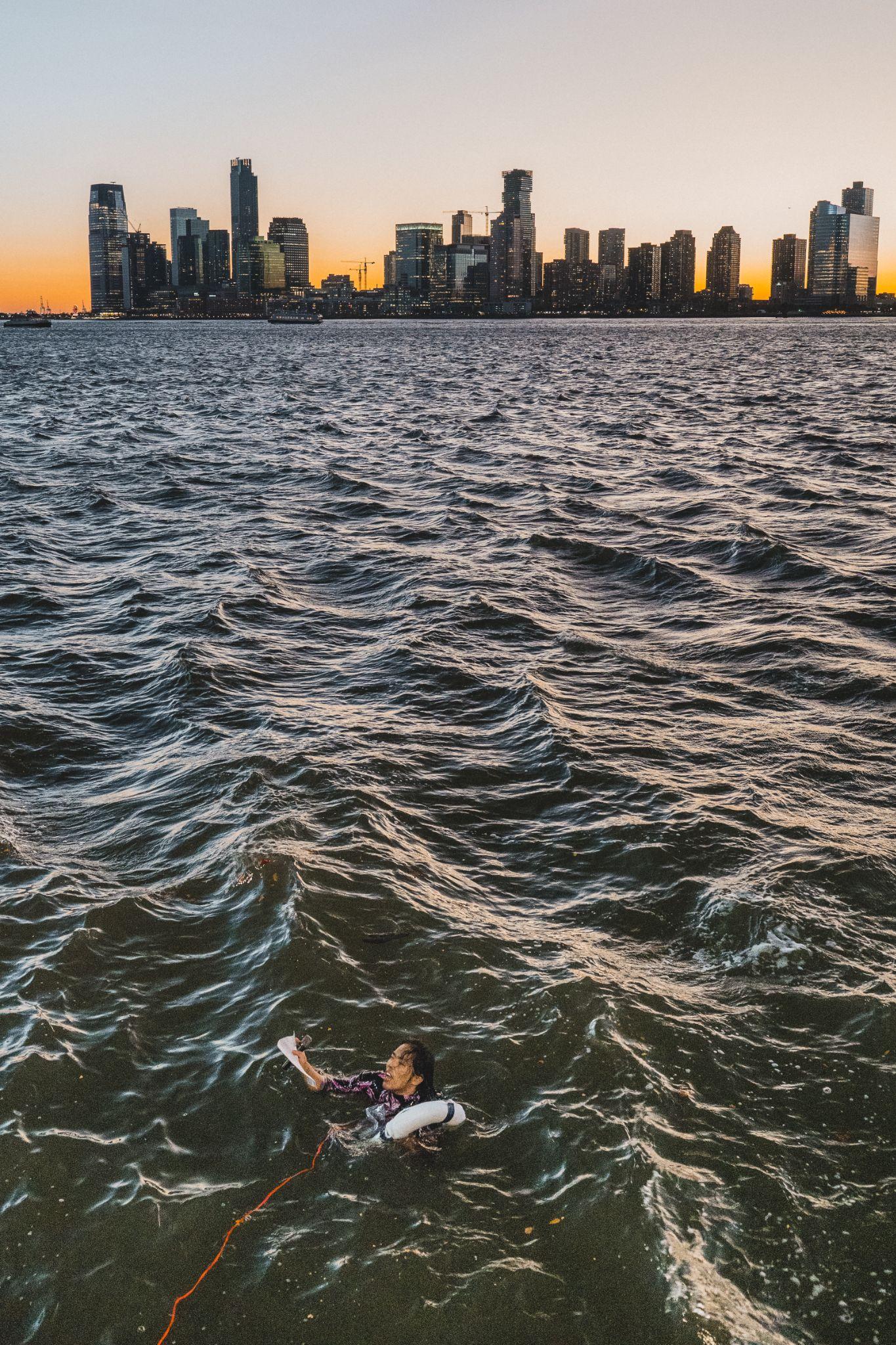
With a life ring thrown out to steady them, Vo delivered a monologue. I understood that the opening connected the Red River to Vo’s hometown of Hanoi, Vietnam, and the Hudson River in New York, later, after accessing the transcript, I learned that Vo was referencing a performance by interdisciplinary artist Vũ Đức Toàn, who rode a bike into the Red River. Both Vo and Toàn used Chinese Phoenix-brand bicycles, which gives the piece its title. Despite the similarities, Vo made it clear in their monologue that the work was not a re-doing, re-performance, or re-enactment; they asserted that their performance was a doing, performance, and translation.
I agreed. The relationship between Toàn and Vo connects present conditions and the artists’ commonalities, along with what distinguishes them—Toàn living and working in Hanoi, while Vo immigrated and works in the United States. It was not a cheap harkening or derivative.
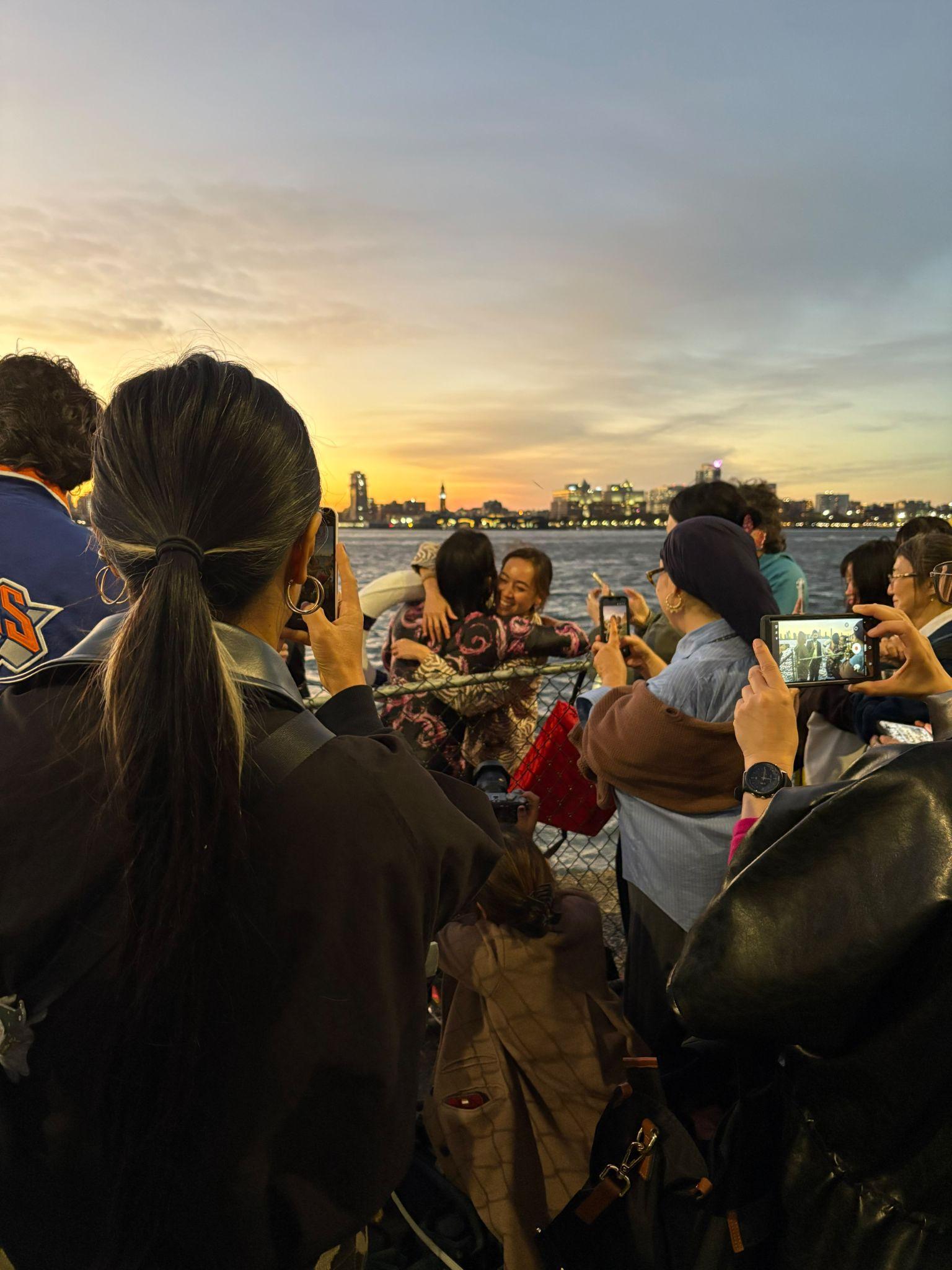
While it was difficult to take it all in with the competing sounds, the passing wind, smacking waves, and audience reactions, it did not change the fact that Vo read these words aloud and dived into dangerous waters. If anything, the distance between the artist and their audience, and any unintelligibility created by the environment, elevated their work and made the piece’s motivations feel so authentically rooted in the self. The act was more important than our exact understanding. It did not matter if I could not make out everything said, because it was said. The reading, the action, and Vo’s tenacity could not be taken away.
In their own words, a sentence I keep running through, “a translation has to transcend the two [subjects], bypassing the logic of equivalence, which stabilizes the one with the other.” This could reflect the ambivalent phenomenon of translating cultural difference or assimilating into a new one—the difficulty, and even impossibility, of a one-to-one translation between Vietnam and the United States in these two performances. Perhaps the translation stabilizes, or it does not? (A bit of both?) I am inclined to believe the latter. By the end of the performance, with the artist safely climbing up a rope ladder, Vo had convinced me to contemplate their multivalent performance, persuasive in their form, treading water that very few of us would dare.
Phoenix Forever was presented as part of The Immigrant Artist Biennial: Identity Card on October 30, 2026. The biennial’s last two events will take place on November 7 at BRIC and November 11 at Shiva Gallery. Reserve your tickets here.
You Might Also Like’
A Variety Show Demanding Balls Fly at Center for Performance Research
What's Your Reaction?
