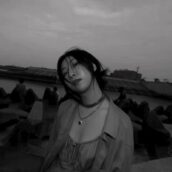
In 心esthesia East Asian Ideals are Felt


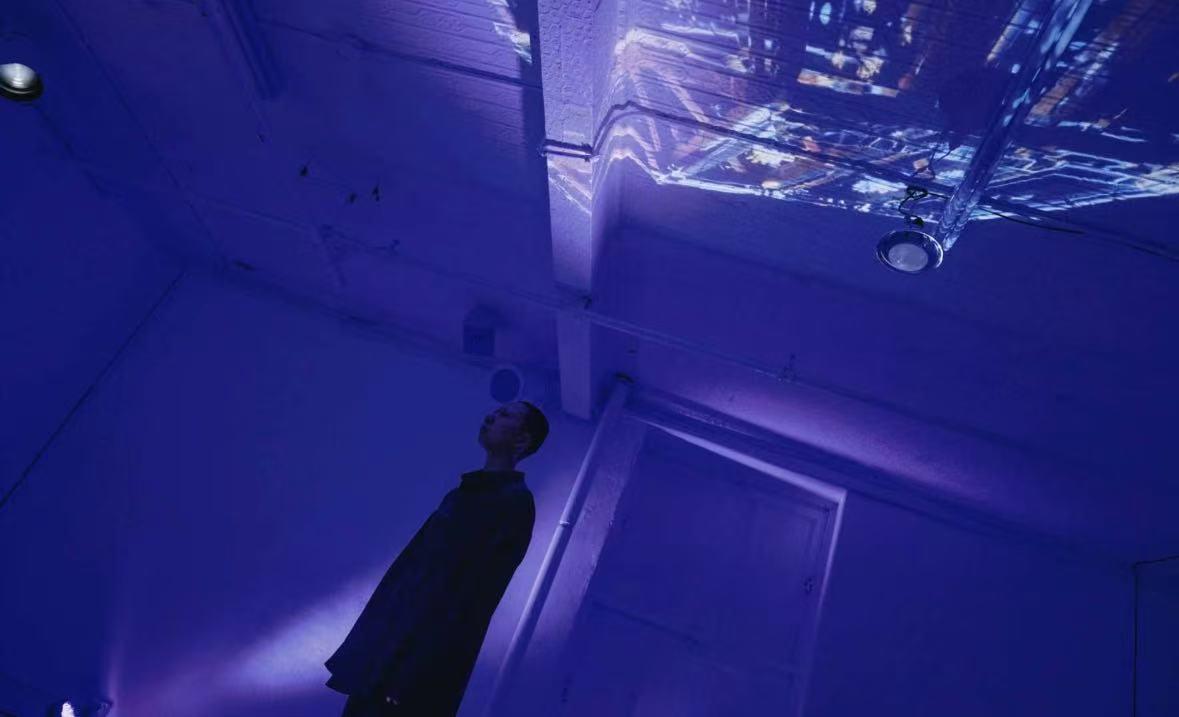
When the elevator doors opened onto the narrow hallway of Theaterlab, I was greeted not by a program but a ritual. The playbill for 心esthesia arrived as a foldable palm booklet — intimate, instructional — offering breathing exercises that eased the audience into a performative dreamscape before a single gesture had been made onstage. There was something quietly ceremonial about this entry, reminiscent of the preparatory rites embedded in many East Asian performance traditions — the stillness before a Noh actor crosses the hashigakari, or the incense that precedes a Butoh rehearsal — where the threshold between ordinary life and heightened presence is never crossed carelessly.
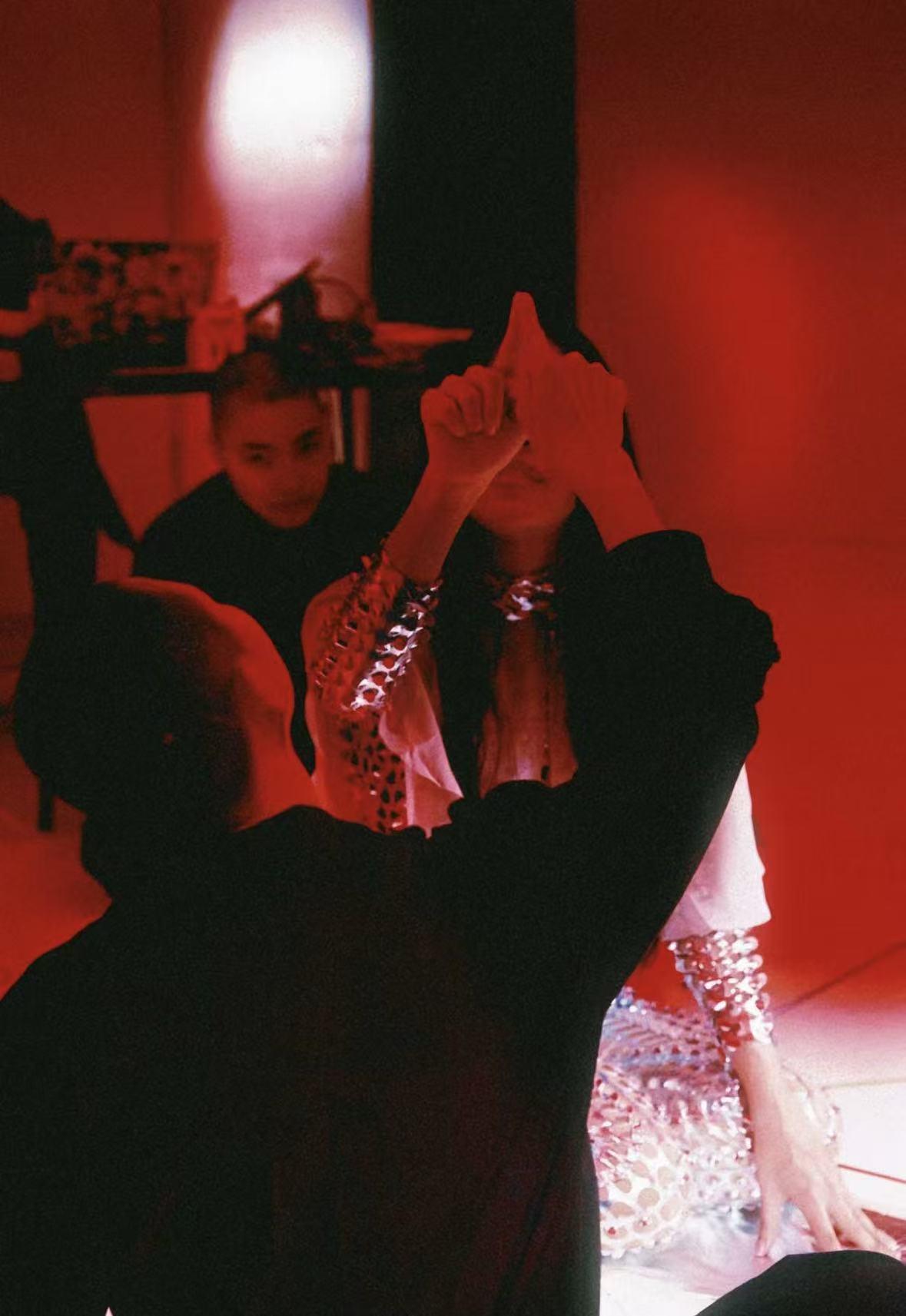
Inside, the first room was furnished with cushions and an assortment of tactile instruments: ring bells, bongs, plastic buttons, and a pair of forks that, when held with both hands, completed a bodily circuit and released sound. Creative technologist Brian Ellis performed improvisational vocals nearby, generating invisible architectures from air and vibration. His presence reframed sound not as accompaniment but as primary material — a logic not unlike the classical Chinese understanding of 氣 (qì), in which breath and energy are not metaphors for life but its actual substance. Even before the performance officially began, its central argument had already taken shape: that sensation is a trained act, one that can be simultaneously playful and political.
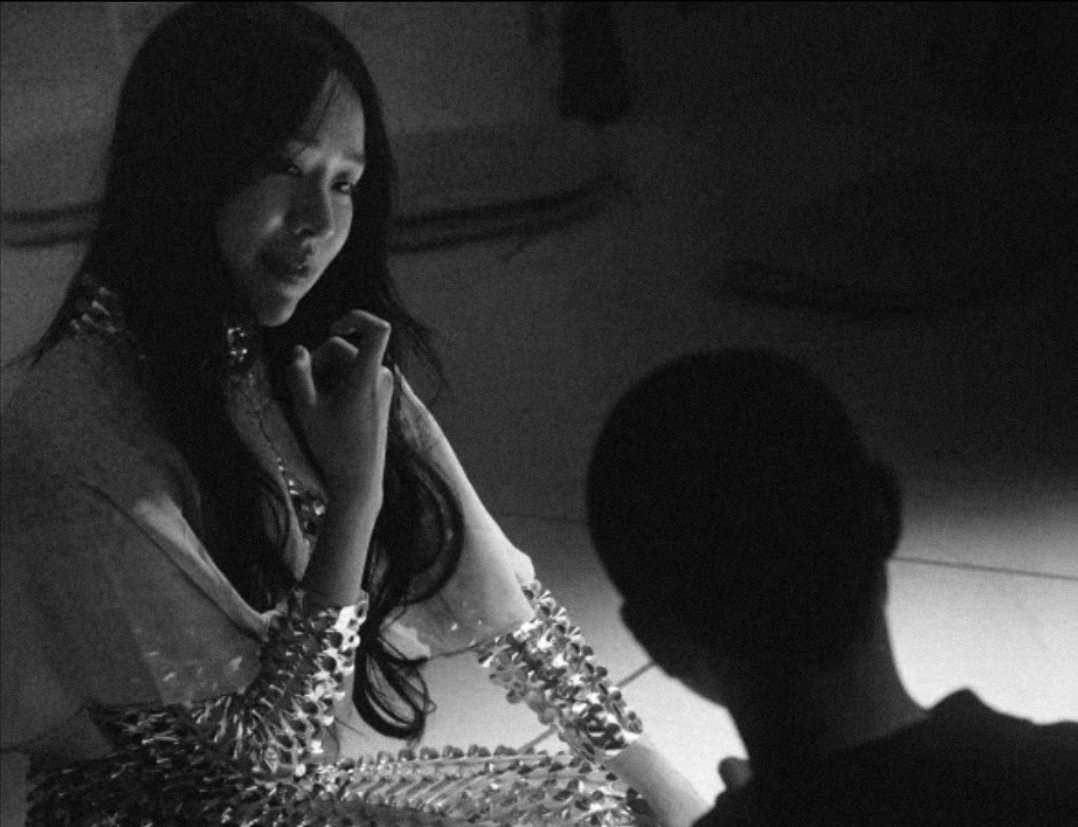
The performance moves through several chapters structured around three figures: the Dreammaster (Claire Zheng Wu), the Dreamer (Frankie/Bingxin Yu), and the Friend (Shannon Yu). Each inhabits their role through movement and expression alone. The triadic structure itself quietly evokes a lineage of East Asian narrative archetypes—the guide, the initiate, the witness—figures that recur from Tang dynasty dream literature to contemporary wuxia, always negotiating the boundary between the real and the conjured. Claire Zheng Wu’s Dreammaster arrives in a futuristic silver bodysuit, playfully tearing rose petals that register as physical hurt on the Dreamer, flipping the cube to transition between dream states. Even within a dream, she seems to say, pain can be designed and imposed—a meditation on control that feels urgently contemporary for diasporic communities navigating systems not built to hold them.
Director Tianding He developed the script in close dialogue with a deaf performer, a collaboration that fundamentally restructured how meaning is made in this work. In the absence of spoken language, interaction was cultivated through narrative ambivalence, corporeal response, and physical formulas. This commitment to embodied “uncertainty” extended to the stage design: no elevated platform, only strips of duct tape on the floor demarcating a probable stage. The gesture is sophisticated in its unease. As performers moved in hypnotic patterns within these fragile borders, one remained acutely aware that those lines could be crossed — that the distinction between viewer and participant was, at any moment, negotiable.
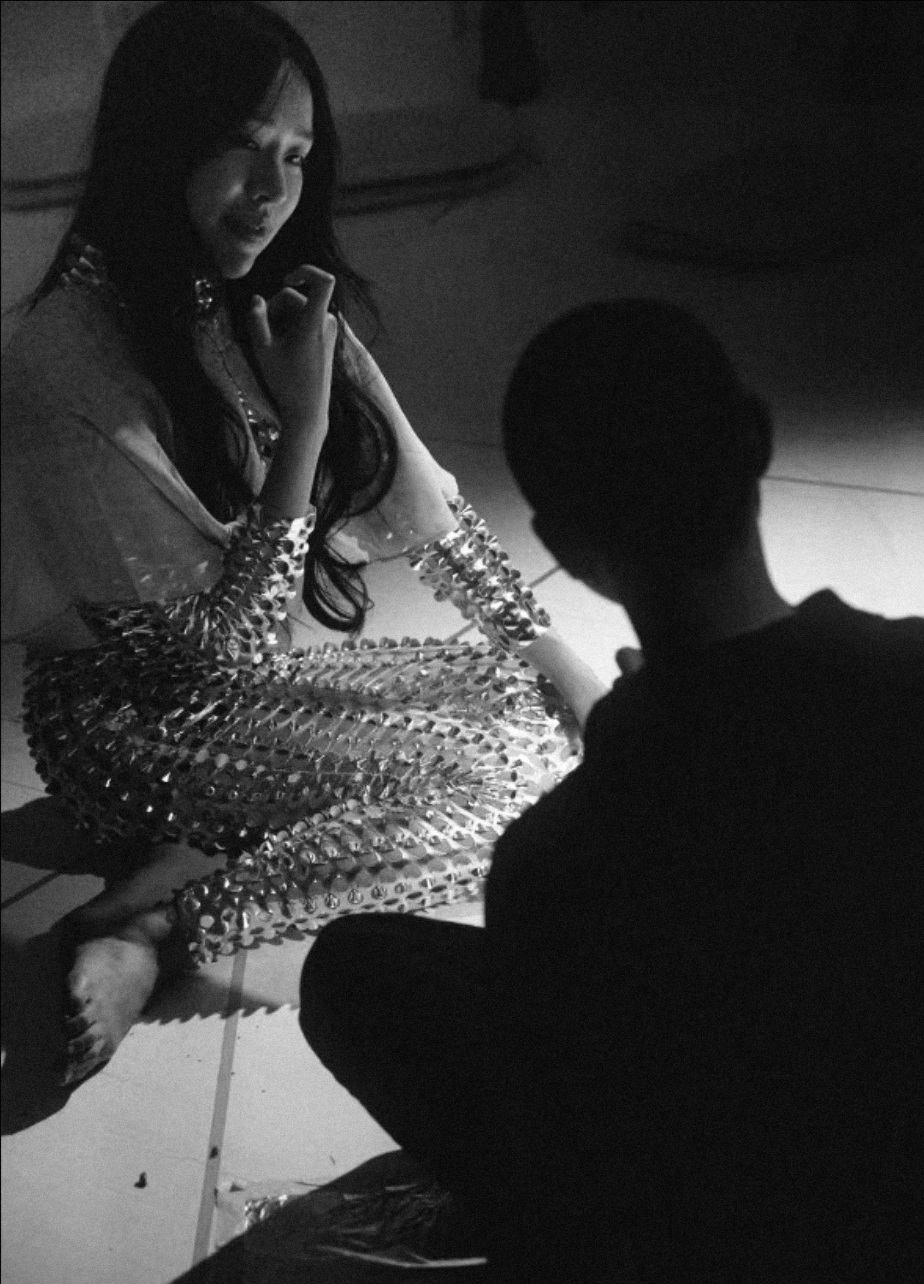
In classical Chinese aesthetics, the concept of 留白 (liúbái) — literally “留 to leave, 白 white” — describes the deliberate use of empty space in painting and poetry not as absence but as meaning-bearing void. 心esthesia operates with a similar philosophy: what is withheld, unresolved, or unnamed becomes as generative as what is presented.
Each collaborator approached this thesis through a distinct but unified lens. Sound artist Xuanqi built the majority of the tactile props, among them a magic cube embedded with motion sensors that trigger audio when slid or shaken, and a row of potted plants that conduct electricity through human skin, emitting crisp tones at the touch. These objects occupy a space between tool and talisman, recalling the tactile logic of traditional East Asian medicine, where the body is understood as a network of conductive pathways, and touch is never merely contact but communication. While real-time visuals in TouchDesigner—particle flows, geometric forms, noise textures—designed by media artist Maya Li directly triggered visual shifts. In its layering of sensation and code, her work felt reminiscent of ink diffusing through water, a process that is simultaneously controlled and surrendered to.
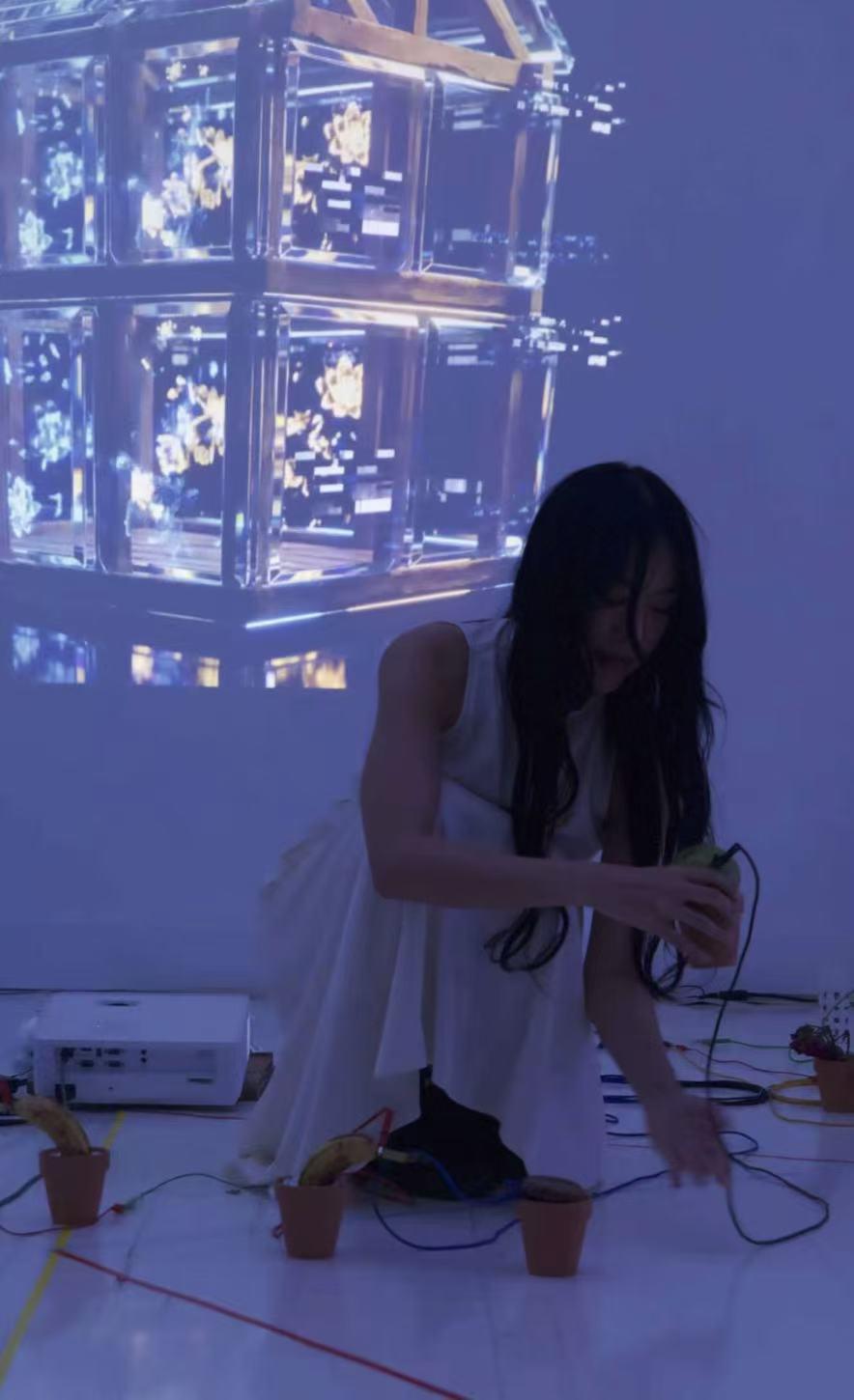
What 心esthesia ultimately stages is a recalibration of attention—an argument that our so-called default feelings are often politically conditioned habits rather than raw human instinct, and that the capacity to feel is itself a right, a site of power. This is a thesis with particular stakes for Asian and Asian American artists working in experimental performance, a field that has historically marginalized non-Western sensory frameworks and expressive vocabularies. To insist, as this production does, that embodied knowledge is legitimate knowledge—that a conducted charge through a plant or a held breath in a darkened room constitutes genuine inquiry—is both an aesthetic and a political act.
The Chinese character at the heart of the title, 心, meaning heart or mind, refuses the Western tendency to treat cognition and emotion as separate territories. Smell becomes a stamp and a sound anchors memory. In classical Chinese thought, 心 is the organ of both feeling and knowing—it is where perception and understanding are not divided but unified. The production, in its very name, announces this epistemological stance: that to sense is already to think. It grants the audience agency over their own sensorial realities while allowing personal experience to become legible as shared truth—something that resonates especially for audiences whose interiority has so often been rendered illegible, exotic, or silent in dominant cultural spaces. In an artistic landscape still learning to hold multiplicity, this production offers something rare: a framework in which difference is not explained but felt, and feeling, as it turns out, is more than enough.
心esthesia was co-created by Tianding He, Xuanqi Liu, and Brian Ellis and directed by Tianding He and ran between March 26 – March 27 at Theaterlab, New York. Thank you to Amy Wu for supporting the editing this piece.
What's Your Reaction?