
‘Pillow Princess’ Tackles Desire and Refusal


At 5-50 Gallery, Pillow Princess sets itself up with a loaded premise, and doesn’t collapse under its weight. The title, borrowed from a term often used to trivialize or eroticize passivity, is here reworked as a provocation: what if refusal, softness, or self-prioritization were not deficits, but strategies? What unfolds across the work of Debra Pearlman, Alexandria Deters, and Kristin O’Connor is a triangulation of positions around desire, shame, and the politics of being seen.
What emerges is a constellation of perspectives that move fluidly between interiority and representation, vulnerability and control. The exhibition’s strength lies in this multiplicity: it resists flattening its subject, instead offering three distinct yet complementary approaches to how desire is formed, negotiated, and expressed.
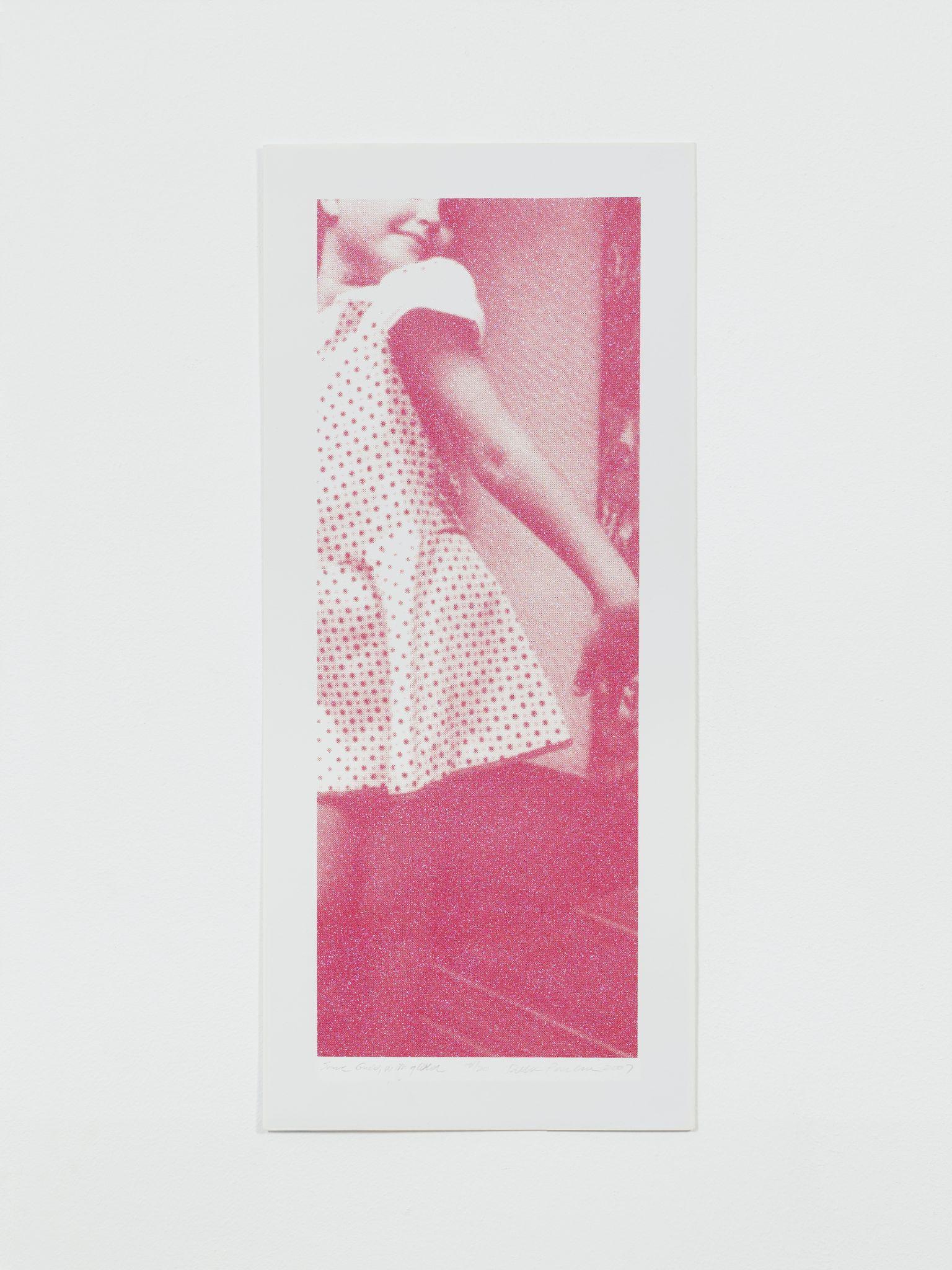
Debra Pearlman’s contribution is among the most formally resolved, translating candid photographs of young girls into materially assertive, tactile surfaces. In these works, the act of looking becomes inseparable from the conditions of reception. Her depictions of prepubescent figures, often with faces cropped or obscured, register as audacious, even precarious. Yet what emerges through sustained engagement is not provocation for its own sake, but a disarming sensitivity: scenes of girls mid-gesture, mid-performance, mid-becoming that unfold as intimate documents of girlhood once the reflexive suspicion of the gaze is momentarily set aside.
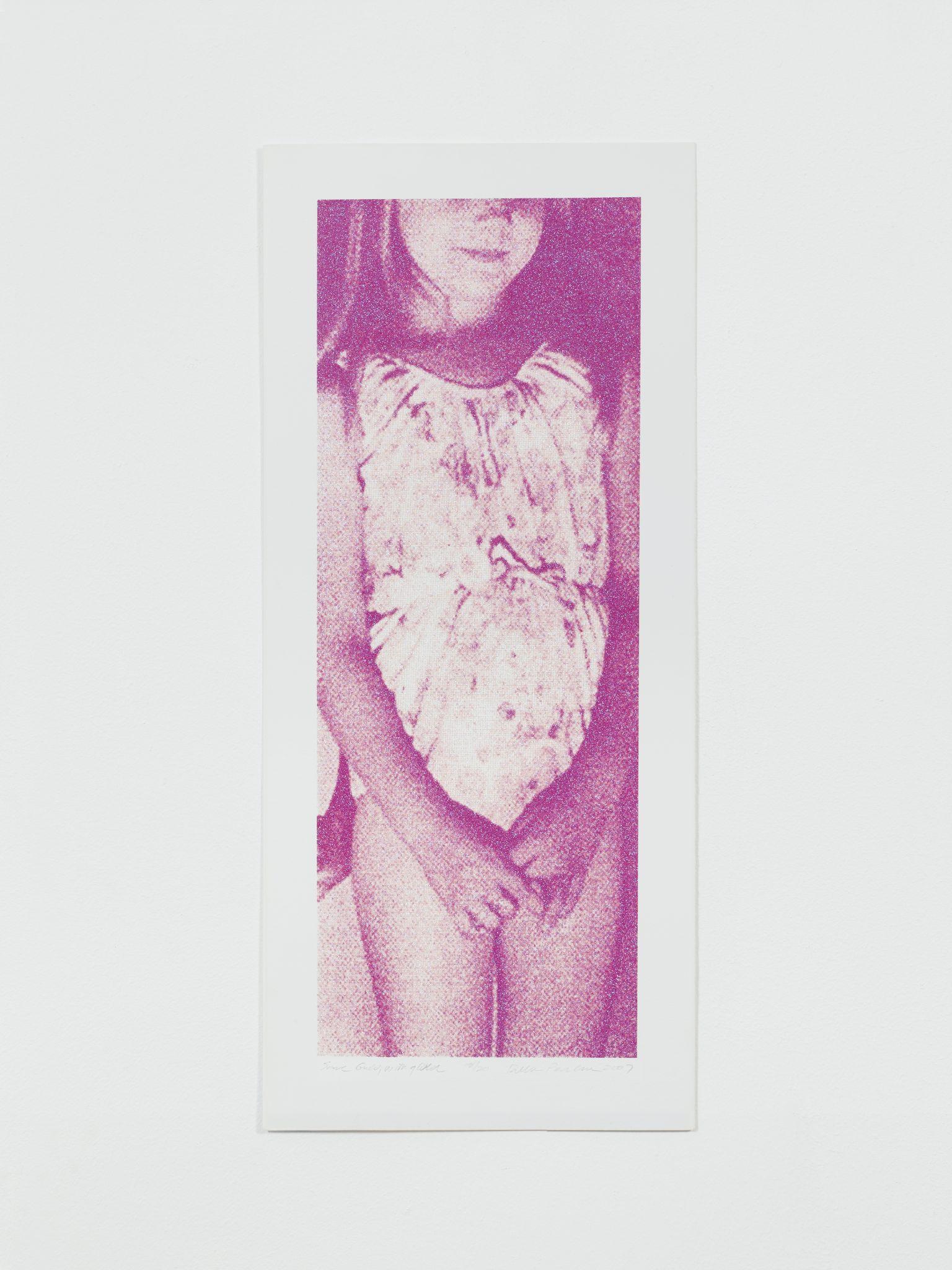
This tension is materially reinforced through Pearlman’s use of crushed glass and magma, which partially occlude the image while fracturing light across its surface. These interventions resist passive consumption, introducing both visual interruption and a subtle sense of threat. The resulting “caul”-like layer operates simultaneously as shield and obstruction, protecting the subjects while implicating the viewer’s desire to see. Rather than resolving the ethical complexities it invokes, the work sustains them, producing a charged space in which looking is made conscious, contingent, and newly accountable.

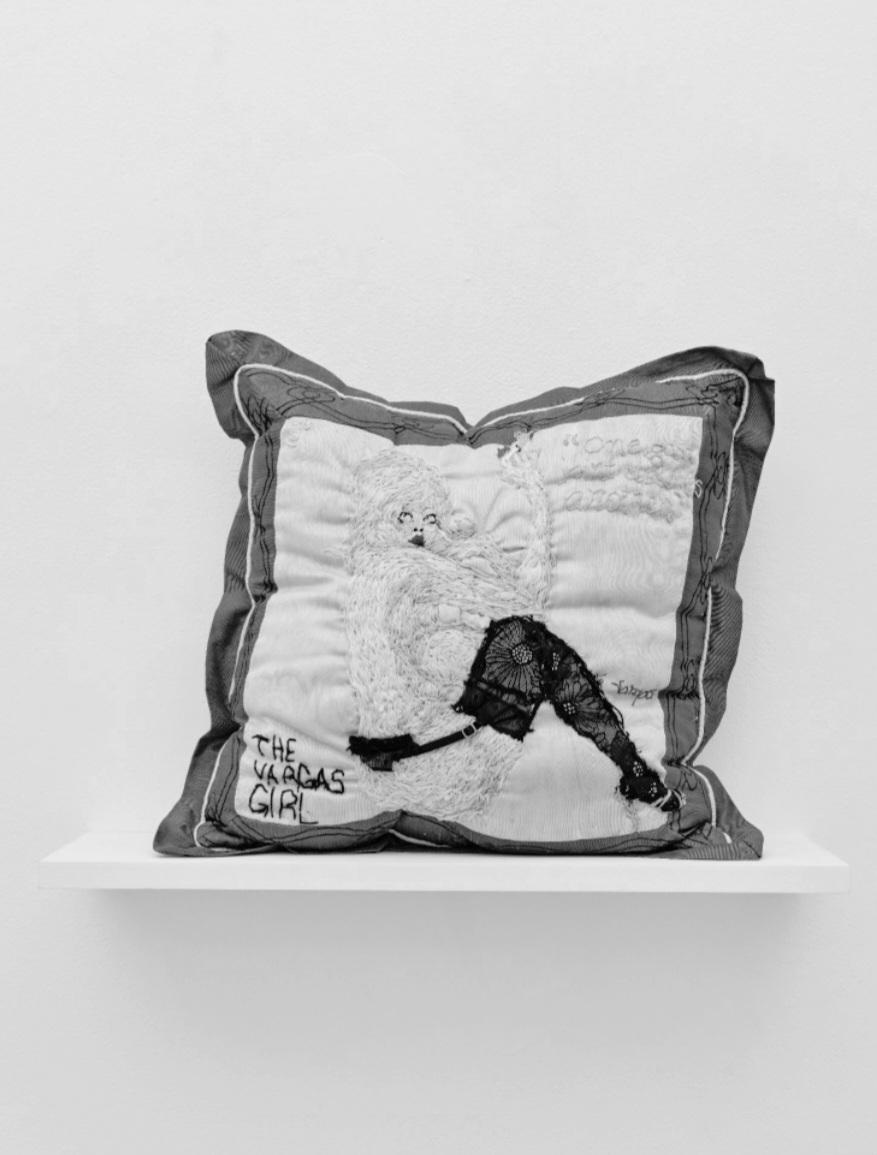
If Pearlman’s work is about the contested terrain of girlhood, Deters operates in the aftermath. Her R.R.R. (Rebirth, Revivification, Revival) series is explicitly cyclical, grounded in the repetitive labor of self-reconstruction following emotional rupture. However, her works do unfold across multiple, interrelated series, in which photography operates as an entry point rather than a terminus. While the staged images establish an affective framework, it is in the embroidered works, particularly those executed on garments and domestic textiles such as pillows, that the practice acquires its most incisive form. Here, scenes of bound and gagged female figures are rendered with an exactitude that initially disorients the viewer, given the softness and familiarity of their supports. This calculated disjunction functions as a form of misdirection, drawing the viewer into a space where comfort and violence coexist. Deters’ reference to mid-century visual culture, including the figure of ‘Sweet Gwendoline,’ a female comic serial character depicted in erotic bondage scenes as developed by John Willie, situates the work within a longer history of fetish imagery, while her reframing of publications such as Playboy as sites that paradoxically made space for women’s testimonies of abuse introduces a more ambivalent reading of the work. Within this context, her works can be understood as acts of reclamation that neither fully reject nor passively reproduce their sources, but instead rework them through the lens of lived experience, particularly the artist’s own history of abusive relationships.
If Deters’ work navigates aftermath and reconstruction, Kristin O’Connor turns to inherited belief systems as a site of psychological containment and distortion. In Legion, drawn from the account in the Gospel of Mark (5:1–20), the figure of demonic possession is used to articulate a dispersed subjectivity—“for we are many”—that resists singular moral categorization. Elsewhere, She Wept invokes the compositional logic of the Pietà to expose the fragility of its narrative transmission within evangelical culture. Across these works, O’Connor does not critique inherited religious iconography but exposes its internal contradictions, revealing how desire, violence, and sanctity are co-constitutive rather than oppositional within these visual and narrative systems.
There is something claustrophobic about these compositions. The two-dimensionality is both formal and psychological. These are worlds where the rules are already written, where deviation is immediately legible as transgression. O’Connor’s strength lies in her ability to make that inherited visual language feel suffocating without rejecting it. Instead, she inhabits it, distorts it, and exposes its internal contradictions.

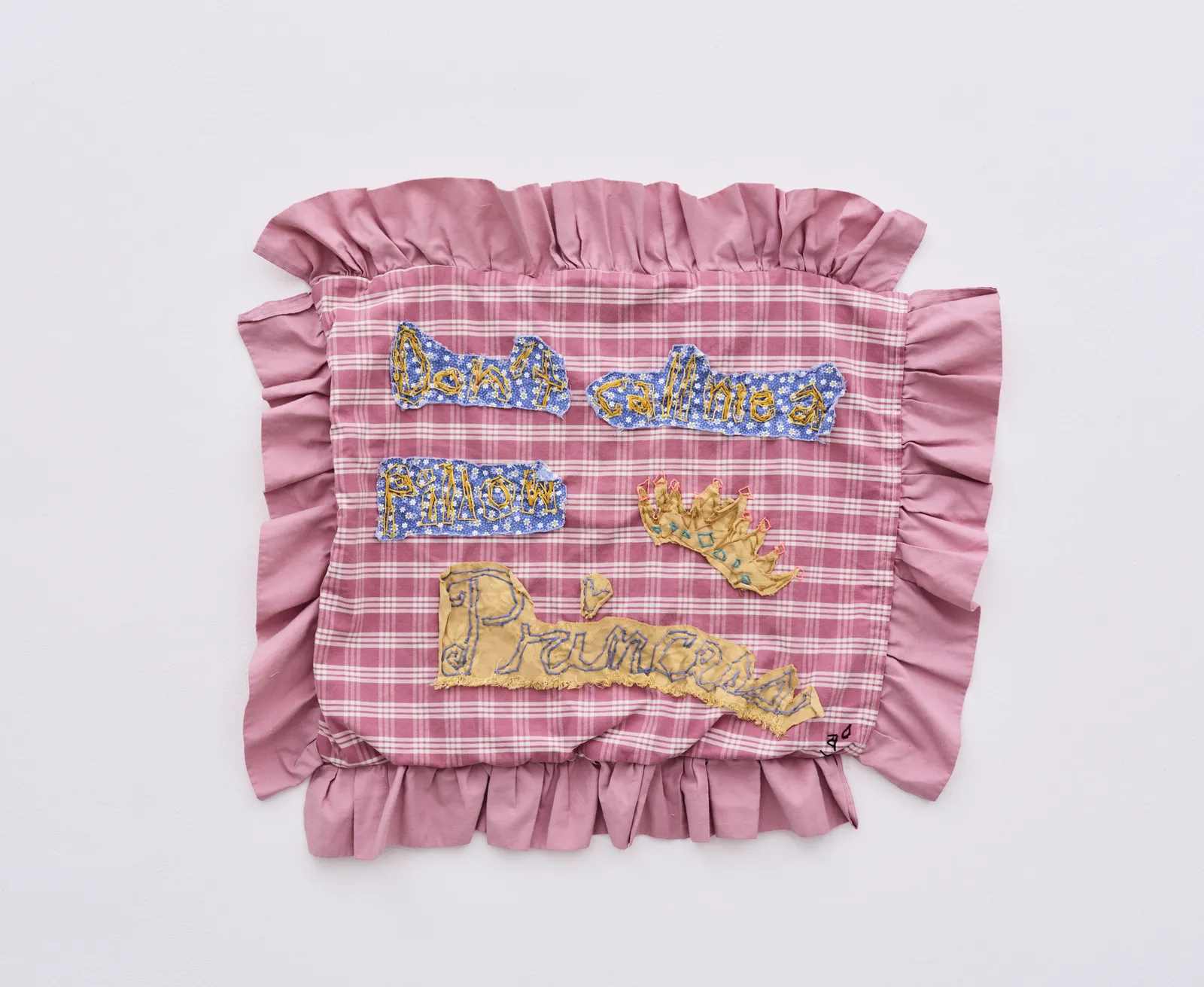
Taken together, the exhibition may seem uneven, but not incoherent. The artists are not in perfect dialogue with one another, and that’s arguably a strength. Instead of a seamless curatorial narrative, Pillow Princess offers three distinct registers: the formation of the self (Pearlman), its fragmentation and reassembly (Deters), and its ideological conditioning (O’Connor). Despite the title “Pillow princess”, a term loaded with cultural baggage, the most compelling moments here are not about passivity, but about resistance to being defined externally. In that sense, the exhibition is less about lying down than it is about refusing to perform. Refusing clarity, accessibility, refusing the demand to be legible on someone else’s terms, and that refusal– uneven, incomplete, but persistent, is what ultimately gives Pillow Princess its edge.
Pillow Princess is curated by Bailey Coleman and features Debra Pearlman, Alexandria Deters, and Kristin O’Connor is on view at 5-50 Gallery, 5-50 51st Ave, Long Island City, NY 11101, through May 17, 2026.
You Might Also Like
Who Are Your Filth Elders? A Discussion with Emily Colucci and Alexandria Deters
Femme Reigns Supreme in “The Ecstasy of Saint Britney” at Ceysson & Bénétière
What's Your Reaction?