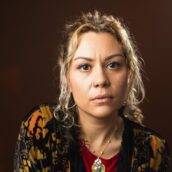
Beneath the Rind: “What We Carry” at The Immigrant Artist Biennial


Outside the building where I grew up, in Brasília, a slope ran down to the row of shops where I used to buy agar candy. Back then, it seemed enormous and steep. You could take the stairs or choose my favorite option: flatten a cardboard box and slide down the grass. It was our tropical-country sled in the ’90s. Boxes were not as plentiful as they are today. They came from a move, a new refrigerator, something big that had just arrived. In a way, they were children’s consumer goods.
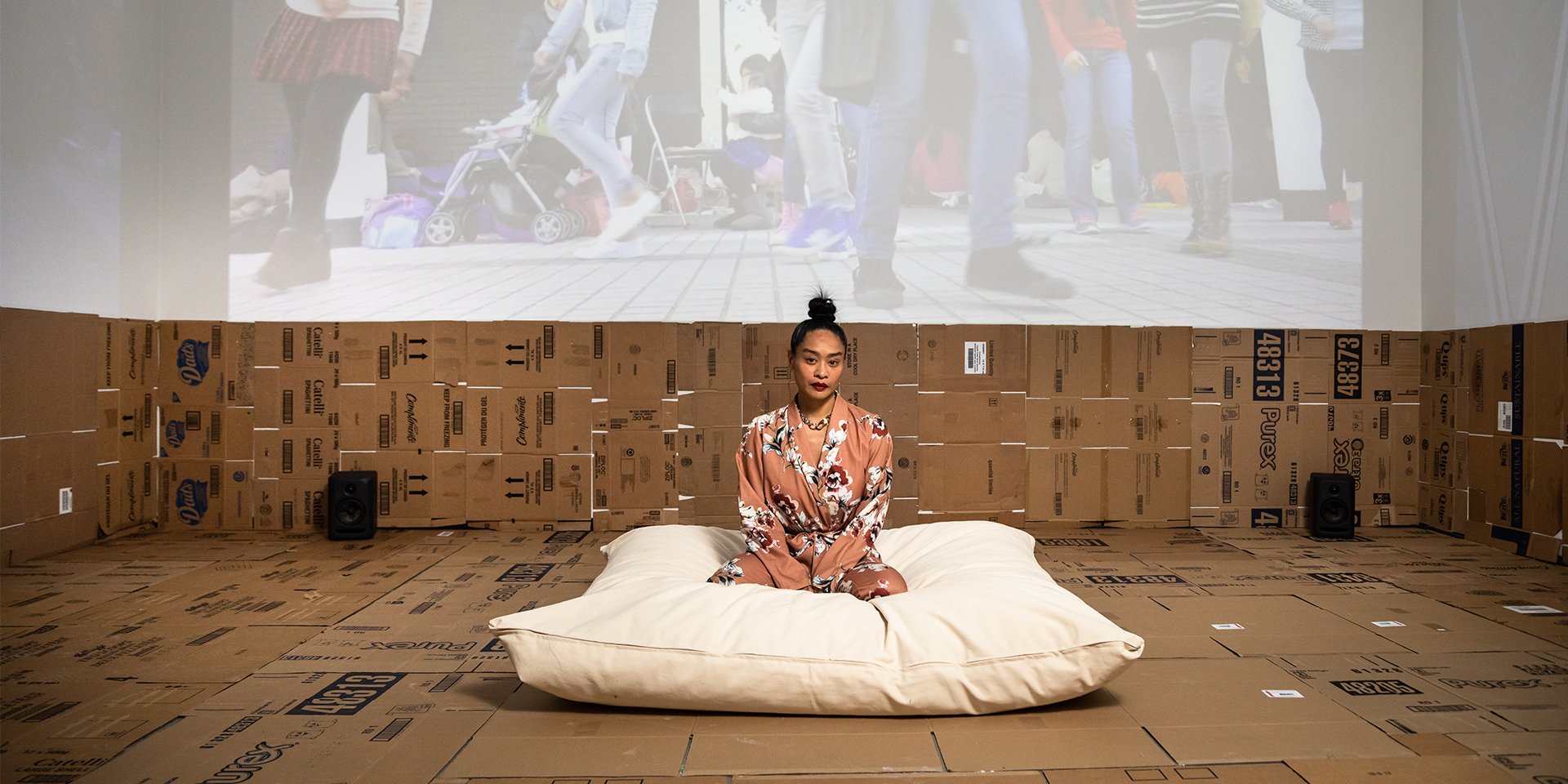
I remembered that slope while watching Stephanie Comilang’s Lumapit Sa Akin, Paraiso (Come to Me, Paradise), one of the three films in What We Carry, the closing program of Identity Card, the third edition of The Immigrant Artist Biennial. On their Sundays off, Filipina domestic workers set up cardboard box apartment-cities in Hong Kong’s financial district. Large groups of women take over walkways, temporarily reshaping public space, gathering to eat together, scroll through their phones, or talk.
The artist calls her films “sci-fi documentaries,” and the label is a sly one. Science fiction loves an invasion: a group huddled at home, fearing the alien that comes from beyond. In Hong Kong, the aliens group together once a week, and they land in Central, one of the city’s most expensive areas. They are one of the least privileged groups in the city, occupying one of its richest districts, and that is precisely what makes them feel like an invasion. Cities have ways of saying who belongs where. In the New York subway stations, wooden benches are broken up by dividers to deter them for being used as places to sleep. Many of these women have no private space in their employers’ homes, so the cardboard boxes become a home they carry with them.
Comilang shot the film from above. Seen from the perspective of a drone named Paraiso, a sentient presence voiced by the artist’s own mother, herself a Filipina migrant. The language of downloads and uploads, usually associated with immediacy and machines, here gives form to a ghost: on their day off, the women record themselves and upload their week to her, she ferries their messages back to the Philippines. The artist has said she wanted to subvert the drone’s association with surveillance by giving it human, female-like qualities through movement and voice.
She made the film in 2016. Watching it ten years later, from a gallery in New York, I could not stop thinking of a particular view from above: a map of houses and streets in deep blue, scattered with points that glow like embers. Each point is a person. Some turn red, as if we could see the heat of their bodies. The map belongs to ELITE, a tool Palantir built for ICE to locate immigrants, raid their homes, and deport them. To select an entire neighborhood, an agent needs only draw a circle around it. Comilang’s drone has a gentleness that undoes that image; Paraiso gives the workers a voice, rather than just surveilling.
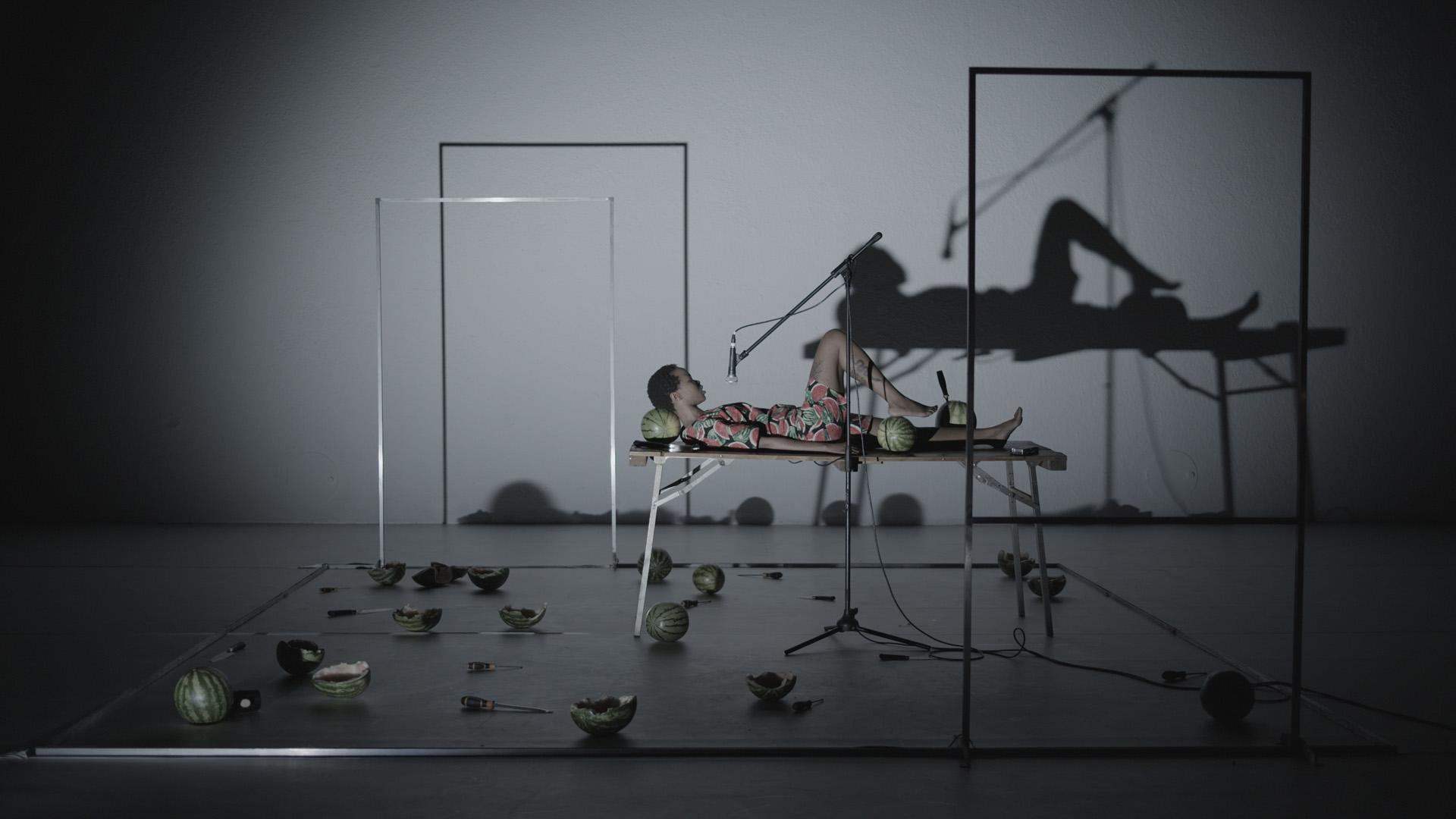
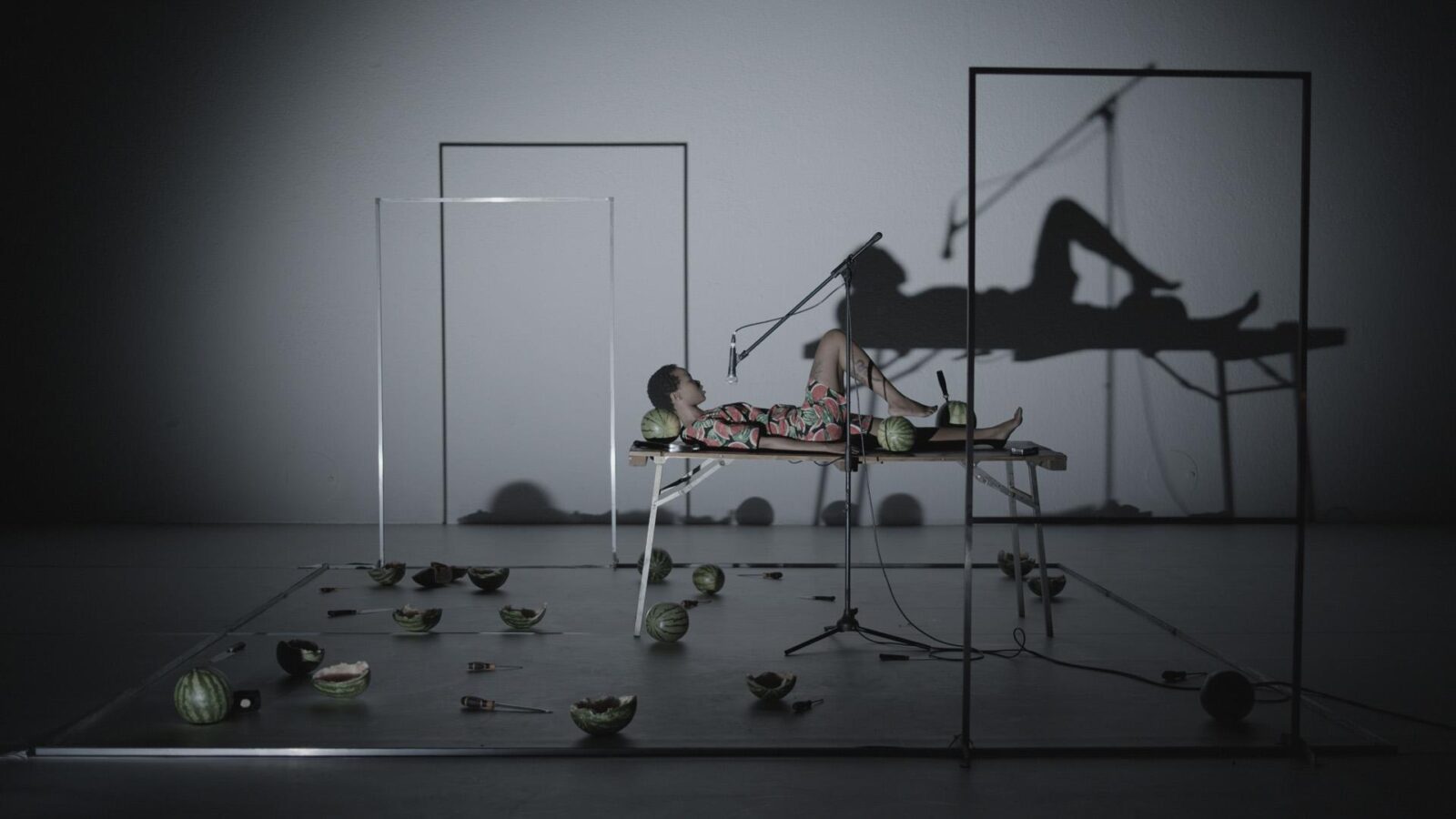
From a Sunday in Hong Kong, the program took me to England, and into a single person’s memory. In as british as a watermelon (2019–2021), mandla tells stories of an uprooted life: asylum, childhood neglect, a family of origin as unsettled as the paperwork. She was born in Zimbabwe and is based in Manchester. It is a work of autofiction; the watermelon becomes the perfect emblem: a fruit from Africa that will never be considered British, no matter how long it has sat on British supermarket shelves.
The alien from Comilang’s film returns here, no longer a crowd on the pavement but a single body bracing behind a door. At the center is the same fear, of hiding from those who knock at the door to “detain and deport.” And yet mandla warns us early on that they are a great liar.
There is something of Fleabag in mandla’s performance: the sideways glance at the camera, the poetic, prickly delivery of a gifted performer who lets you in only to keep you guessing. The piece was first written for the stage, and much of it plays as filmed theater; cinema arrives in the close-ups, where the lens, placed above eye level, becomes a confessional.
If society has already narrated mandla as the watermelon, imported, displayed, expected to stay clean and whole for consumption, the film is the story of how to stop being the fruit. mandla refuses to be a role model, and instead spends the film showing their scars, the marks that make consumers discard it. “My name is mandla. It means power. I gave it to myself,” they say. Fabulation here is not a lapse in honesty but a method: a way of telling one’s own story past the limits it was handed.
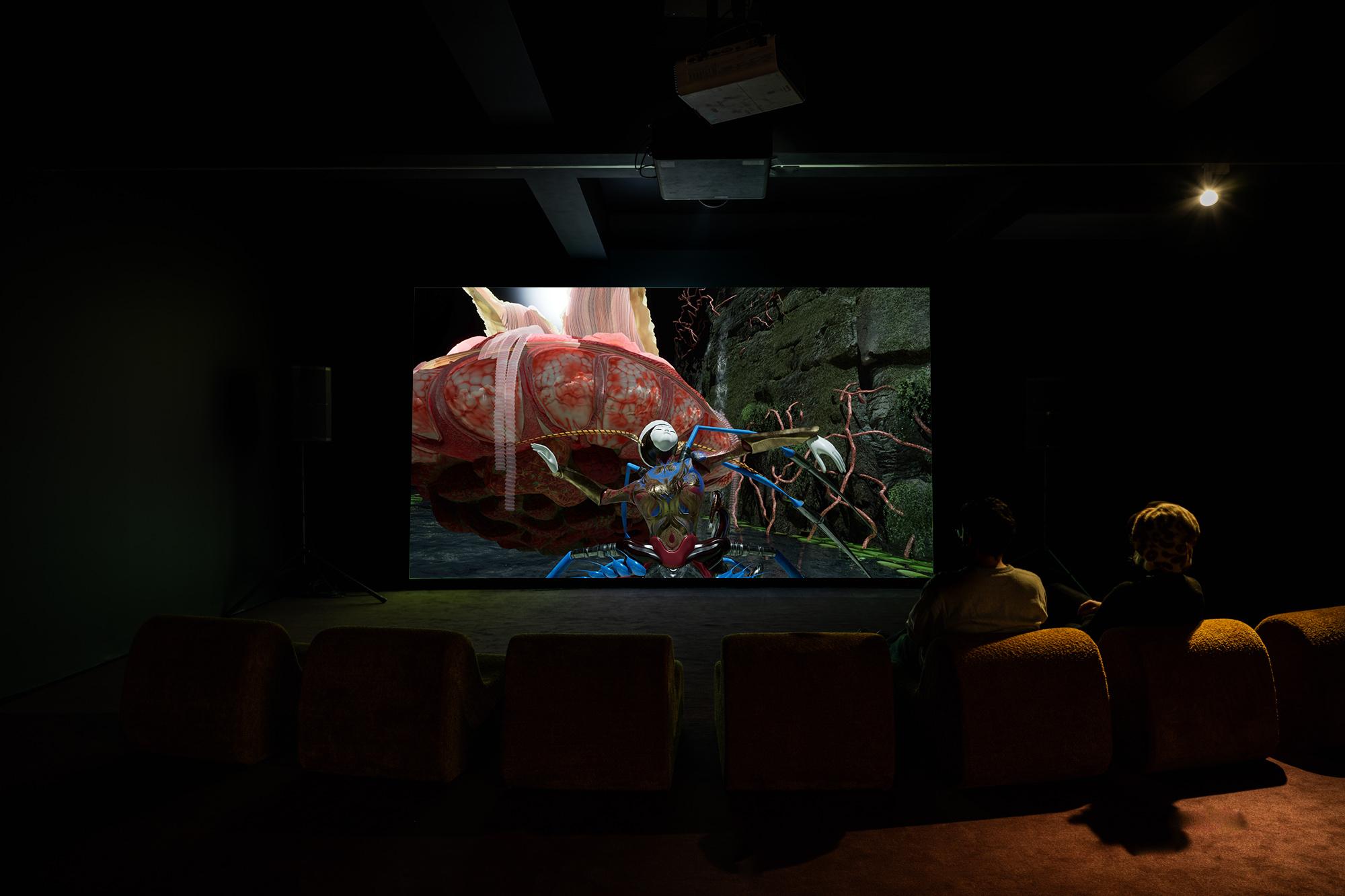
For the last stop of the night, we traveled to a world built entirely by Pearlyn Lii. InfiniteMother v2.0 is a machinima, a film made inside a video game engine, where the organic and the synthetic grow into each other. In a grotto modeled on Chinese mountain-water landscapes, among waterfalls and giant water lilies, a regal Mother dances around an enormous flower with mucous-membrane petals, the Fetal Peach. Daughter, a feminine creature with spider legs sprouting from her back, joins her in a dance that looks more like a dispute. The mother insists on tradition; the daughter pushes against the old forms and the inherited prisons of femininity. If the other films crossed borders, this one carries an ancestral myth into a territory that has none.
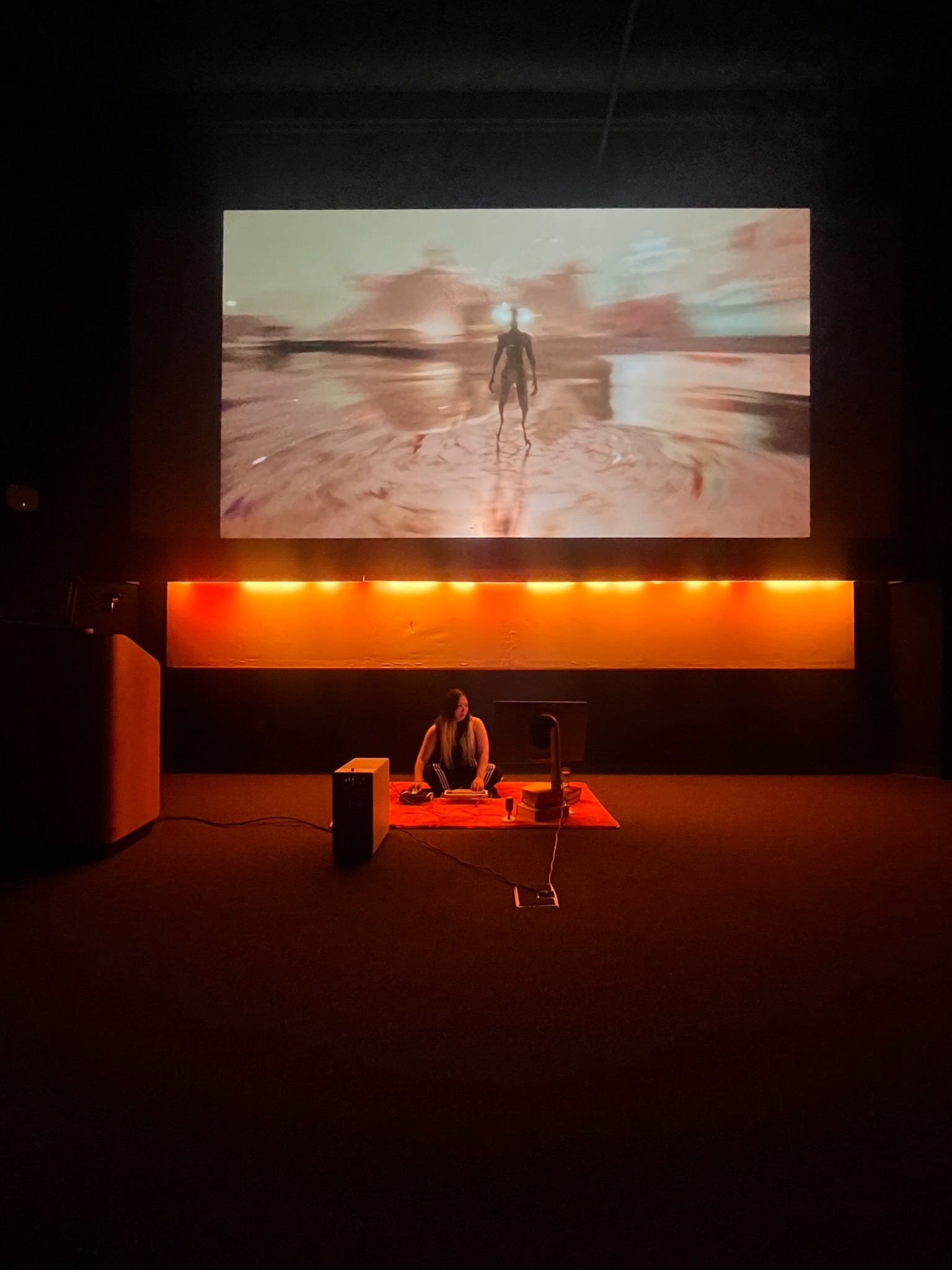
Lii followed the screening with a live performance, In the desert you are close enough, playing a game in which a humanoid avatar with a tail and a horn wanders a rose-gold realm, its body changing with each creature it meets. At each encounter, Lii lifted a distorted microphone and spoke the unlocked phrase, half robot, half animal. After one transformation, she asked: “Do I like that?” Although both pieces borrow the look of video games, they leave out the genre’s grammar: no missions to complete, no speed, no violence, no territory to conquer or victory to claim. Lii’s worlds exist to rehearse feelings rather than to win anything.
Her half-human, half-animal beings reminded me of Indigenous Brazilian myths, where the border between people and animals was once open, and bodies crossed it in both directions. Lii’s characters seem to live in that in-between, bearing animal traits like an inheritance. There is a great freedom in it, the freedom to reinvent a self, a family, a culture, in a body that does not have to choose. I also sensed that the dispute between Mother and Daughter rested on a mythology I do not hold. Later I read that in Chinese myth, peaches are the fruit of immortality, grown in the garden of the Queen Mother of the West. Maybe that is what they were circling, an origin and an eternity at once. Maybe not.
I left the gallery with a question I am still harboring: how do I enter realities that are foreign to me? Each of us arrived with our own keys. Mine was a cardboard box on a grassy slope in Brasília. After the screening, a Vietnamese artist friend told me something I had not known: across Southeast Asia, people from poorer countries often leave to work as domestic workers in wealthier neighboring countries. She had not known about the Philippines in Hong Kong, but she recognized the pattern at once. Her key opened a door mine could not.
Some of what these works carry may remain untranslatable, and perhaps it should. The point is not to make these worlds transparent, but to come closer to them, and to learn to live with what stays opaque. A screening happens once, in a room, among people who bring their own histories to the same images. What it offers is not understanding so much as an encounter, and the conversations that begin after the lights come back on.
What We Carry took place on November 11, 2026, at the Andrew and Anya Shiva Gallery, John Jay College, as part of the third edition of The Immigrant Artist Biennial: Identity Card. The four works were curated by Anna Khimasia and Sofia Thiệu D’Amico.
You Might Also Like
The Immigrant Artist Biennial Announces Artists for its Third Edition
What's Your Reaction?