

“Between Institution and Playground:” A Conversation with Carolina Edman


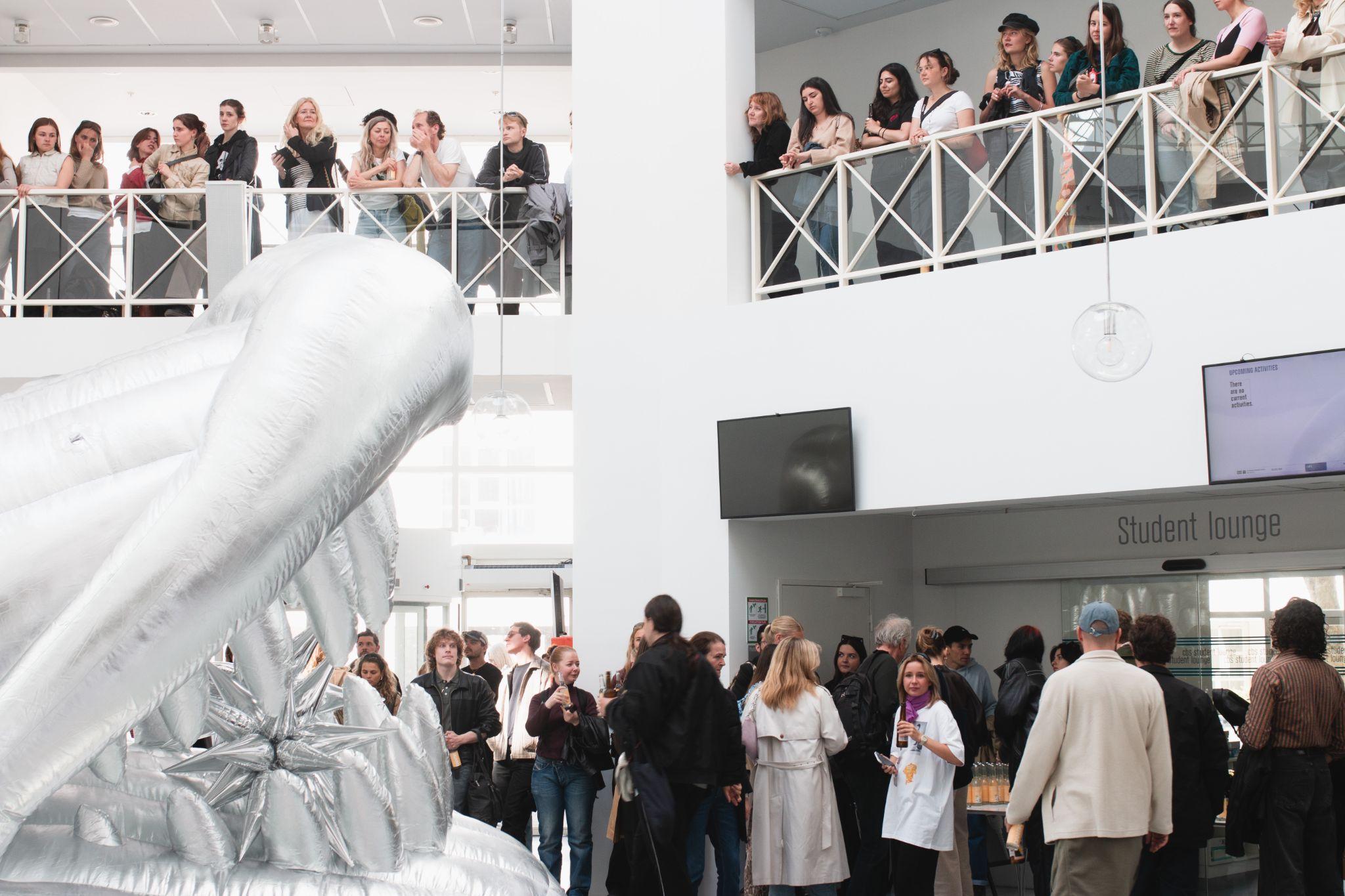
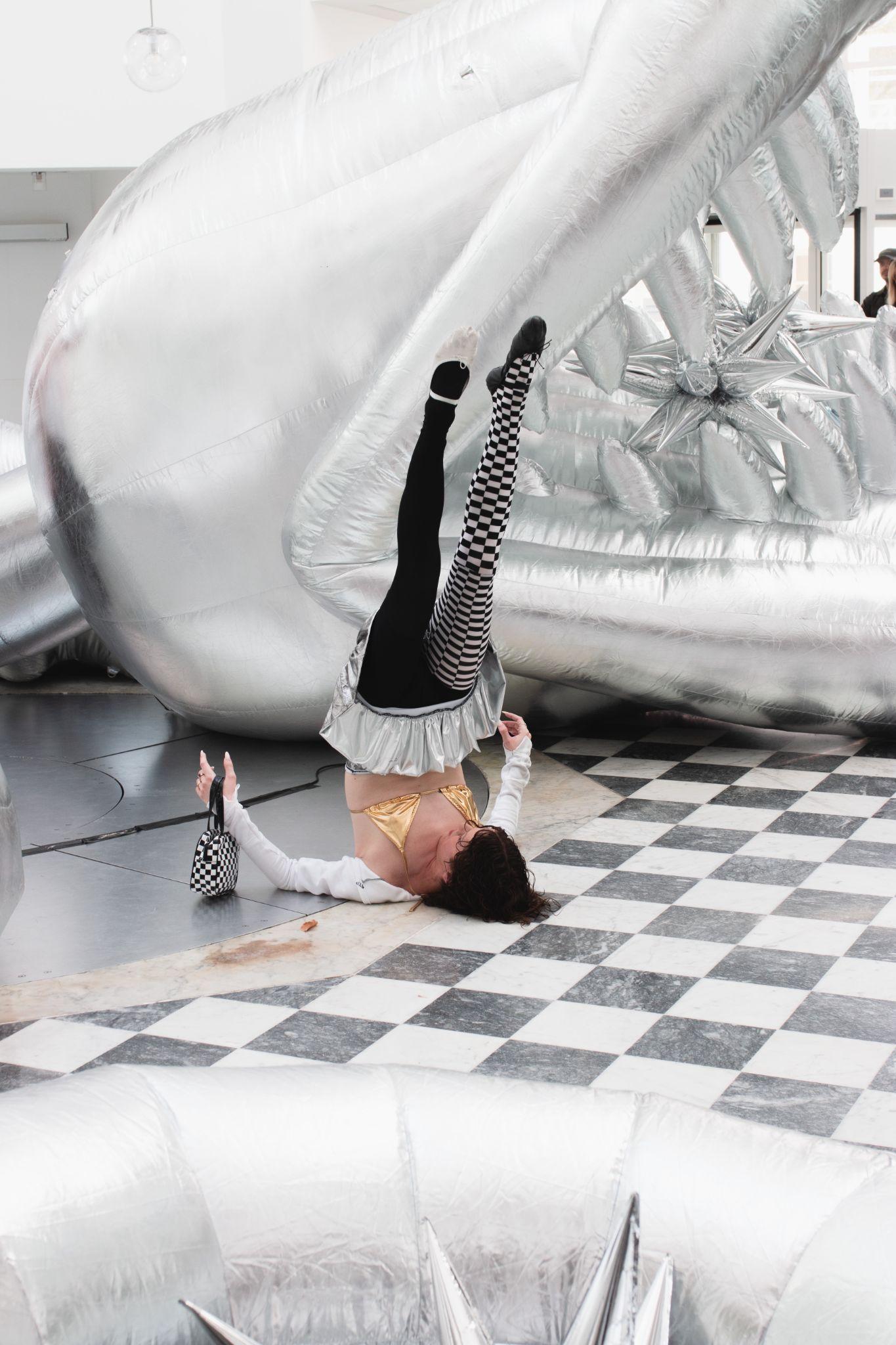
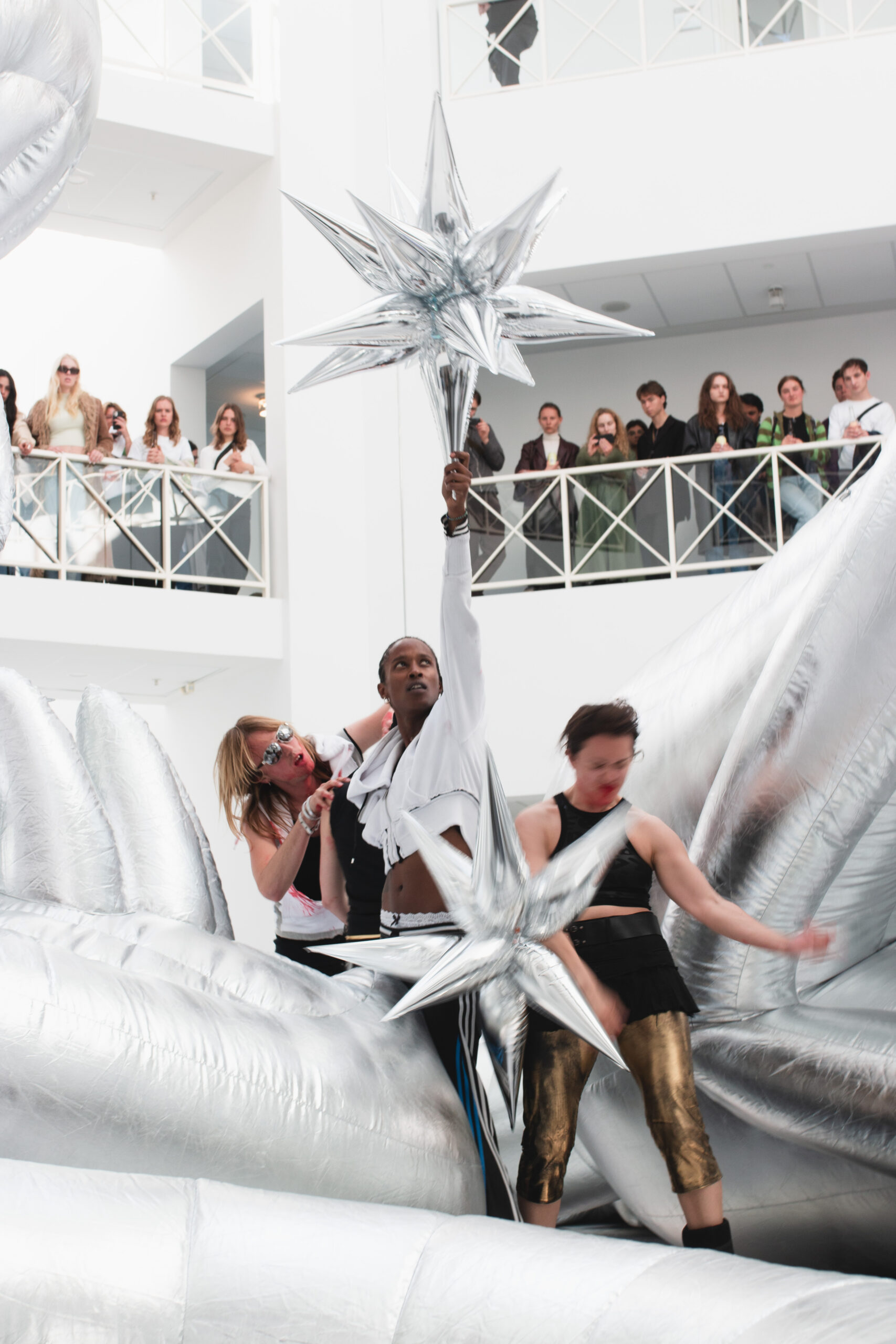
As I sit down with curator Carolina Edman, the performance she produced with Esben Weile Kjær still lingers in my mind as clear as the azure sky. I remember the wrinkled foreheads of the security personnel, the throbbing techno music, the eccentric movements of the performers, suspended on their own plane of being. HYPER! was staged on May 18th at Copenhagen Business School (CBS), unfolding through the atrium of Dalgas Have, an architectural icon by Henning Larsen completed in 1989, five years after his landmark Ministry of Foreign Affairs in Riyadh opened. The kinship between the two buildings is unmistakable: the same interplay of light and surface, arched gateways, and monumental minimalism. During the performance, the audience watched from three stories of balconies, navigating around larger-than-life silver inflatables that bulged monstrously through the long hallways clad with checkered marble. All the performers were dressed in garments designed especially for the occasion by the cult favorite brand Icon Visions, incorporating the black-and-white patterns of the mosaic into a punk homage to the early aughts.
HYPER! was first presented at Museum Tinguely in Basel, Switzerland and it was no small feat to bring the ambitious project to Denmark. Kjær comments on working with Edman, originally from Sweden, to bring the work to Danish audiences: “a great curator doesn’t simply organize exhibitions, but they create the conditions for artworks to unfold in unexpected ways.” He continues, “Edman has a rare ability to combine sharp conceptual thinking with genuine care for artists, making our collaboration feel both ambitious and effortless. She understands how to build a framework that challenges the work while allowing it to remain open, alive, and surprising.” Edman’s visionary curatorial project was a part of CBS Art Initiative’s tenth anniversary celebration, making her an integral part of a network of forward-thinking curators, philosophers, and professionals who push the envelope for cross-disciplinary approaches at business schools. “We should not only have business people on museum boards; why not have artists as business advisers?” Edman asks.
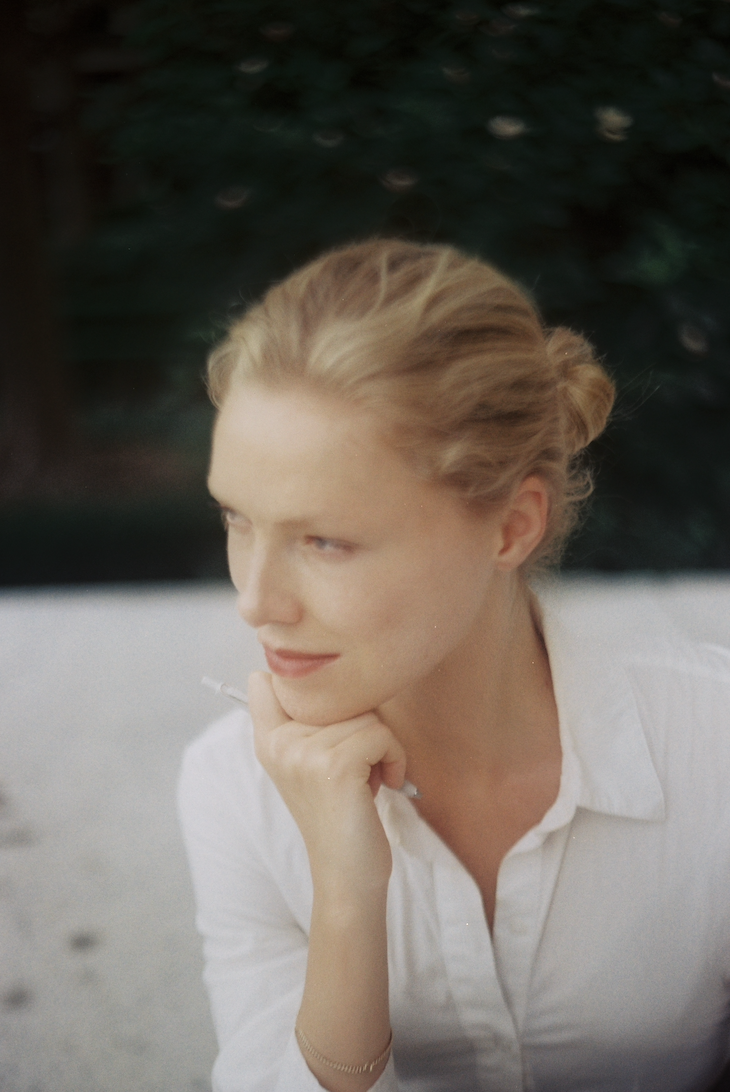
I catch her during one of her visits to New York, in town for an exhibition by Faurschou, the international art institution she currently works with, to discuss the piece and her curatorial practice.
How did this all get started and how did the vision come to life?
It was the particular architectural and spatial conditions of Dalgas Have that inspired me to create an intervention to mark the centennial of the Art Initiative at Copenhagen Business School. Inviting Esben Weile Kjær was an obvious choice. Today, the depths of our being stand on thin ice. We feel like outsiders to our own skin. I wanted to create a slit in the usual rhythm of the university, whose hallways I once walked down daily, to create a surprise, and to provoke reflection on the hyperbolic culture of spectacle that we live in. Esben works with sculpture and performance to reflect these aspects of contemporary existence, and HYPER! turned out exactly as we had hoped. The wide eyes of the onlookers reflect the dissolution of borders and structures that define our actions. People could not look away, and they could not quite describe what they had seen.
How did you meet Esben Weile Kjær?
In curating, many are the serendipitous doors that take an idea to reality. The ascent of Kjær has been breathtaking, and after his acclaimed exhibition at Arken Museum of Contemporary Art earlier this year, I felt very inspired to work with him. Esben strikes a chord with a generation seeking freedom and human authenticity. I got in contact with Claus Andersen, who immediately supported the idea, and after a visit to the campus, Esben was intrigued by the tension we could create. Working with Esben is not about planning with a set score. His practice is about cathartic intuition, emergent material, which also involves the participatory imagination of the audience. The performance ended up being visited by hundreds of people from all over Copenhagen, the place I have called home for nearly five years.
How did you end up in Copenhagen?
I moved to Copenhagen in 2018, having been based in Berlin and travelling across Europe’s major cultural capitals. In Copenhagen, I first stayed on the infamous Istedgade street, then moved to the inner city, around the corner from where the physicist and Nobel Prize winner Niels Bohr was born. There is something uncanny about the spirit of Copenhagen, as you walk down the same streets where some of the most important minds of the past century laid out the theories of quantum mechanics.
Why is it important for a business school to engage in arts programming?
Business schools train the people who will run the institutions and companies that shape society. If they graduate without ever having had art irritate their ideas, or see new aspects of life, we all inherit the consequences. There is a long culture in Silicon Valley regarding the relationship between art and successful business. What if it was discovered also among “regular” business too? This pursuit, which we have run as an international collaboration between researchers and professionals across Stockholm School of Economics, University of St. Gallen, and Bocconi University, is only the start of a greater demand for a new approach to pedagogy and knowledge.
I believe that by integrating aesthetics into the education of future political and financial leaders, it is possible to rephrase problems, drive innovation, and bring people together. Through this work, I seek to inspire to look beyond the confines of dichotomic disciplinary thinking. It is important to note that art here is not understood in an instrumental way. Art is what generates the kind of ambiguity that management education tends to eliminate: situations without correct answers, experiences that resist metrics, perhaps a more human approach to what existence means.
What have you learned working with an art initiative inside a business school?
My mentor for many years, Pierre Guillet de Monthoux, has been driving this work for decades in Stockholm. It is an absolute honor and privilege to follow his long-durée exploration of aesthetics, management, and politics. I have come to believe that the complexity of today’s problems can only be solved through cross-disciplinary collaboration. We cannot continue working in silos and expertise corridors. Art in management education is about creating holistic people who can sense the world and become better, more intelligent actors in it. Once you learn to see, you can start to express.
How does this work fit into the overarching themes of your curatorial vision?
Since Duchamp, and more recent movements in art into the expanded field of mediums and spaces, art has irreversibly invited the spectator in its own creation. The meaning finds itself in the making of the piece. This is carried forth by a generation of artists that maintain a dialogue while folding new layers in our perception. HYPER! embodies that idea. It was a performance refusing to complete itself: the audience wanted to join yet did not dare, the movement never settled into a storyline or narrative. That suspension, between spectator and participant, between institution and playground, is where work that questions our habitual patterns actually takes place.
My curatorial work is drawn to what I call the nonfinite, where the viewer becomes aware of their perception, and that their visual experience depends on their viewing point, or attention. By withholding finality, a work humbly admits its place in a larger continuum. Images emerge from interactions with the world, and the world becomes as we shape it through imagination. Life activates thought, and in turn, thought activates life.
What are the differences between the art world in Denmark and Sweden, and the similarities?
They are closer than either country likes to admit. Both have strong public funding, strong institutions, and a certain modesty. The difference, to me, is temperament. The Danish scene is more permissive; there is a continental connection to the European cultural capitals of Paris, Berlin, and Rome. In Copenhagen, the artists and the institutions are in dialogue with this heritage, which has been passed down from even more ancient civilizations. Thinking about it, Esben’s work is a case in point, I think a Swedish institution would have loved HYPER! in theory and hesitated in practice.
Are you a Scandinavian curator? Is there such a thing, and what does it entail?
I will never be bound to a country or region. Having lived a life of movement and welding of difference, I often relate to the idea of myself as a sailor. It is true that my work and inspiration is built on giants from Sweden, who adopted the same refusion of identity, such as Dag Hammarskjöld. For me, art is about the universal values of being human, and curating opportunities for artists is to cross frontiers. I look forward to my upcoming move to New York, where I will continue my career in art through further studies at Columbia University this fall.
Esben Weile Kjær’s HYPER!, curated by Carolina Edman, was performed on May 18th, 2023 at Copenhagen Business School featuring performers Johan Bech, Therza Balaj, Camilla Lind, Steph Quinci, Ezra Shami, and Judith Heineman. Styling and outfits by Icon Visions (Cecilie Hjorgensen and Svend Brandt). Music by Elias Gozal.
You Might Also Like
Your Guide to Stockholm Art Week 2023
Ayana Evans at The Barnes Foundation: the work of throwing hexes
Katya Grokhovsky on FANTASYLAND and a Decade of Making and Migrating
What's Your Reaction?
