

What Does Le Corsaire Have to Do With Feminism? Ballet’s Complicated Past


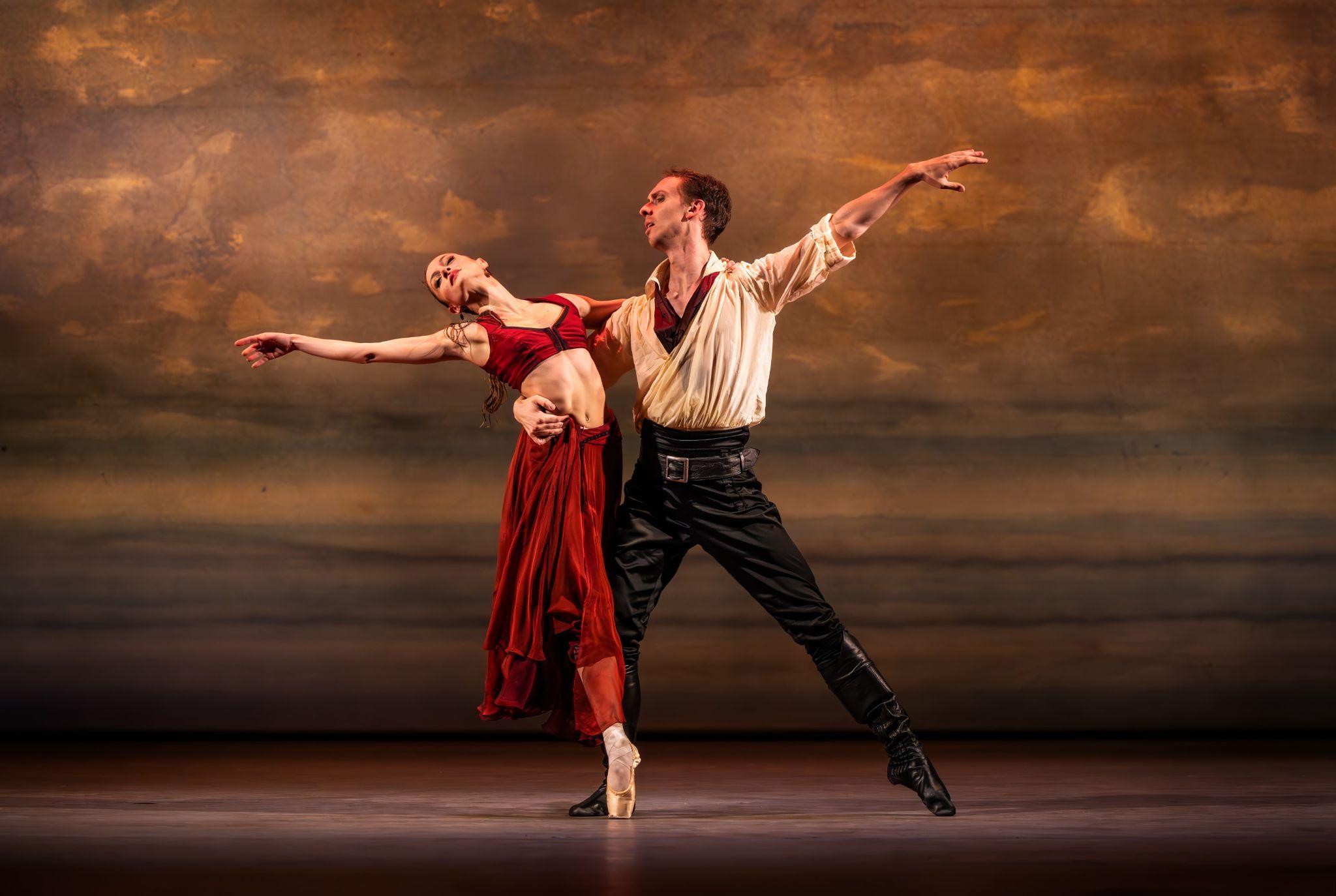
Le Corsaire recently premiered at the Royal Swedish Ballet in Stockholm, and I was blown away. I loved it all—the pirates, the dancing, the costumes, the drama, and did I mention the pirates? Freed from slavery by the pirate Conrad, Medora falls in love with him, but is recaptured and taken to a Pasha’s palace. Conrad rescues her again; finally, they both survive a violent shipwreck—the story unfolds through a 19th-century fantasy of the “Orient.” Should I be ashamed of loving it? To think through that contradiction, I decided to talk with Cynthia Dragoni, a dancer-turned-dance-education-fluencer and the woman behind The Dance Lens, about feminism in the field and what it means to love a ballet with a complicated past.
Anna Mikaela Ekstrand: I found that the transformation of Medora (danced by Luiza Lopes, who was spectacular, spellbinding, really) from slave girl to washed up on a beach with her pirate boyfriend to start a new life was quite feminist. Especially considering many other sad endings for female characters in ballet—like Giselle dying of a broken heart, sparing the life of a man who wronged her.
Cynthia Dragoni: Yes, escape from ownership is always a feminist move, isn’t it, even if the ballet’s dramaturgs would probably roll over in their graves to hear it. In Giselle too, she defies the murderous rule of the Wilis. If you think about it—the Wilis are still under the control of men and society’s conditioning—they do not choose their actions; they merely act according to the spell. A spell that says “women who die before their wedding day will rise from the dead each night. If a man walks through the forest, they will dance him to death.” Their ghoulish “lives” are still wholly centered on men. They seek to dominate rather than submit but they are not free. Whereas Giselle chooses and transcends—she’s the only one in the story who is freed of both desire and vengeance. In that sense she’s more punk than she gets credit for.
AME: I do like that. The word feminist seems to be gravely out of fashion in the mainstream. I just applied for an Austrian grant the other day—as a phd scholar—and was advised against pushing the feminist approaches within my work. I’m certainly a feminist, but I’ve been thinking about another word for striving toward gender equality to use in my everyday life. Last week, a tall guy approached me on the street to make a TikTok video. I asked if he was a feminist. “No.” I need another word, I thought, an “equalist?” Also no. He wanted to give me the bouquet I had just bought for the video. Instead, I switched the roles and gave him my flowers—they were mine, after all—and asked for his number. It’s part of a micro-trend: tall guy locks eyes with short girl, she approaches, he hands her his phone, she puts her number in. PUA-esque; I didn’t want to be portrayed as a passive subject.
CD: But if you asked him: do you believe women should be able to work, earn fair pay, vote, and sign a lease? He probably would have said yes. The optimist in me thinks he probably doesn’t know what the word means. And if he said no, then you should not make a video with him. Points of view go in and out of style and words take on implied meaning, but feminism by definition simply means believing women and men should have equal rights and opportunities. The fact that we even need a word for that speaks to an illness in society, a disease in the collective consciousness (and experience). By rights, what do we mean? To be “allowed” to work, to be paid fairly, to vote, sign a lease, have sovereignty of our own bodies—to exist in society as full humans, not half humans. We only need a word to define this when it’s still absent or if it’s in danger. So by that definition of course I’m a feminist, because I’m sane. As for feminism in ballet, women in ballet are both powerful and powerless. You see them own their creativity and agency much more in modern dance, historically speaking. For example, there are zero major historical classical ballet choreographers who are female. Zero. In modern dance it’s quite the opposite: Martha Graham, Katherine Dunham, Isadora Duncan, Pina Bausch and Twyla Tharp (an egregiously incomplete list) defined entire styles and genres of dance. Whereas in ballet, women are predominantly still waiting to be chosen. It’s a much longer conversation about the art form’s historical roots, and it’s very complex.
AME: Often a woman’s narrative is centred around waiting to be chosen, or becoming desirable enough to be chosen. Cinderella is one of the ultimate pick-me stories, but also, more contemporaneously, Bridgerton. Scholars have explored and pushed back on these depictions, and their real and imagined life conditions. Luce Irigaray argued that patriarchal society operates on a commodities market where women’s bodies are the goods being traded in her 1977 book Ce sexe qui n’en est pas un (This Sex Which Is Not One). Fifteen years after it was first launched, Catherine Hakim’s concept of erotic capital is still cited and hotly contested; it implies that women can instrumentalize their beauty, sex appeal, skills of self-presentation, and social skills. It is important that we understand what conditions these depictions shape and how they impact the ways we behave, or are expected to, socially.
CD: The Three Odalisque variations, for example—they are virtuosic and very difficult which makes them perfect for training young dancers. So you’ll too often see young kids in competitions with exposed bellies doing these solos, meanwhile I’m like, did anyone tell their mothers she’s playing a woman who is for sale? That she’s joyfully hoping to be Pasha’s new sex slave? Do their teachers who assigned them the role even remember the story or know what the word means? It’s so absurd when you think about it.
AME: Subjugation, captivity, and fragility—all the same to me—are too common central traits for female characters in ballets. Which ballets are the most feminist?
CD: Ballets created by women. Jessica Lang, the choreographer, is a particular favorite. I’m not against any artist to be clear; I wish for great talent to be discovered and nurtured, or perhaps it’s nurtured and then discovered, regardless of the body that houses it. But I do think it’s important that the demographic (women) that make up 70-90% of ballet’s population contribute to the art form’s development. Great talent is rare, and if you only have 10-30% of the art form’s population (men) creating work, we’re narrowing the possibilities for the art form. When you look at those numbers, you begin to realize the potential losses we’ve had with so few women in creative roles. What might they have made?
AME: Agreed. I also have a bone to pick with partner dancing; if I am better at the Waltz, Foxtrot, Two-step, I usually lead, which puts some men off. It is frustrating being lead by a dancer who does not have sufficient skills. Of course, in ballet, a very important role of the male dancer is to support their partners and these roles cannot as easily be reversed. Can you tell me more about this relationship?
CD: Yes, in most ballet choreography we are dealing with physics over philosophy. If I’m the one being lifted into the air then it’s not a choice of who is supporting whom. Although at Scottish Ballet recently, they did a production called Cinders (based on Cinderella) where the genders were swapped from cast to cast. The director was talking about the built-in hierarchy in classical choreography and how it’s only once you start reversing roles that you even realize it’s there. I’m paraphrasing here; it was very interesting. But you know, the ballerina is not being thrown around like a dead fish; she’s actually doing most of it herself. For example, have you seen the videos of Skylar Brandt literally promenading herself around on pointe? So when the partner is skilled, it makes her better, he creates a container for her to fully expand and I think it represents what deep support does for any of us: allows us to fully become who we are.
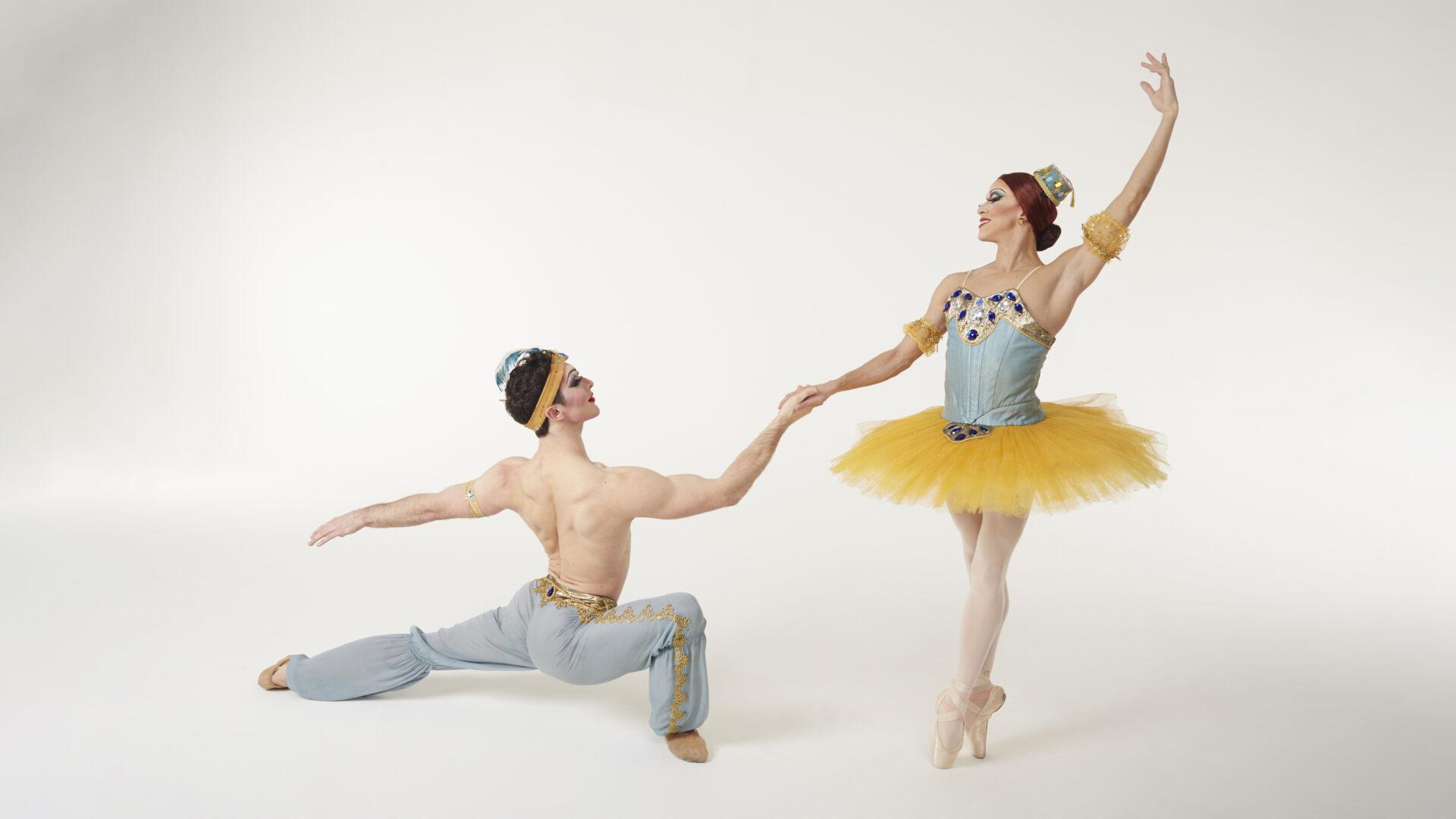
AME: That is beautifully put. I have still not seen Les Ballets Trockadero de Monte Carlo—the satirical company where men dance on pointe—but I see they are in New York at the Joyce Theater beginning December 15 this year. I have never seen a man dance on pointe, but they can!
CD: The Trocks dancers are amazing. Ballet22 is another company where the men are on pointe, and I love them. The Trocks are truly great comedians. To make great comedy, you have to have a rich understanding of your subject and they have that in spades. They’re thrilling and hilarious even if you know nothing about ballet, but oh my god, if you know those ballets and what they are “supposed” to look like you will be dying laughing. Your cheeks will be sore the next day. They also poke fun at the differences in ballet cultures from country to country and they’re just such a joy. Do not miss the show.
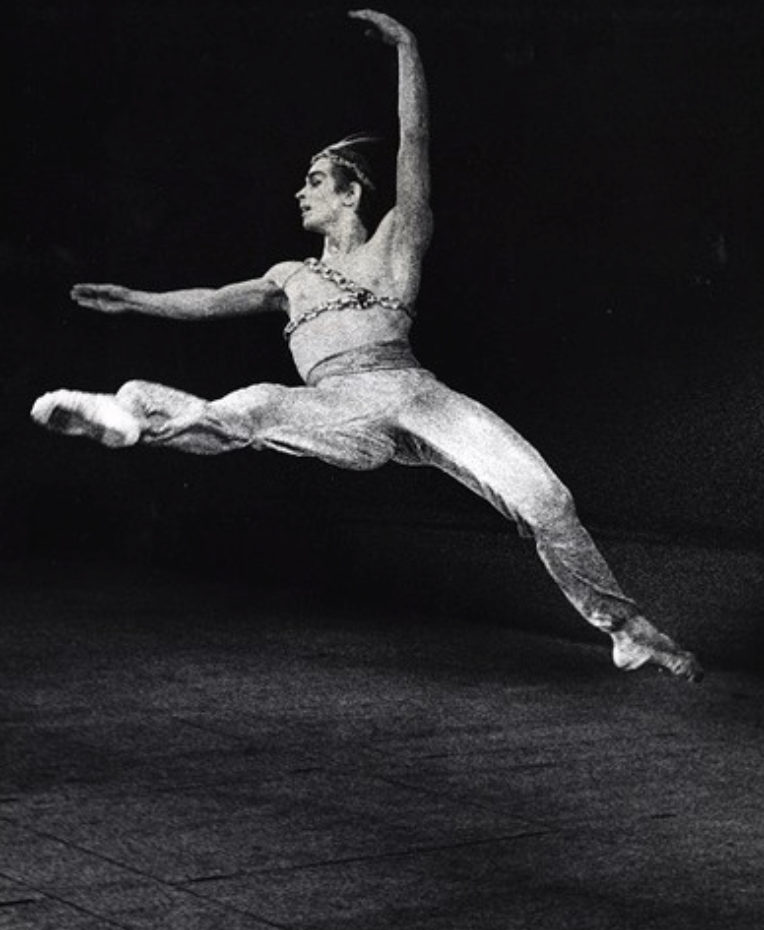
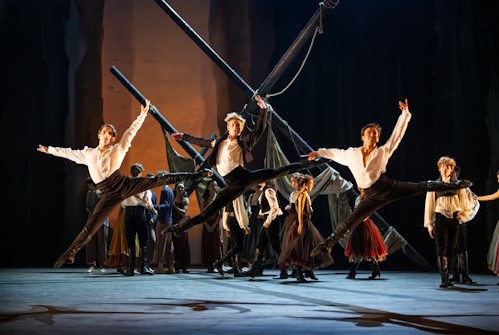
AME: What I really liked in Le Corsaire was that there were so many men, pirates, on stage. Le danse de Corsaire with Conrad and his second Birbanto is fabulous. The male solos are so virtuosic.
CD: Yes, it’s a great ballet for showing off the male dancers, and that’s less true in many others. But Corsaire has not aged well into the modern era. Ballet, especially classical ballet, exists so much for the sake of its own traditions that sometimes we stop thinking about their original meanings-
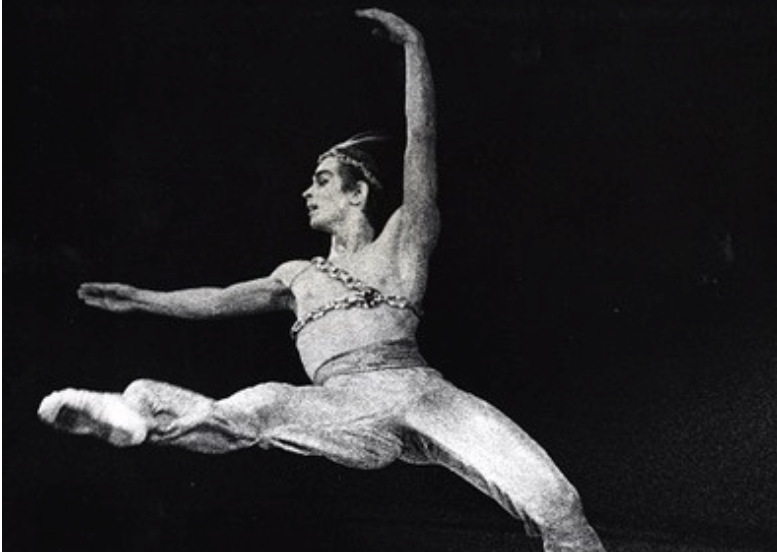
AME: -the Orientalism? The wardrobe is fabulous: flowing chiffon pants and exposed midriffs and torsos, for the slave girls and pirates. I love the chain Nureyev wore in 1964. But there have been many representations of characters that fall into nasty stereotypes, sometimes borrowing from disparaging representations of other cultures. Can companies approach orientalism respectfully?
CD: I think the short answer to your question is no. How do you respectfully enact an idea of a people that was created in a time when we neither understood nor respected those people? No matter what, it’s a caricature. In today’s terms, it’d be like asking how can we respectfully stage a minstrel show. You can change the ballet, but then you’re staging something else aren’t you? Which maybe is what you’re really asking, can we change the ballet enough so that we still have its timeless beauty and virtuosity while removing the horrifyingly offensive parts? And if we can’t then does it mean we just lose these ballets? There is value in the archiving of work, what about the role a ballet played in the development of the art form? Do we cast it aside because now we know more? It’s a question that spins on and eventually devours itself. Phil Chan has written whole books on this subject: Banishing Orientalism and Final Bow for Yellowface, which I highly recommend. No matter your point of view, it’s a question about looking backwards and the premise is limited because there’s only so much past to look at. Ballet is a moving language, but for economic and educational reasons we’ve ended up understanding it as a fixed noun. It would be my hope that we continue to create new classics, multidimensional spectacles that uplift and entertain—equal parts transcendence and catharsis. Then we can stop asking about whether or not the girls should still be playing sex slaves. But it’s no easy task, creation is expensive and ballet no longer has the unlimited support of the czars and monarchies it had when every single one of the ballets we are discussing were created.
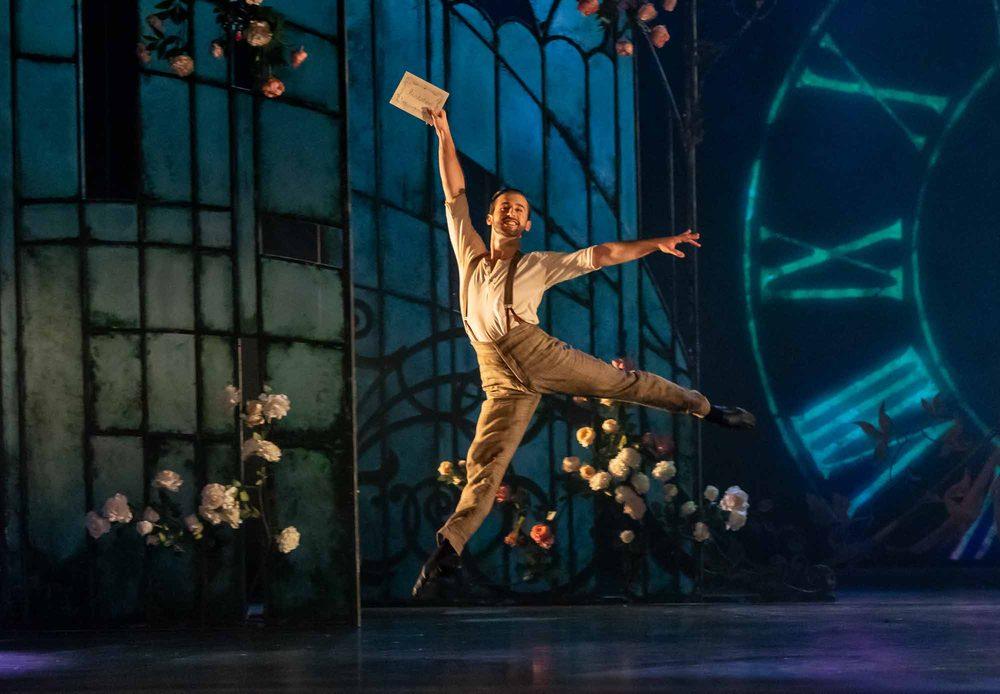
AME: Is there another problematic ballet you would like to see staged, or that you think should not be staged again?
CD: I grew up loving La Bayadere. There was a Royal Ballet recording with Darcey Bussell as Gamzatti and, in my opinion, the queen Altyani Asymuraltova as Nikiya. I watched her snake dance solo so many times I wore out the VHS. And I loved the colors and the golden idol solo. As a young girl, it never occurred to me that the mudras on the golden idol might not be correct, and that’s the danger of imagery isn’t it? We observe, and a part of us accepts and believes what we see because we see it. But even as a child, I noticed the fakirs in the temple were made to move like wild animals. I remember thinking: are these people? If they are, why are they moving around on all fours? There are sections of the ballet like the Shades scene that are pure choreographic mastery, but other sections that I really wonder why it took one and half centuries to notice they don’t belong onstage.
I think beyond all specifics, it’s actually all about arts—in this case dance—education. For people to learn what an art form is capable of, for them to then grow up and vote to fund arts and arts education so we can continue to evolve, to offer new stories, new stories with old beauty. So we can eventually ask brand new questions, and maybe one day even the word feminism will fade into oblivion as a concept that was once needed when society was much more barbaric and needed to be told its women were actual people.
Le Corsaire is on view through October 2, 2026, at the Royal Swedish Opera in Stockholm. Cinders! is touring December 11, 2026-January 30, 2027 around Scotland, and Les Ballets Trockadero de Monte Carlo are on view December 15-January 3, 2027 at the Joyce Theater in New York City.
You Might Also Like
A Look Into Iconic Collaborations at Martha Graham Dance Company
A Rare Collaboration, New York City Ballet’s Sara Mearns Dances Amidst Diana Orving’s Sweeping Arcs
What's Your Reaction?
